Castle of Faria: A Romanesque Fortress in Portugal


Site at a Glance
- Rating
- 4.4
- Popularity
- Very Low
- Country
- Portugal
- Primary era
- Medieval
- Eras represented
- Iron Age, Medieval
- Civilizations
- Portuguese
- Site type
- Military
- Remains
- Castle
On this page7 sections
History
Castle of Faria is a ruined Romanesque castle in Portugal, at Gilmonde, whose medieval form developed during the 9th or 10th century in the context of the Reconquista, the Christian reconquest of Iberian territories ruled by Muslim powers. Adapted from earlier hilltop buildings, it served the territory of Terra de Faria, an area of military and symbolic importance in Entre-Douro-e-Minho.
Prehistoric and Iron Age origins
The hill had been occupied since the 3rd or 2nd millennium BCE, with settlement placed at approximately 3000 BCE. Occupation continued through the Late Bronze Age and into the late Roman period. Pottery, arrowheads, and other artifacts reflect this long sequence of human activity.
Around 700 BCE, the settlement developed into an Iron Age hillfort enclosed by three lines of walls and a palisade. Between the 5th and 4th centuries BCE, its inhabitants maintained close trading connections with Mediterranean peoples. This fortified settlement formed the earlier foundation for the later castle.
Medieval castle and Portuguese state formation
During the early Middle Ages, existing structures on the hill were adapted into a castle serving Terra de Faria. The fortress was first recorded in 1099, when it was granted to the Portuguese nobleman Soeiro Mendes da Maia. Its importance to the emerging Portuguese nobility grew during the 12th century through documents and the involvement of nobles connected with its fortification, including Ermígio Riba Douro, Mem de Riba Vizela, and Garcia de Sousa.
Castle of Faria was associated with the revolt of the counts of Portucale against Theresa, Countess of Portugal. Tradition holds that it was among the first fortifications seized in 1128 by Infante Afonso Henriques, later King Afonso I of Portugal and the ruler traditionally regarded as the founder of the Portuguese kingdom. The identification of the fortress in this chronicle tradition was once disputed because the name Faria might have referred to Santa Maria da Feira, but later studies supported its identification with Castle of Faria.
King Denis strengthened the castle during the second half of the 13th century. A tower was later built during the reign of King Ferdinand I, who ruled from 1367 to 1383. The castle also became associated with the war with Castile in 1373 and with the tradition of Nuno Gonçalves da Faria, its alcalde, a medieval official responsible for commanding or administering a fortified place.
According to the celebrated tradition, Castilian forces captured Nuno Gonçalves da Faria and brought him before the fortress, hoping that his son, who commanded the garrison, would surrender. Instead, he urged the defenders to resist and threatened his son with a curse if he capitulated. A Castilian archer then killed him, while the castle remained unconquered and the Castilian forces were driven back toward the foot of the hill.
In 1400, King John I granted the castle to Gonçalo Telles de Meneses, who ordered the erection of his fleur-de-lis coat of arms. The emblem later became associated with the Counts of Faria. After the accession of the Avis dynasty, the Portuguese ruling dynasty established by John I in the late 14th century, the fortress gradually lost its defensive and administrative importance.
Decline and archaeological investigation
The castle fell into decline and was in ruins by the 16th century. Stone from the fortress was reused to construct the Convent of Bom Jesus do Monte at Franqueira. The ruins were recognized as a National Monument on 13 July 1956.
Archaeological excavations began in 1929 under the Alcaides de Faria group and continued during the 1930s and 1940s. Reconstruction of the walls and keep began in 1939, including the closing of openings, cleaning of the cornices, and removal of construction debris and other material. Cleaning directed by the Campo Arqueológico da Universidade de Braga began in 1978, followed by excavations led by Brochado de Almeida and Teresa Soeiro of the University of Porto between 1981 and 1985. These interventions clarified the presence of the Iron Age fort and its defensive system, while reconstruction of the towers was initiated.
Excavations recovered medieval military objects including belt buckles, helmets, swords, chain mail, and other weapons, along with coins from the reign of King Ferdinand. The identification and provenance of the so-called Tomb of Faria remain uncertain. It was investigated in work associated with Carlos Alberto Ferreira de Almeida in 1990 and with Carla Varela Fernandes in 2001 and 2002.
Remains
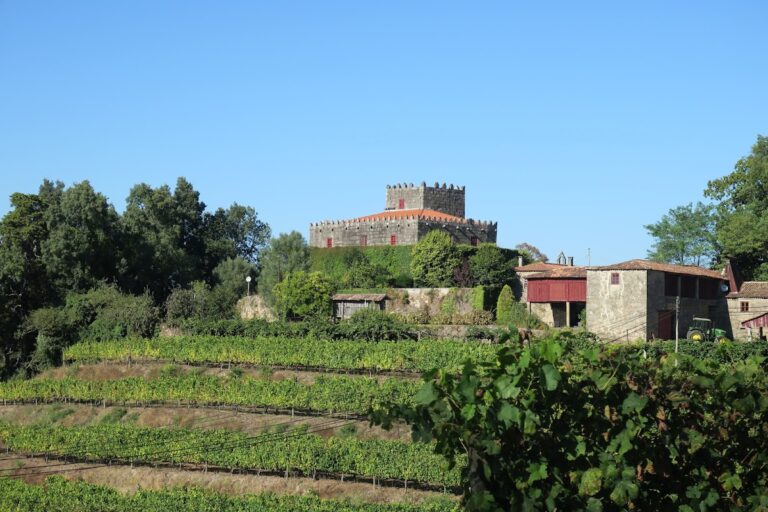
Castle of Faria occupies a steep, rocky hillside on the northwestern flank of Monte da Franqueira. The site lies in a rural landscape covered by dense pine growth and overlooks the Cávado River. Its position also placed it above the road connecting Barcelos with the port of Viana. The surviving ruins combine the broad defensive arrangement of an Iron Age hillfort with the upper medieval castle, which was built in Romanesque forms from granite.
Iron Age fortifications and settlement
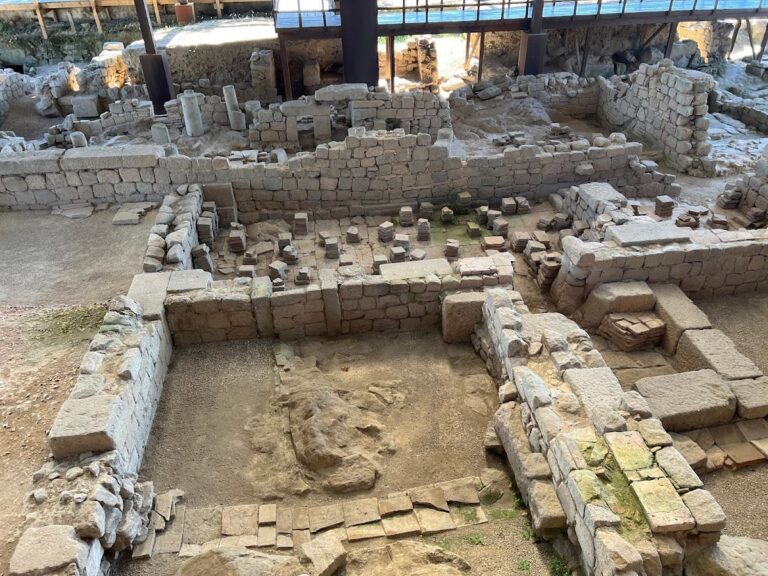
Three lines of walls enclosed the earlier settlement. On the eastern side, the outer wall was preceded by an extensive trench before the road between Franqueira and Milhazes was opened. Between the outer and second walls are the remains of ten Iron Age buildings, concentrated mainly on the eastern side. Several are circular or oval and contain vestibules and fireplaces.
Further circular and rectangular building remains survive on both sides of the second wall. The defensive arrangement also included a wall and a barbican, an advanced defensive enclosure positioned outside the main fortification. Together, these features show how the settlement occupied successive defended areas on the hillside.
Medieval castle
The medieval fortress occupied the upper courtyard of the earlier defended site. Its traditional quadrilateral plan included an internal courtyard, a barbican, and a crenellated defensive wall. The rectangular keep survives in ruins, as do the walls of the alcalde’s palace. A lower slope between the keep and the lateral wall supports the ground of the upper terrace, preserving part of the relationship between the principal upper structures and the surrounding enclosure.
Granite forms the main building material of the castle. The keep, walls, and towers survive as ruins, with reconstruction work having addressed parts of the walls and keep during the 20th century. The surviving medieval military objects, including swords, helmets, chain mail, belt buckles, and coins, provide material evidence for the fortress’s armed use during the medieval period.