Castle of Châteauneuf-du-Pape: A Papal Fortress in France




Site at a Glance
- Rating
- 4.5
- Popularity
- Medium
- Country
- France
- Primary era
- Medieval
- Eras represented
- Medieval
- Civilizations
- Papal States
- Site type
- Military
- Remains
- Castle
On this page12 sections
History
Castle of Châteauneuf-du-Pape is a Gothic castle in France, built under the Avignon Papacy between 1317 and 1333. Rising above the village and vineyards, it formed part of a landscape shaped by nearly eight centuries of religious authority, military conflict, and wine production.
Early Fortifications and the Château de l’Hers
A Roman castrum, meaning a fortified settlement or military position, probably occupied the site before its destruction during the great invasions. A charter of 913, signed by Louis the Blind, names the place castellum de Leri and transferred it to Foulques, bishop of Avignon.
In 1077, Bishop Rostaing granted the fief to Pierre d’Albaron, who built a keep, the principal fortified tower of a castle. During the Middle Ages, this older stronghold served as a watch post and toll station on the Rhône. It later passed among families allied with the Albaron family.
The fortress was enlarged during the twelfth century and became known as the Château de l’Hers. It was renovated in the thirteenth century. Earlier historians linked it with the Knights Templar, but historians in the twentieth century rejected that tradition. A separate fortified settlement called Castro Novo, which gave Châteauneuf its name, appears in a charter of 1094. A construction from 1146, made under the Count of Toulouse, was identified in a 1283 document as the “old tower.”
In 1157, a charter transferred the holding to Godefredus Lauger, bishop of Avignon, and his successors. The same charter also mentions vineyards. This connection between episcopal authority and winegrowing continued as the settlement developed.
The Avignon Papacy and the New Castle
During the Avignon Papacy, the period when the papal court was based primarily in Avignon rather than Rome, Châteauneuf held a special position within the Comtat Venaissin. This papal territory in southeastern France was administered through institutions including the rector of the Comtat and the bishop of Avignon. At Châteauneuf, both high and low jurisdictions were administered by the bishop rather than the rector, and the parish was described as In Comitatu rather than de Comitatu.
Pope Clement V passed through Châteauneuf on 5 April 1314 while travelling across the Rhône toward Roquemaure. He died there about fifteen days later. In 1316, Jacques d’Euze, formerly bishop of Avignon, became Pope John XXII. Because Châteauneuf was directly subject to him, he ordered the restoration of the older Château de l’Hers and allocated 3,000 florins for the work.
John XXII ordered a new castle in 1317. Construction continued until 1333, with the work directed successively by Hugues de Patras, Raymond d’Ébrard, and Guillaume Coste. The building’s scale and commanding position gave it a primarily defensive purpose. In 1318, John XXII also ordered the village to be enclosed by ramparts.
The castle formed part of John XXII’s wider interest in the area’s wine production. He brought winegrowers from Cahors, who introduced grape varieties that helped develop the Châteauneuf-du-Pape vineyard. Papal production rose from four or six barrels a year to twelve barrels by 1325. By 1328, the enclosed vineyard covered an estimated eight hectares and later expanded to about ten hectares.
A land register of 1334 gives at least 285 hectares of vineyard for the wider territory. In 1344, under Pope Clement VI, the first known local terroir, called Vieille Vigne and now known as Bois de la Vieille, was identified. Pope Innocent VI valued both red and white wines, while Pope Urban V ordered muscat grapes to be planted.
Papal Residence and Decline
John XXII’s successors rarely stayed at Châteauneuf. The castle became more active when plague threatened Avignon and the papal court moved there, as it did in 1383. Antipope Clement VII, a claimant to the papal title during the Great Western Schism, lived at Châteauneuf from 1385 to 1387. He maintained the castle, replanted its vineyards, and spent longer there than any other pope.
His successor, Antipope Benedict XIII, moved into the castle in 1396 after restoring it. Clement VII placed a high value on the local wine. In 1390, he required a winegrower who had failed to supply 22 saumées of muscat wine to provide twice that quantity in clairet at the next harvest. The residence was also threatened by Raymond de Turenne, nephew of Pope Gregory XI and son of Guillaume III Roger de Beaufort.
After the Great Western Schism ended and the papacy returned to Rome, the castle lost the resources and administrative attention needed for its upkeep. The bishops and archbishops of Avignon, to whom it belonged, allowed it to deteriorate. The surrounding wine economy nevertheless continued to develop. In 1584, Georges d’Armagnac, archbishop of Avignon, issued an ordinance protecting the vineyards of the commune, then called Châteauneuf-Calcernier and known as “du Pape.”
Wars of Religion and Later Ownership
The Wars of Religion, the sixteenth-century conflicts between Catholics and Protestants in France, returned strategic importance to the castle. In 1562, Jean-Perrin Parpaille tried to capture it but was repulsed by troops commanded by Cardinal Alessandro Farnese, a senior church official and apostolic administrator of Avignon. Parpaille left his munitions behind.
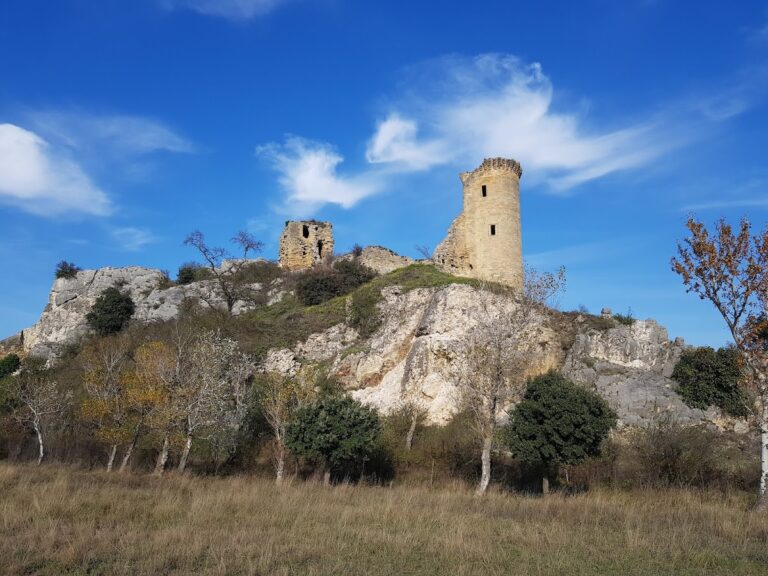
In July 1562, Huguenots, French Protestants, led by Charles Dupuy de Montbrun, seized the village and castle after the inhabitants abandoned them following the massacre at Mornas. The Huguenots used the stronghold as a base for attacks on the surrounding region until February 1563. After their withdrawal following the battle of Valréas, the Baron des Adrets retook the castle and burned part of it in March. His troops also pillaged the salt warehouse and burned the church. Only the keep and a large section of wall survived.
The remaining castle was restored in 1578. In 1580, Pope Gregory XIII granted Jean-Baptiste d’Alphonse and his male descendants the title of perpetual captain of the castle. Gregory XV annulled the appointment in 1623, but Mario Philonardi, vice-legate of Avignon, restored it to Pierre d’Alphonse in 1633. Charles de Suarez, provicar general of the archbishopric, later obtained the title and took possession of the castle.
In 1681, Archbishop Hyacinthe Libelli restored and embellished the castle for his residence. In 1728, Archbishop François-Maurice Gontier leased it, together with the papal enclosure, to John, Baron of Powers, an Irish nobleman. The baron attempted to ship his wine through Roquemaure, but the port refused it on the grounds that Châteauneuf wine had an inferior terroir. The Marquis de Tulle encountered the same problem in 1731 at Château la Nerthe.
Revolution, Ruin, and Modern Survival
After Avignon and the Comtat Venaissin joined the French Republic in 1793, winegrowers at Châteauneuf were allowed to sell their production above the departmental maximum because the wine was regarded as superior in every season.
In 1798, the castle and its domain were sold at auction to J. B. Establet, acting with the support of thirty fellow citizens. Establet resold the property in equal shares to those backers in 1799. They dismantled the walls, either to sell the stone or to use it themselves. The ground floor of the keep was leased for storage in 1858, with access retained for inspections of the apartment. In 1892, the ruin returned to the French state and was immediately classified as a historic monument.
German forces occupied the castle during the Second World War. They used the keep as an arms depot and an anti-aircraft observation post. During their retreat after the Allied landing in Provence, the garrison detonated explosives and stored munitions on 20 August 1944, destroying the northern section. A young member of the Francs-Tireurs Provençaux was reportedly killed near the castle in June 1944, and a commemorative plaque marks the place.
The castle remains linked to the wine culture of Châteauneuf-du-Pape. In 1960, the municipality installed a reception hall in the pontifical cellar. The Échansonnerie des Papes, a wine confraternity founded in 1968 by Philippe Dufays, uses the cellar twice a year for initiation ceremonies. Its titles and rituals imitate elements of the medieval papal court, and initiates symbolically receive a key to the pope’s cellar. The site also hosts wine-related cultural events, including presentations of new vintages, the Feast of Saint Mark, the Feast of Veraison, and the harvest proclamation.
Remains
Castle Buildings
Keep and Residential Block
The new castle was a three-storey Gothic structure composed of a substantial residential block flanked by four towers. Its simple, fortified form reflects the Rhodanian Gothic style, which combined northern French Gothic forms with the Romanesque traditions of Provence and Languedoc. The building used rib vaults, in which intersecting masonry ribs support the ceiling, smooth column shafts, simplified capitals, and narrow openings that limited exposure to the mistral and intense sunlight.
The ground floor contained three large rooms, including the pontifical cellar. Official life took place on the first floor, where a large ceremonial hall formed the principal public space. The pope’s private apartments occupied the second floor. Roof carpentry followed the main construction phase. Timber was floated down the Rhône from Seyssel, and Pierre Gautier, a carpenter from Avignon, directed the carpentry begun in 1333 after travelling to Liguria to obtain construction timber.
Pontifical Cellar
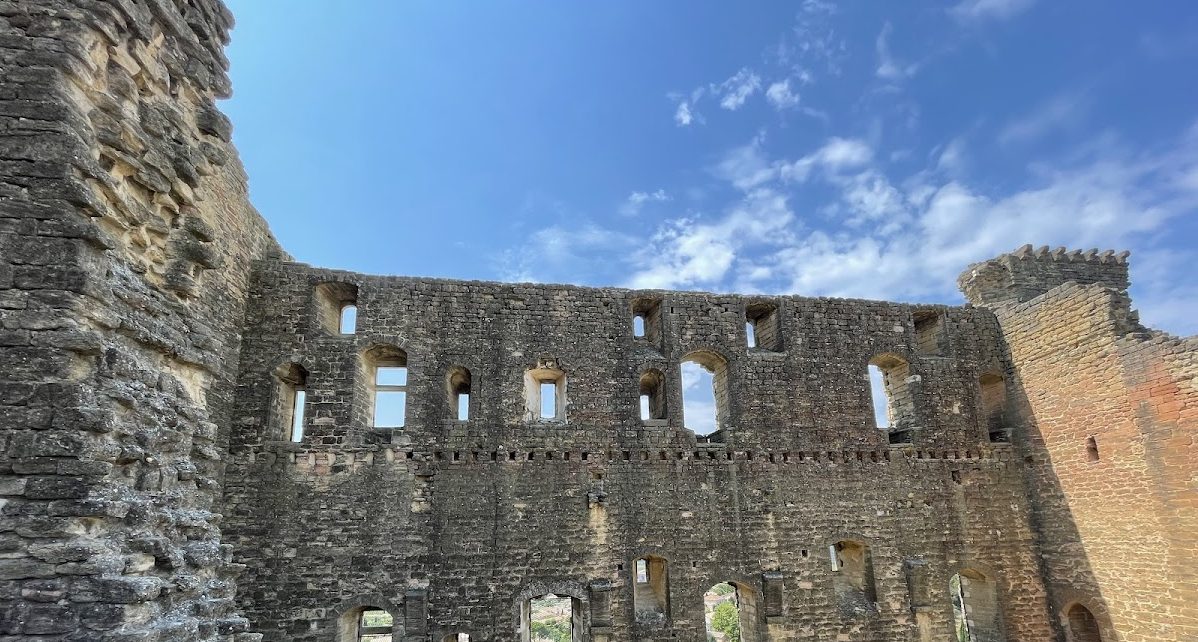
The west facade was already ruined before the explosion of 1944, but it survived the wartime destruction. Its windows still show the building’s three-level arrangement. The south face of the keep and the pontifical cellar also remain intact, while the entire northern section was destroyed. The cellar preserves the original proportions of the castle’s large lower-level hall and now serves as a reception and ceremonial space.
Original Floor Pavement
Excavations in the pontifical cellar in 1960 recovered nearly 1,000 glazed, fire-resistant terracotta tiles from the original floor. Many were monochrome green, yellow, or dark brown. They came from workshops in the Uzège. Papal financial registers mention orders for 50,000 tiles between 1317 and 1319 and a further 34,300 in 1336. Pierre Biscarel, a tilemaker from Châteauneuf-du-Pape, supplied 6,000 paving tiles on 3 November 1317, while other local tilemakers supplied another 16,800 white tiles.
The decorated pavement combines plant, geometric, and animal motifs. Copper and manganese pigments produced green and brown backgrounds, sometimes supplemented with yellow antimony or iron pigment. Some tiles carry an open cross that suggests a continuous carpet when placed together. At Châteauneuf, this design appeared in closed patterns alongside monochrome series.
A second excavation in spring 1994, along the south facade below the residential wing, recovered about fifty tiles from modern fill. Investigation of local private collections identified about one hundred more decorated tiles dispersed during nineteenth- and twentieth-century demolition. Together, these pieces broaden the known designs and show the consistency of the pavement associated with the pontificate of John XXII.
Papal Enclosure
The papal enclosure, historically called the bishop’s park, covers 9.2 hectares. Its walls surrounded vineyards, olive groves, and woodland, and were described in the early nineteenth century as substantial but partly damaged by time and the French Revolution. The enclosure remains cultivated as vineyard, with a major vineyard parcel occupying its northeastern part.
Part of the vineyard has belonged for generations to the Avril family, which has been present at Châteauneuf since at least the eighteenth century. The surviving enclosure therefore preserves a cultivated landscape associated with the castle’s papal use and with the long development of Châteauneuf-du-Pape wine production.
Nearby sites