Castle of Castelguelfo: A Medieval Fortress at the Taro Crossing
Site at a Glance
- Popularity
- Very High
- Country
- Italy
- Primary era
- Medieval
- Eras represented
- Medieval, Early Modern, Modern
- Civilizations
- Duchy of Milan, Holy Roman Empire, Italian
- Site type
- Military
- Remains
- Castle
On this page12 sections
History
The Castle of Castelguelfo is a restored fortress in Italy, first probably built around the beginning of the 12th century to guard the ford where the Via Emilia crossed the Taro River. Its precise construction date is uncertain. The original stronghold may have been a single defensive tower, and the river ran close to the castle in the Middle Ages.
Early fortifications and medieval rule
In 1189, Holy Roman Emperor Frederick I, known as Barbarossa, granted the castle, then called Burgo Taronis, to Marquis Oberto I Pallavicino. Bishop Obizzo Fieschi probably acquired the fief, a feudal grant of land or rights, in 1212. His nephew Sinibaldo succeeded him in 1224. Sinibaldo later became Pope Innocent IV, head of the Catholic Church from 1243 to 1254. He renamed the fortress the Tower of Sinibaldo and had it reinforced around 1226 with walls and defensive towers.
The Guelfs and Ghibellines, rival Italian factions broadly associated with papal and imperial loyalties, fought over the fortress in the early 14th century. The Rossi family took it in 1312 and placed it under Gherardo da San Michele. He imprisoned about fifty Guelfs there, including some relatives or friends of Giberto III da Correggio. Several prisoners died from deprivation. Gherardo transferred the castle to Giberto in 1313, perhaps fearing his response or feeling pity for the captives. Unable to hold it, Giberto had the fortress razed in 1314.
Pallavicino control and repeated sieges
The Da Correggio family probably rebuilt the stronghold, which belonged to Antonio da Correggio by the late 14th century. In 1397, Gian Galeazzo Visconti, Duke of Milan, confiscated it after Guido da Correggio broke a promise of loyalty. Guido had spent seven years imprisoned for conspiring against the duke; after his release, he joined the duke’s enemies. Visconti granted the castle to Marquis Niccolò Pallavicino, who was murdered at Bargone in 1401. Niccolò’s illegitimate son Rolando, known as “the Magnificent,” succeeded him, rebuilt the fortress and strengthened its defenses. It became known as the Tower of Orlando and the Tower of the Marquis.
On 14 June 1407, Guelf leader Ottobuono de’ Terzi besieged the castle. After repeated attacks with catapults and bombards, large early cannons, the defenders capitulated on 20 June. Terzi renamed it Castrum Guelphum, or Guelf Fortress, refurbished the walls and replaced painted eagles on the battlements with lilies to mark the Ghibellines’ defeat.
After Ottobuono was murdered in 1409, his brother Giacomo took refuge in the castle. On 8 October, Captain Ferro da San Felice attacked on behalf of Marquis Niccolò III d’Este but soon abandoned the attempt. Giacomo later fled through Borgo San Donnino to Fiorenzuola, where he was captured and killed. On 6 December, Alberto Scotti besieged and occupied the fortress. In 1410, Orlando Pallavicino abducted Bishop Branda Castiglioni of Piacenza to raise money for an attack, releasing him after four months in return for a substantial ransom. That April, Ferro da San Felice again attacked for Niccolò d’Este. Niccolò first assigned the castle to Dante da Castiglione; in 1416 he ordered its transfer to Gian Martino Sanvitale as compensation for the loss of Noceto.
Control remained disputed. In 1421, Filippo Maria Visconti, Duke of Milan and then lord of Parma, ordered Parma’s chief magistrate to take possession in his name. Rolando Pallavicino, Niccolò Terzi and Parma’s civic government also claimed the castle. Visconti supplied it with ammunition in 1422 and reassigned it to Pallavicino in 1425. Although Pallavicino allied with Venice against the duke two years later, Visconti confirmed his possession of all his fiefs in 1432.
In 1441, military commander Niccolò Piccinino persuaded Visconti that Rolando had betrayed him. Rolando fled and his lands were confiscated. After Rolando demonstrated his loyalty in 1445, the duke agreed to restore nearly all of them, except Monticelli d’Ongina and several other fiefs already granted to Piccinino. Following Visconti’s death in 1447, Parma took the castle, but Pallavicino forces soon overcame its garrison. In 1448, Francesco Piccinino briefly captured Rolando and his son Oberto, while Parma failed to take Castelguelfo and Belvedere. When Rolando died in 1457, his eldest son Niccolò inherited Castelguelfo along with Varano Marchesi, Gallinella and Miano.
Sixteenth-century conflict and changing ownership
In 1474, Duke Galeazzo Maria Sforza granted the fief to Niccolò’s son, Marquis Alessandro Pallavicino, while retaining the castle. Gian Galeazzo Maria Sforza formally granted Castelguelfo to Alessandro in 1481. French forces under King Louis XII occupied the fortress in 1500 during the Italian Wars and plundered it in 1509. In 1551, troops of Emperor Charles V, led by Ferrante I Gonzaga, seized and fortified it during their conflict with Duke Ottavio Farnese, intending to tighten the siege of Parma. They withdrew after a truce in 1552. In 1557, Ottavio ordered the castle demolished.
The fief passed successively to Ercole Pallavicino, Alessandro Pallavicino and Sforza Pallavicino. When Sforza died without an heir in 1614, it returned to the Ducal Chamber, the ducal administration responsible for the ruler’s property and revenues. On 26 January 1644, Duke Odoardo I Farnese granted the marquisate of Castelguelfo, together with the county of Felino, to his first minister Giacomo Gaufridi. Ranuccio II Farnese sentenced Gaufridi to death in 1650 while seeking to appease Pope Innocent X after Parma’s defeat in the War of Castro, a 17th-century conflict between the Papacy and the Farnese over the Duchy of Castro. Ranuccio then granted the fortress to Apio Conti, Duke of Poli. After Conti’s wife and three daughters died, he relinquished the fief, which returned to the ducal administration. In 1666 Ranuccio granted Castelguelfo to Odoardo Scotti, Marquis of Vigoleno. Scotti’s descendants held feudal rights until decrees under Napoleon abolished them in 1805.
Private ownership
Marquis Filippo Maria Scotti sold the castle to Felice Bernini Carra in 1815; Carra sold it to Baron Gaetano Testa in 1827. Baron Antonio Profumo bought it in 1851, and his son Pietro succeeded him the following year. In 1866, the Parma court expropriated the estate, which was then bought by Giovanni Maria and Luigi Paolo De Luchi. In the early 20th century, Genoese shipowner Fasce acquired the fortress from Gian Luigi De Luchi. After further changes of ownership, entrepreneur Luigi Bonati acquired it in the second half of the century. His heirs sold it to the Rovagnati family in 1994, and the family remains its owner.
Remains
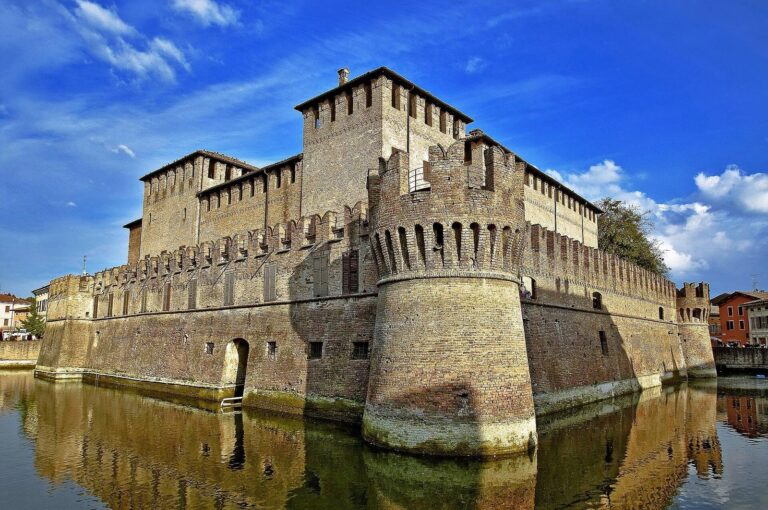
The restored fortress has a square plan around a central courtyard and is faced in brick. Its defenses, entrance and surrounding estate buildings form distinct parts of the surviving complex.
Fortress and courtyard
Walls and towers
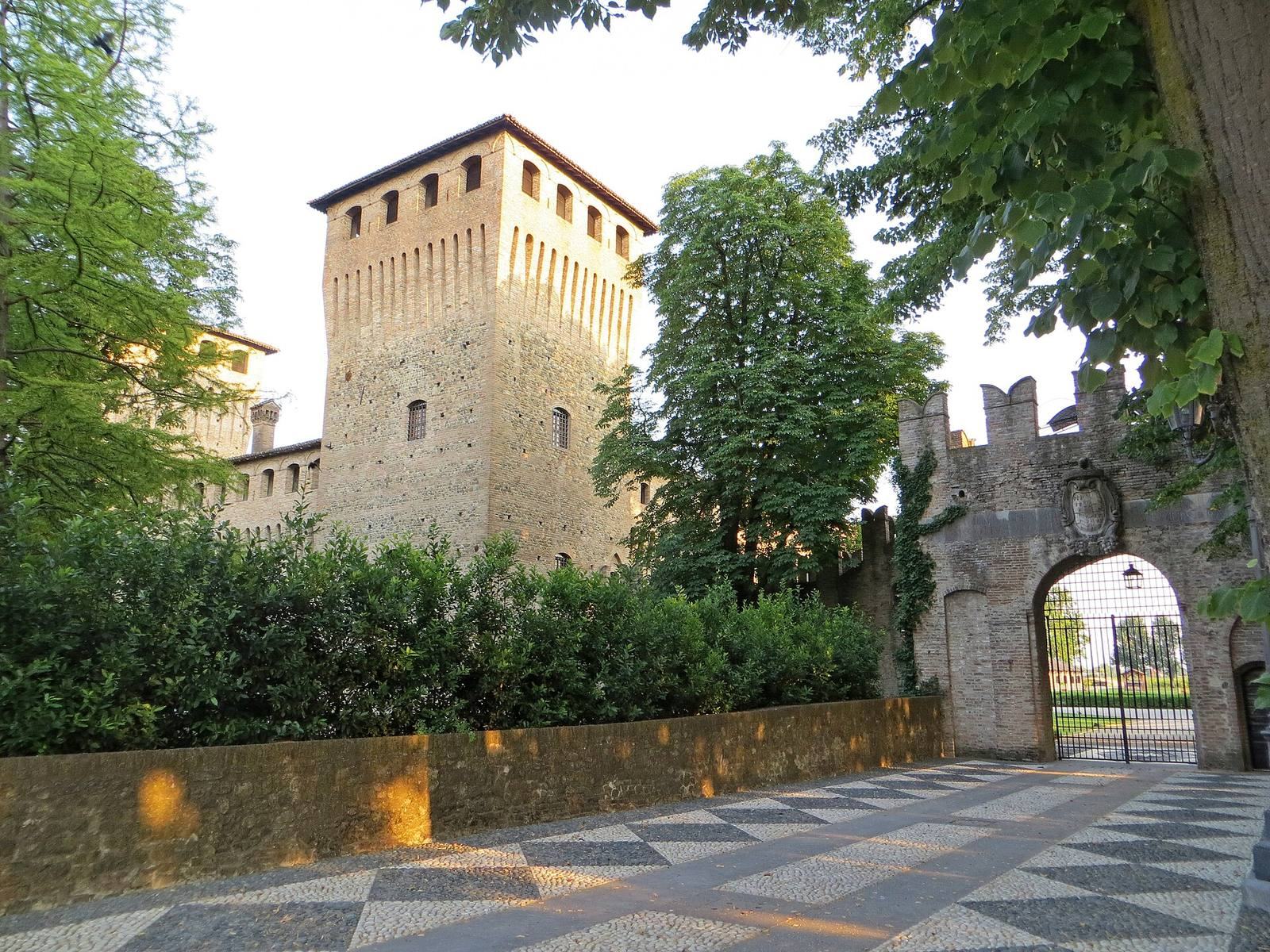
Two towers stand on the north side, with additional towers at the centers of the east and south fronts. The south side has a central entrance tower, and another tower stands midway along the western side, which faces the park. The high northern façade is bounded by corner towers. Projecting supports carry machicolations, openings that allowed defenders to attack below, and similar features continue along the other fronts. The former wall-walks, walkways along the tops of the defensive walls, were roofed during the comprehensive renovation begun in 1916. The southern façade was remodeled in the early 20th century, with projecting corners extending along the adjoining sides.
Central courtyard
A portico, or covered walkway, surrounds the courtyard, with an open gallery above it. The castle’s interiors were decorated with numerous paintings under Baron Gaetano Testa, who also laid out the English-style garden that still surrounds the fortress.
Entrance and estate buildings
Eastern entrance
East of the castle, facing the Via Emilia, a broad round-headed arch passes through an old ravelin, an outwork placed before a fortification to protect an entrance. The ravelin has swallowtail crenellations, battlement tops with forked shapes. It adjoins a building in a revived Gothic style that formerly served as the gatehouse.
Park and service buildings
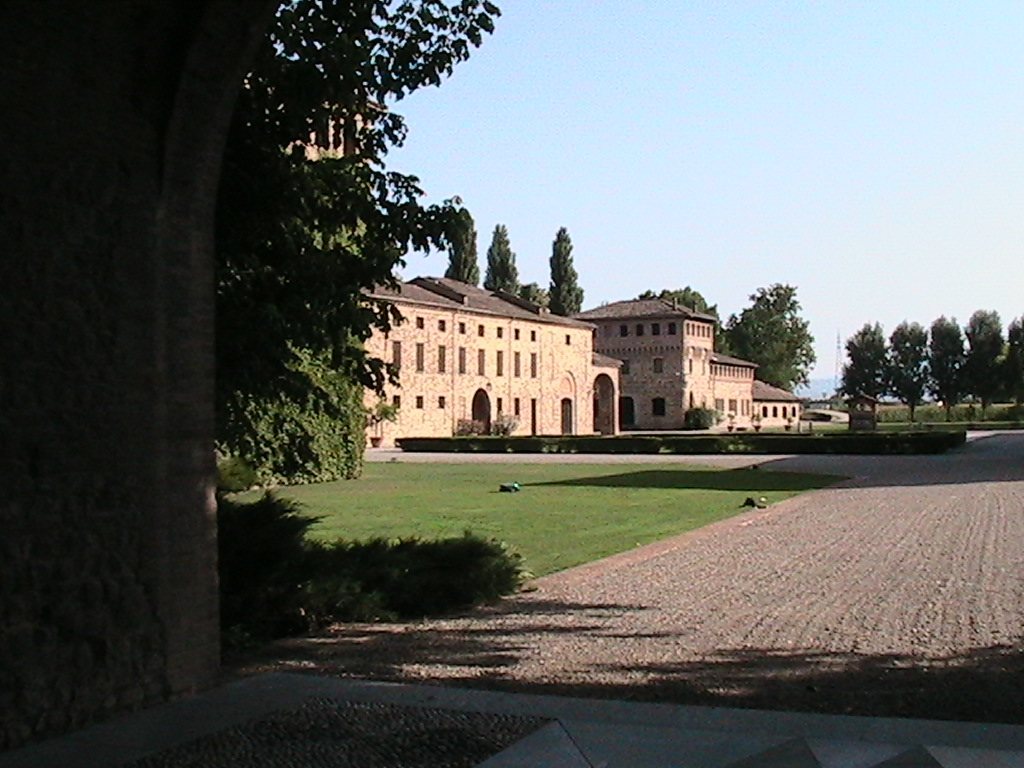
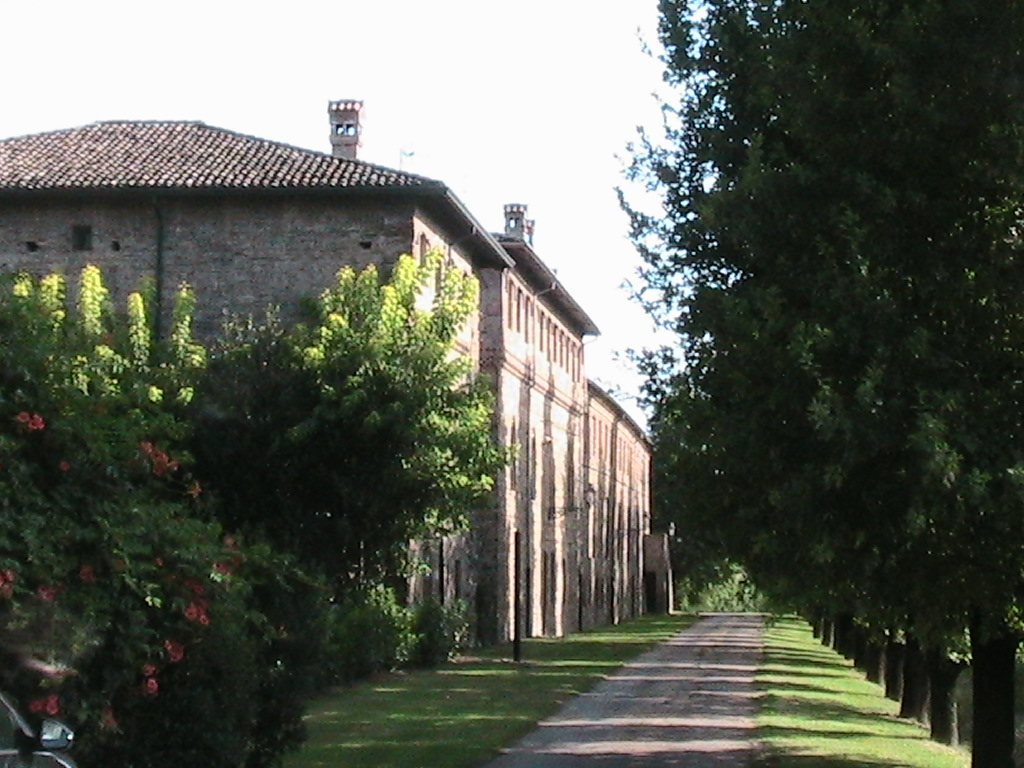
A large park with a lake extends south and east of the castle. West of the park, ancillary buildings stand in two main groups around a large courtyard. These include former greenhouses, stables and a mill, as well as an oratory, a small chapel for prayer, built in 1852. Their brick facing, projecting supports, roofed battlements and covered walkways use medieval-style features.
The renovation begun in 1916 removed a clock from the façade and involved demolishing the dairy and some neighboring dwellings. The old mill, greenhouses, stables and large park were retained or restored.