Sanctuary of the Blessed Virgin of the Holy Rosary: A Dominican Pilgrimage Church in Fontanellato
Site at a Glance
- Rating
- 4.7
- Popularity
- Low
- Country
- Italy
- Primary era
- Early Modern
- External website
- Open
- Eras represented
- Early Modern, Modern
- Civilizations
- Duchy of Parma and Piacenza, Italian
- Site type
- Religious
- Remains
- Sanctuary
On this page26 sections
History
The Sanctuary of the Blessed Virgin of the Holy Rosary is a Roman Catholic sanctuary in Fontanellato, Italy, established by the Dominicans and developed as a pilgrimage centre around devotion to the Virgin of the Rosary. Its present church was begun in 1641 and consecrated in 1660, in the Baroque period, after an earlier Dominican complex had been destroyed and rebuilt several times.
The Dominican foundation
In 1512, Countess Veronica da Correggio, widow of Giacomo Antonio Sanvitale, brought Dominican friars from the convent of Santa Maria delle Grazie at Zibello to Fontanellato. The Galeotti family of Soragna donated the fourteenth-century Oratory of Saint Joseph near the fortress, while Veronica supplied land beside it for a convent. The convent and a new church were completed in 1514.
The complex suffered a violent disruption in 1521, when French and imperial troops sacked and attacked it. The friars took refuge in the nearby castle and returned only after peace was established in 1531, when they began repairing the damaged buildings. In 1543, however, the Sanvitale counts demolished the entire complex to obtain bricks for Fontanellato’s defensive walls, which were threatened by Milanese troops. The friars moved to the Benedictine monastery of Priorato in 1550, then returned in 1552 to the ruined Saint Joseph complex and rebuilt it completely.
The rise of the Rosary sanctuary
During the late sixteenth century, a confraternity dedicated to the Madonna of the Rosary was established in the convent church and given its own chapel. Its altar received a richly dressed wooden statue of the Virgin in 1615. The statue was carved by an unidentified artist from Parma and became the focus of the sanctuary’s later devotional history.
The first miracle associated with the Madonna of Fontanellato was recorded in 1628 and later approved by the Diocese of Parma. Fontanellato was only marginally affected by the plague of 1630, strengthening local belief in the Virgin’s miraculous powers. During the war in the Duchy of Parma and Piacenza, the statue was moved to the Church of Saint Peter Martyr in Parma, where it remained until 1637.
Growing devotion and further miracles led the Dominicans to begin a larger church outside the town in 1641. The Sanvitale family provided most of the financing. Alessandro Pallavicino, Bishop of Fidenza, solemnly consecrated the church on 18 August 1660, during a ceremony that also included the coronation of the Virgin’s statue.
A new convent beside the church was begun in 1672 and completed around 1700. The original, simpler facade was finished in 1680, and an organ was installed in 1699. The friars later gathered accounts of miracles and published accounts of graces associated with the Virgin, reinforcing the sanctuary’s role as a centre of Dominican and Marian devotion.
Suppression, restoration, and renewed Dominican administration
In 1769, Guillaume du Tillot, the ducal first minister, ordered the Dominicans to leave the convent. Duke Ferdinand of Bourbon recalled them in 1775 and restored their responsibility for the sanctuary. Napoleon’s suppression of religious orders in 1805 again dispersed the friars. Count Stefano Sanvitale obtained permission for the sanctuary to become a school for the Daughters of Charity, while the convent became the boys’ school of Saint Stephen, later renamed the Corpo dell’Industria and administered by a former Benedictine prior.
In 1816, Duchess Maria Luigia allowed cloistered Dominican nuns to occupy the former friars’ convent. The friars constructed a hospice opposite the church facade, completing it in 1822. The church was restored between 1858 and 1860. A royal decree of 1866 suppressed religious orders and corporations, transferring the Dominican convent and hospice to the Municipality of Fontanellato and absorbing associated properties into the public domain.
The Dominicans later reacquired the complex. Their return was marked by the solemn consecration of the sanctuary on 13 May 1877, in the presence of Domenico Maria Villa, Bishop of Parma. Pope Pius X elevated the church to the rank of minor basilica on 26 September 1903. This papal title is granted to churches of particular religious, historical, or pastoral importance and is distinct from the category of major basilicas.
Twentieth-century changes
Between 1913 and 1920, the architect Lamberto Cusani designed the monumental Neo-Baroque facade and the projecting south wing. Neo-Baroque was a later revival of the dramatic forms and rich ornament associated with Baroque architecture. A bronze statue of Blessed Cardinal Andrea Carlo Ferrari, made by the sculptor Amleto Cataldi, was installed in front of the church.
Construction of an orphanage beside the convent began in 1925. The building was almost complete by 1940, when it was requisitioned during the Second World War, first as a prison and later as a school for officer cadets of the Italian Social Republic. Allied bombing damaged it. The building was completed and opened to orphans in 1948, but closed in 1982 because of regional legislation.
In 1971, the ruins of the nineteenth-century convent were replaced by a large forecourt designed by Enea Trenti, with a long portico along its northern side. A cloister was added inside the new Dominican convent in 1978. The former orphanage became the Pilgrim House in 1996, and the church interior underwent a complete restoration in 1997. The sanctuary remains principally associated with Roman Catholicism, the Dominican Order, the Diocese of Parma, and the long devotional tradition surrounding the Virgin of the Rosary.
Remains
The sanctuary consists of a Latin-cross church, meaning that its long nave is crossed by a shorter transept, together with a forecourt, portico, Pilgrim House, and Dominican convent. The church has a single nave, four chapels on each side, a transept, and a relatively small choir. Its exterior combines the Baroque dome and older fabric with Cusani’s monumental twentieth-century Neo-Baroque additions.
Facade and exterior buildings
Marble facade
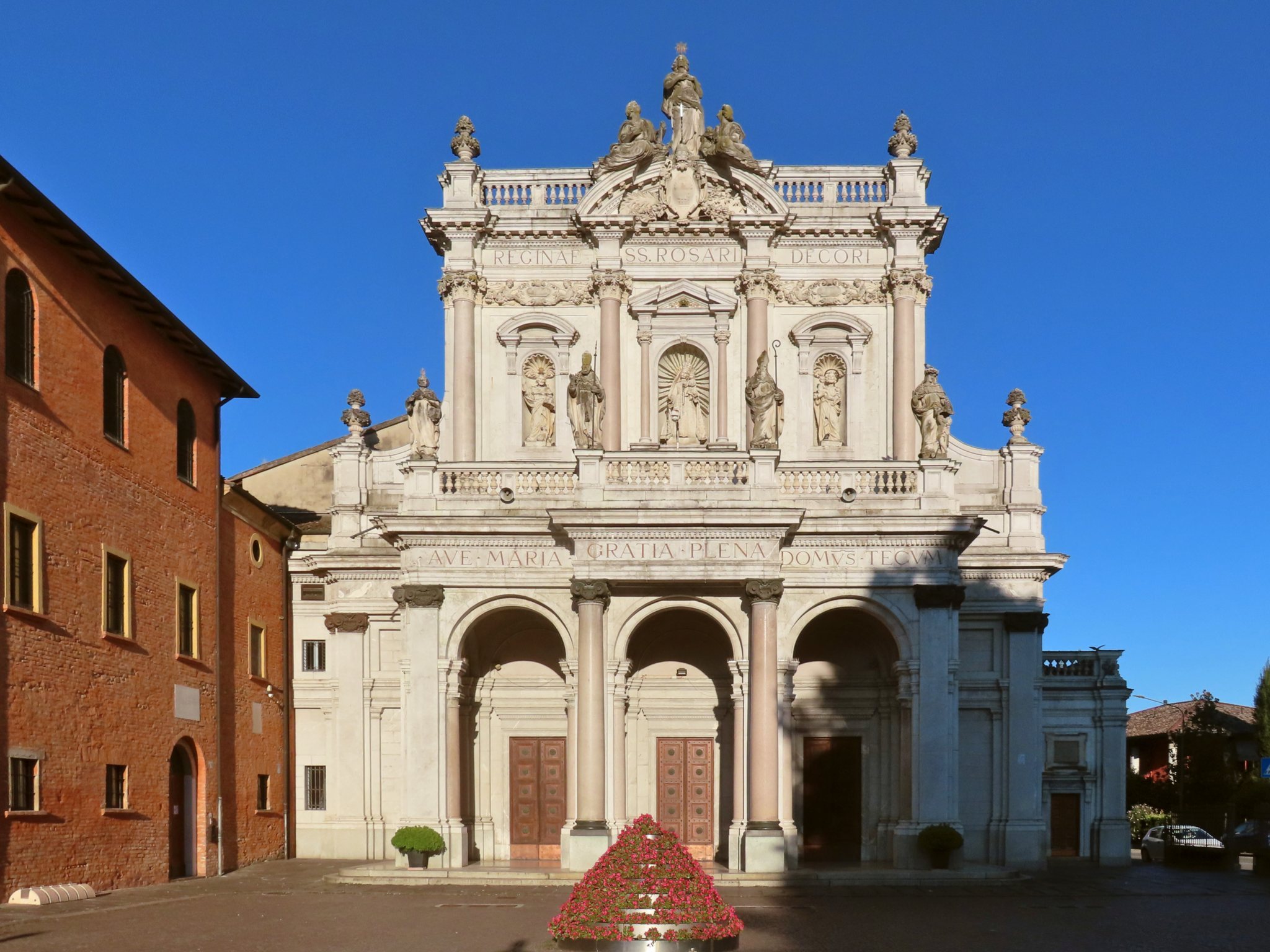
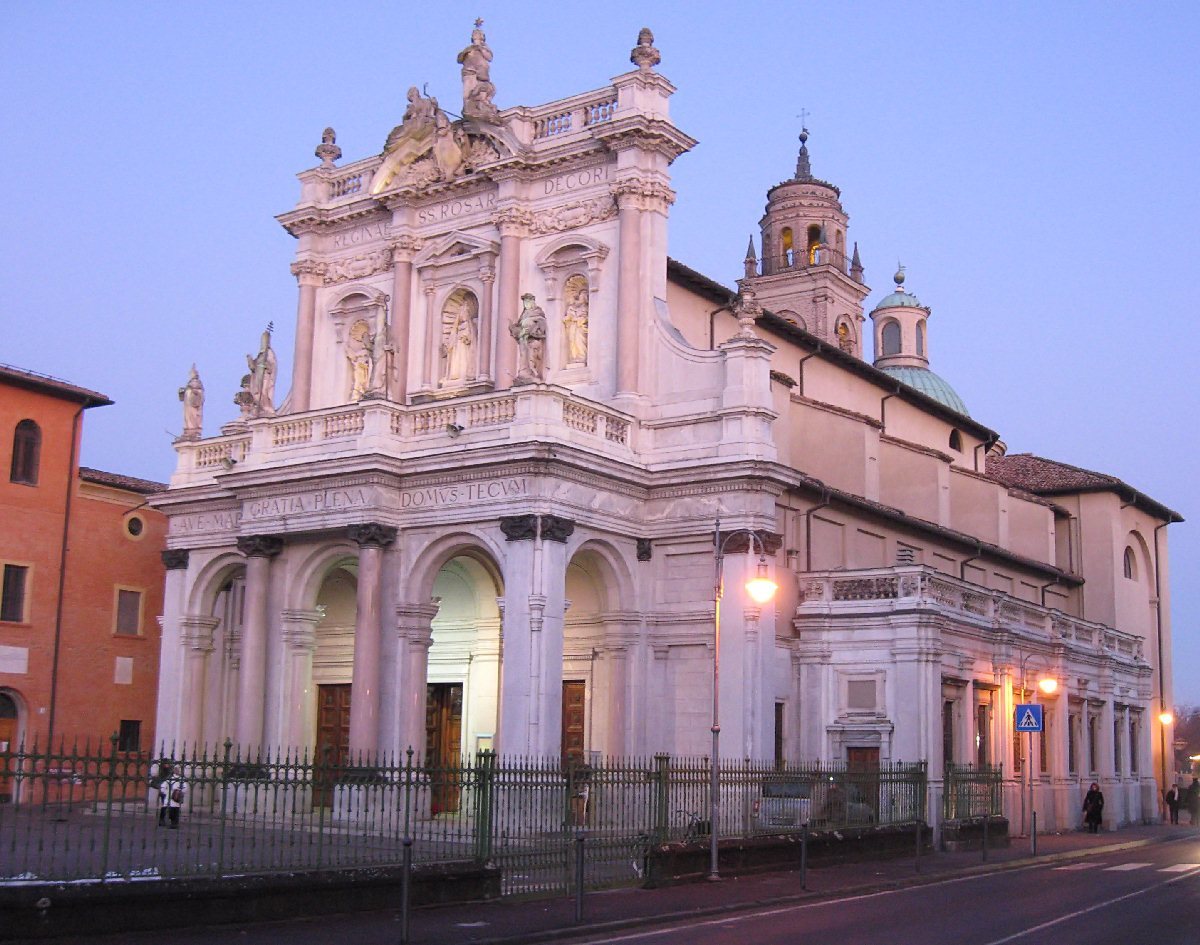
The main facade is entirely faced in white marble. Its central portico rests on four pillars decorated with pilasters and is flanked by columns with bronze Ionic capitals, lower Tuscan half-columns, architraves, and friezes. A balustrade with small columns crowns the portico and supports four statues of saints. Saint Louis Bertrand and Saint Rose of Lima came from the earlier facade, while Saint Dominic and Saint Joseph stand in the two lateral niches.
The upper level is divided by four half-columns with Corinthian capitals, which support an elaborate architrave and projecting frieze. Three large niches contain statues, including a central image of the Madonna of Fontanellato. The circular pediment carries coats of arms and reliefs and is crowned by statues of Hope, Charity, and Faith. Two side balustrades end in bases supporting vases. Pietro Morseletto made the twentieth-century sculptures from designs by Lamberto Cusani.
Confessional Gallery and dome
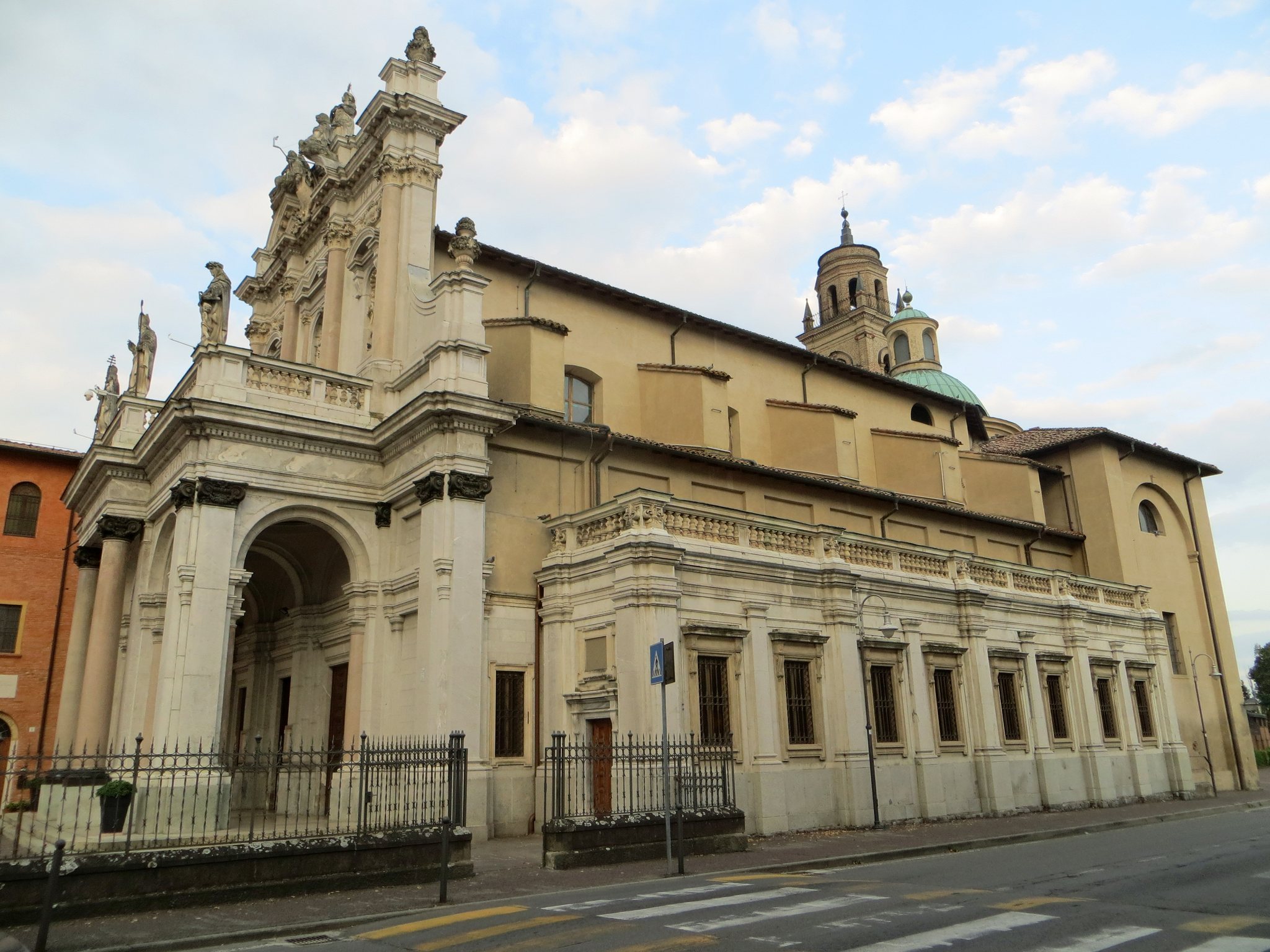
Along the south side is the projecting marble Confessional Gallery, a single-storey addition made by Cusani in 1920. Alternating single and paired half-pilasters with Doric capitals divide the structure. Its windows have frames with volutes and crowning architraves, while a long balustrade runs above it.
A Baroque dome with a lantern rises above the presbytery from the church’s two-pitched roof. It was retained when Cusani proposed rebuilding the original brick bell tower. The bell-tower work was never begun because sufficient funds were unavailable.
Forecourt and associated buildings
The forecourt is bordered on its northern side by a long portico with low-segmental arches resting on pillars. Bronze statues of the venerable Giocondo Pio Lorgna, Blessed Andrea Carlo Ferrari, and Saint Guido Maria Conforti stand there. The building to the left of the sanctuary dates from the first half of the twentieth century and has housed the Pilgrim House since 1996. It is faced in brick and arranged around a large square courtyard, with a garden behind it.
Behind the church stands the modern Dominican convent dedicated to Saint Joseph. The later building is faced in brick and contains a cloister added in 1978.
Nave and presbytery
Nave frescoes and pavement
The nave is covered by a barrel vault with lunettes divided into four bays. Against a pink background, Pietro Rubini painted frescoes in 1731 showing the Virgin giving the Rosary to Saint Dominic, sheltering Dominican children beneath her mantle, obtaining from her Son Saint Dominic’s mission to preach to all peoples, and appearing as the Virgin of the Rosary with two Dominican saints.
Venetian-style pavement dating from 1817 covers the nave floor. Stucco pilasters with Corinthian capitals divide each side into four round-headed arches containing the chapels. The transept walls carry Rubini’s paintings of the Massacre of the Innocents and the Miracles of the Virgin, made during the second half of the seventeenth century.
Presbytery and high altar
The presbytery, the area around the principal altar, is covered by a dome decorated with stucco and frescoes. Its marble paving was donated by Count Alessandro III Sanvitale and his wife, Paola Simonetta, in 1684. The entrance arch bears 15 oval scenes of the Mysteries of the Rosary, while a marble balustrade with Sanvitale coats of arms marks the front of the space.
The table-form high altar incorporates portions of the former altar of Parma Cathedral. Behind it stands a monumental polychrome-marble aedicule, a framed architectural setting for a sacred image, flanked by wooden statues of Saint Dominic and Saint Catherine. Giovanbattista Guerrini made it in 1650 to a design by Carlo Natali. Two tall pink-marble columns with Corinthian capitals frame the 1615 statue of the Madonna of the Rosary. The arched pediment contains frames and statues and is finished with a carved and gilded wooden ornament.
Choir and altar chapel
A small chapel-oratory behind the altar contains a fresco of the Blessed Virgin of the Rosary. The polygonal apse contains a Baroque wooden choir, probably made by the sculptor Giulio Seletti during the first half of the eighteenth century.
Side chapels and furnishings
Chapel of the Dominican saints
The eight chapels are equal in form and size. Their altars have polychrome scagliola frontals made by Marco Mazelio in 1701. Scagliola is a polished composite material made to imitate coloured marble. The chapel dedicated to Dominican saints contains a richly carved and gilded Baroque wooden altarpiece from the early eighteenth century, crowned by angels. Its 1669 altarpiece painting shows Saints Dominic, Vincent Ferrer, Louis Bertrand, Antoninus of Florence, Catherine of Siena, and Agnes of Montepulciano.
Chapel of Saint Thomas
The chapel of Saint Thomas contains a white-and-gold Baroque wooden altarpiece dated 1706. Its reliefs include a large tree emblem. The 1665 painting shows Saints Paul, Thomas Aquinas, and Peter.
Chapel of the apparition at Soriano
The chapel dedicated to the apparition of Saint Dominic at Soriano has a gilded late-Mannerist wooden altarpiece with reliefs and caryatids, dated 1706 and crowned by a broken circular pediment. Countess Lucrezia Cesi Sanvitale donated its 1666 painting of the apparition.
Chapel of Saint Joseph
The chapel now dedicated to Saint Joseph was originally dedicated to the Circumcision. Its gilded Baroque wooden altarpiece has reliefs, twisted columns with Corinthian capitals, and a broken triangular pediment bearing the Dominican emblem. A nineteenth-century wooden statue of Saint Joseph stands within it.
Chapel of the miracle of Saint Raymond
The chapel dedicated to the miracle of Saint Raymond contains a richly gilded Baroque wooden altarpiece matching that of the chapel opposite. Its painting of the Miracle of Saint Raymond dates from 1669.
Chapel of Saint Hyacinth
The chapel of Saint Hyacinth has a white-and-gold Baroque wooden altarpiece matching the one opposite, except for an emblem flanked by two eagles. Its painting of the Miracle of Saint Hyacinth was made in 1669.
Chapel of the Circumcision
The chapel now dedicated to the Circumcision contains a gilded late-Mannerist wooden altarpiece related to the one opposite. It bears a Farnese emblem, and its painting of the Circumcision dates from 1663.
Chapel of the Crucifix
The chapel of the Crucifix contains a gilded Baroque wooden altarpiece and a wooden Crucifix made in 1663. The crucifix is set before a painted hilly landscape.
Paired roundels beside the chapels depict 16 miracles of the Madonna of Fontanellato. Pietro Rubini painted them within stucco frames around 1731. Seven altarpieces and a crucifix date from the second half of the seventeenth century.
Organ and votive gallery
Pipe organ
Above the entrance is a large pipe organ housed in an elaborate carved Baroque wooden choir loft decorated with putti. The instrument was probably made by the Cremonese organ builder Giulio Sacchi in 1699. It has two keyboards, a pedalboard, and numerous stops. The organ was completely rebuilt in 1900 and restored in 1986.
Gallery of Graces Received
Beyond the sacristy, the Gallery of Graces Received contains a large collection of ex votos, objects offered in fulfilment of a vow or in thanksgiving for divine assistance. The oldest offerings date from the seventeenth century and include tablets and small paintings on canvas or wood, with examples from 1628 onward. Metal hearts became common in the nineteenth century, followed by newspaper articles and early photographs.