Castle of Camarena de la Sierra: A Medieval Hilltop Fortification in Spain


Site at a Glance
- Rating
- 4.7
- Popularity
- Very Low
- Country
- Spain
- Primary era
- Medieval
- Eras represented
- Iron Age, Medieval
- Civilizations
- Almohad, Crown of Aragon, Iberian
- Site type
- Military
- Remains
- Castle
On this page9 sections
History
The castle of Camarena de la Sierra is a hilltop fortification in Spain, probably constructed during the Islamic period and assigned a construction date in the twelfth to thirteenth centuries. It stands on El Castillejo, also known as Cerro de San Cristóbal, above the Camarena River. The site later became part of the Christian territories governed by the Crown of Aragon and retained evidence of occupation into the late medieval period.
Islamic origins and Christian conquest
The castle may have been established under Islamic rule, although the surviving remains do not allow its early history to be reconstructed with certainty. Christian control followed the conquest of the area by Pedro II of Aragon in 1210. Pedro II, also known as Peter the Catholic, was the Aragonese king whose reign included Christian expansion toward Muslim territories bordering Valencia. After the conquest, the castle was entrusted first to Pedro Fernández el Castellano and later to Pedro de Pomar.
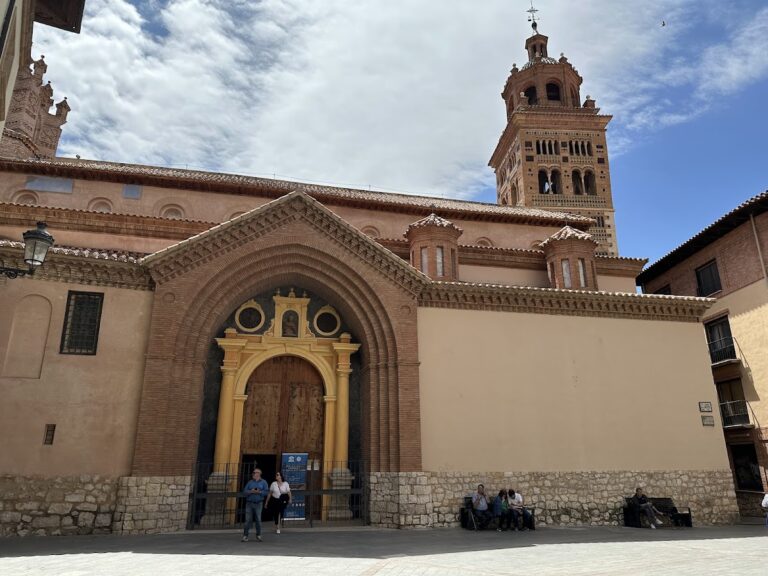
The circumstances of the capture remain uncertain. It has been associated either with the campaign around Castielfabib or with the Battle of the Llano de la Matanza. In 1217, Camarena de la Sierra belonged to the Diocese of Zaragoza. The diocese exchanged it with the Crown for the Castle of La Palma at Sástago, after which the settlement was incorporated into the Community of Villages of Teruel, a territorial institution organizing settlements and shared administration under Teruel. Camarena became part of the Sesma of Campo de Sarrión, a sesma being a territorial subdivision used for local administration within such a community.
Depopulation and later religious use
Camarena de la Sierra was unpopulated by the 1260s. On 8 May 1268, while in Montpellier, Jaime I of Aragon authorized the Council of Teruel to choose six or seven men to divide and resettle Camarena and several other places in the territory of Teruel. Jaime I, known as James the Conqueror, was the Aragonese king associated with the Crown of Aragon’s thirteenth-century expansion and the organization of settlement in newly controlled territories. It remains uncertain whether all the places named in the authorization were resettled, or whether some were settled and later abandoned.
The primitive parish church on the castle hill acquired a new role after a parish church was built in 1677. The earlier building was converted into the Hermitage of San Cristóbal. The castle is listed in the Aragonese Register of Assets of Cultural Interest as a castle designated an Asset of Cultural Interest under the second additional provision of Aragonese Cultural Heritage Law 3/1999. The listing was published on 22 May 2006.
Remains
Hilltop enclosure and defensive structures
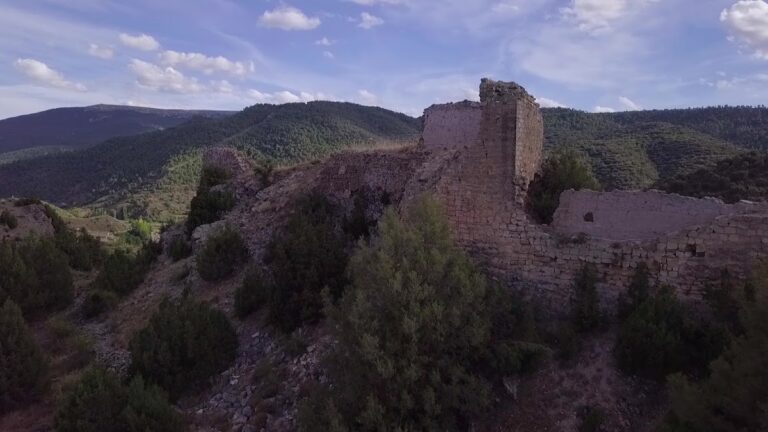
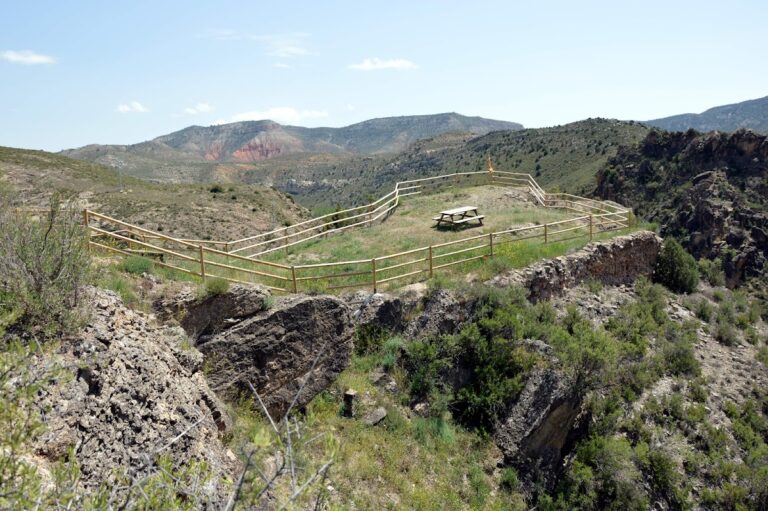
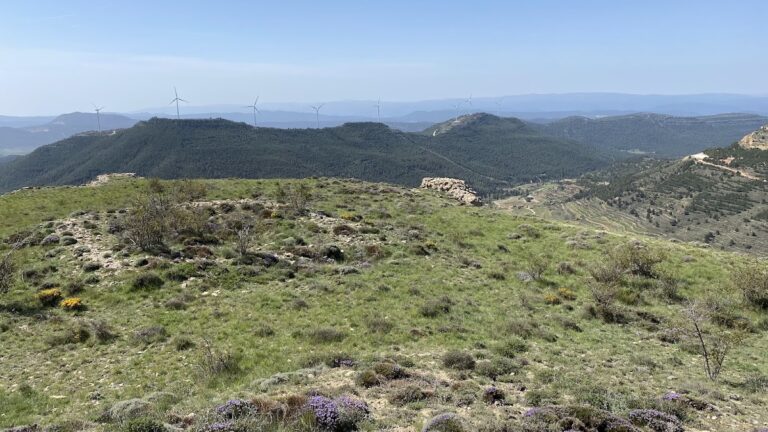
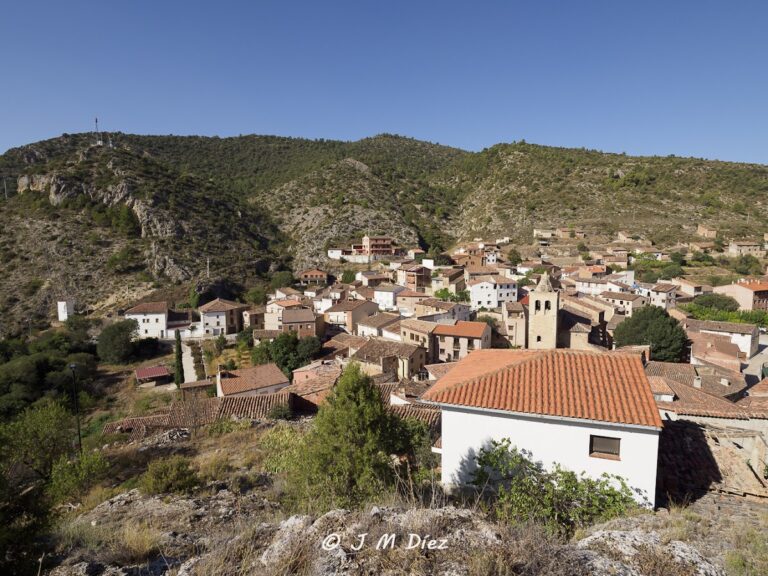
The remains occupy the summit and slopes of a substantial rocky hill on the right bank of the Camarena River, west of Camarena de la Sierra. El Castillejo, the popular name for the hill, recalls the fortification formerly located on its summit. Archaeological remains are irregularly distributed across the hilltop and southeastern slope, including fragments of gypsum masonry and scattered ceramics from both the Islamic period and the late medieval Christian period. The hill also contains remains of an Iberian settlement.
Southeastern perimeter wall
A severely deteriorated perimeter wall survives on the southeastern slope. Built from rounded stones, with sections arranged in a herringbone pattern, it has lost much of its outer masonry. The wall encloses a platform that slopes toward the southeast, where part of the medieval village may have stood. Some surviving sections in this herringbone arrangement may derive from the Islamic period and may have been reused during the early Christian period, although their precise dating cannot be established from the remains.
Tower remains
A tower in the southeastern part of the site has walls made from masonry bonded with lime-and-rubble mortar. In the southwestern area, a defensive structure occupies the highest part of the rocky outcrop. It may represent a castle tower and is clearly visible from the western slope. The principal castle structures and the area potentially occupied by the medieval village were concentrated in the southeastern part of the hill, beside a prominent rocky block and in an intermediate hollow. The ground toward the Hermitage of San Cristóbal is more irregular but may also have been partly occupied.
Primitive parish church
Temple on the northern hilltop
In the northern part of the hill are the remains of a rectangular temple measuring approximately 20 by 7 metres. It was built as a platform directly over exposed rock and has been identified with the primitive parish church later converted into the Hermitage of San Cristóbal. Its position forms part of the wider hilltop complex, alongside the fortification remains and the area associated with the medieval settlement.
Nearby sites