Castillo del Poyo: A Strategic Fortress in Alpuente, Spain


Site at a Glance
- Rating
- 4.5
- Popularity
- Very Low
- Country
- Spain
- Primary era
- Medieval
- Eras represented
- Medieval
- Civilizations
- Umayyad
- Site type
- Military
- Remains
- Castle
On this page10 sections
History
Castillo del Poyo is a hilltop fortress in Alpuente, Spain, whose origins may reach back to the Roman period and whose surviving historical phases include Muslim and medieval occupation. Archaeological finds from the surrounding area indicate activity from the Bronze Age, Iberian, Roman, Islamic, and medieval periods. Its position on a high hill near the boundary with Teruel gave it lasting strategic value.
Early Occupation and Muslim Reconstruction
Coins and other Roman archaeological pieces found around the site have led to the possibility of Roman origins. The Muslims appear to have constructed or reconstructed the fortress in the tenth century. This phase established the stronghold that later powers continued to use because of its commanding position.
Christian Rule and Later Decline
After the Christian conquest, Castillo del Poyo remained occupied and maintained for its military importance. It was gradually abandoned over time, although the fortress was reformed in the nineteenth century and continued to serve a military purpose during the Carlist Wars, nineteenth-century Spanish civil wars between supporters of the Carlist claim to the throne and defenders of the liberal constitutional order.
The Carlist Wars
During the First Carlist War, the fortress housed an academy intended to promote Carlist army officers. After Morella surrendered, the troops at Castillo del Poyo refused to leave. Forces commanded by the liberal General Azpiroz eventually captured the stronghold in one of the conflict’s final military episodes.
Liberal troops took and devastated the fortress on 6 August 1840, yet occupation continued into the period of the Third Carlist War. In 1875, during the Second Carlist War, Castillo del Poyo remained loyal to Carlism, the traditionalist movement supporting the Carlist cause, after Carlist forces north of the Ebro withdrew following the capitulation of Cantavieja. Troops under the liberal General Manuel de Salamanca attacked repeatedly, and an artillery bombardment using heavy guns finally forced the fortress to surrender. Its fall marked the end of the war in Valencian territory.
Archaeology and Protection
Archaeological discoveries from Castillo del Poyo are partly preserved in the Municipal Archaeological Museum of Alpuente. The ruins have also been progressively affected by the removal of building material for neighboring hamlets. Castillo del Poyo was declared an Asset of Cultural Interest, Spain’s protected cultural-heritage designation, on 9 October 1996.
Remains
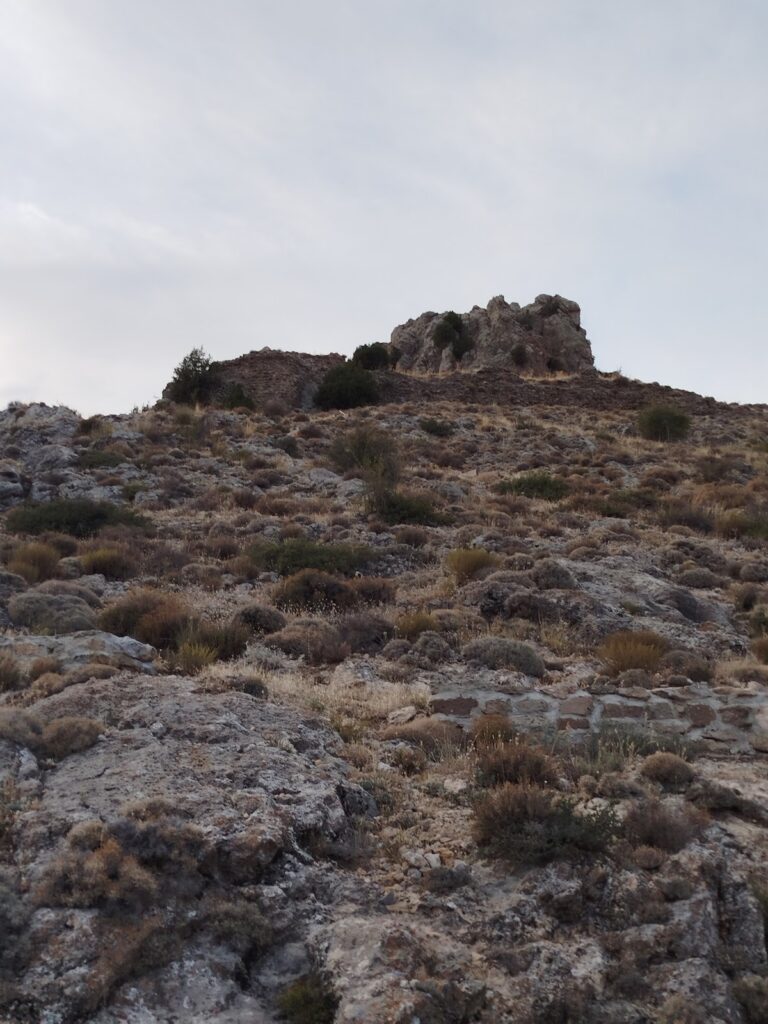
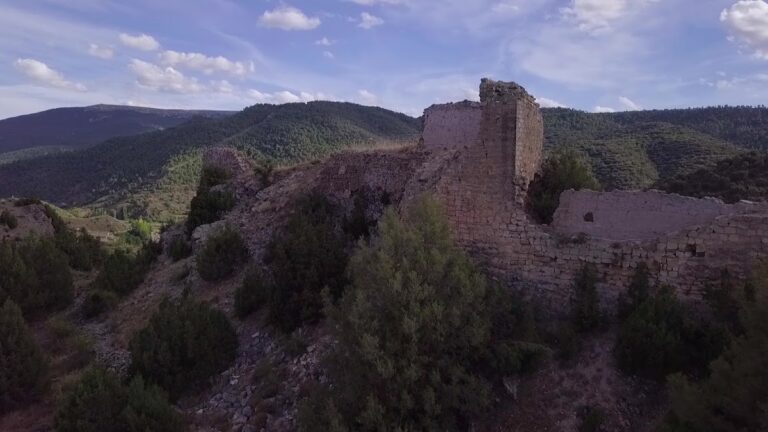
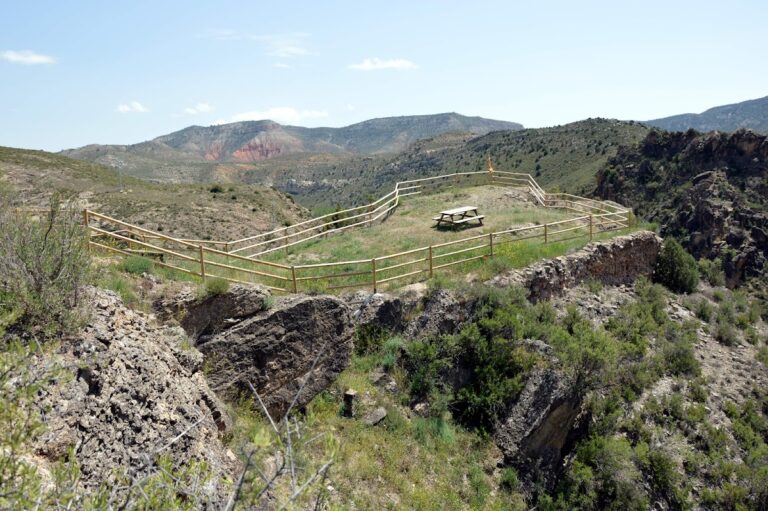
The ruins occupy the summit of Cerro del Poyo at an elevation of 1,475 metres. The site lies more than one kilometre from the hamlet of El Collado and about 12 kilometres north of Alpuente. A completely cut rocky crag, approximately 10 metres high, forms the summit, and ashlar, carefully shaped masonry, was built upon it. The irregular enclosure measures about 200 metres in length and 80 metres across its principal axes.
Summit Enclosure
Walls and Towers
Little of the former Fuerte del Collado survives above ground. The perimeter wall begins along the rocky escarpment, while remains and basal traces mark the positions of its towers. No tower remains standing. The fortification was built predominantly with dry-laid stone, meaning that stones were set without continuous mortar. Lime mortar, a binding material made from lime and aggregate, appears in some areas where the walls were joined or repaired during successive periods of maintenance and consolidation.
Interior Structures
Extensive rubble fills the enclosure, but the arrangement of internal buildings can still be discerned. In at least one place, a vault emerges from what appears to have been an underground structure, providing evidence of the built spaces within the fortified summit.
Slopes and Archaeological Material
Construction stones and ceramic fragments extend down the slopes below the summit. Together with the archaeological finds preserved in Alpuente, these remains reflect the long sequence of activity associated with the fortress and its surrounding settlement area.
Nearby sites