Castle Nijenrode: A Water Castle and University in the Netherlands


Site at a Glance
- Rating
- 4.6
- Popularity
- Very Low
- Country
- Netherlands
- Primary era
- Early Modern
- External website
- Open
- Eras represented
- Medieval, Early Modern, Modern
- Civilizations
- Dutch
- Site type
- Military
- Remains
- Castle
On this page10 sections
History
Castle Nijenrode is a water castle in the Netherlands, near Breukelen, whose origins lie in a 13th-century defensive castle and whose present complex includes a Dutch Renaissance rebuilding. The name Nijenrode means “newly cleared land.” Around 1275, Gerard Splinter van Ruwiel had the first castle built on the bank of the Vecht River.
Medieval origins and destruction
The castle was destroyed in 1481 and again in 1511. In 1536, the ruin passed by inheritance to Johan van den Bongard, hereditary chamberlain of Jülich and bailiff of Grave. It then passed to his son, Bernard I van den Bongard, before reaching Bernard II van den Bongard.
Rebuilding in the seventeenth century
Bernard II rebuilt Nijenrode between 1632 and 1642 in the Dutch Renaissance style. This architectural tradition combined classical decorative ideas with local building forms in the Netherlands. The castle was again drawn into military events during the Rampjaar, or “Disaster Year,” of 1672, when the Dutch Republic faced invasions and major military crises.
French forces occupied Nijenrode in 1672, and their commander La Fosse used it as his headquarters for several months. In 1673, troops commanded by Frans de Montmorency, Duke of Luxembourg, set the castle on fire. The ruin was sold in 1675 to Joan Ortt, an Amsterdam merchant. He rebuilt the castle once more, and it remained in the Ortt family until 1849.
Nineteenth-century transformation
After a public auction in 1849, Nijenrode passed to Jonkheer W. J. A. van Romondt. Willem Hendricus de Heus, an Utrecht entrepreneur and member of the provincial legislature, acquired land around the castle. The sale followed the death of Vrouwe Ortt van Nijenrode, born Schroyestein, on 29 November 1848.
De Heus acquired Nijenrode at another public auction in April 1853. He regarded the property as a business investment rather than a residence and commissioned a substantial renovation in the Neo-Tudor style in 1860. After his death in 1872, the property passed to his son Henri de Heus. Henri lived and worked in Apeldoorn and had little interest in Nijenrode, so he rented the castle for several years to C. J. van der Meulen, who established a boarding school there. After Henri’s death, his heirs sold the castle.
Restoration, art, and wartime loss
Michiel Onnes, an Amsterdam coffee trader, owned Nijenrode from 1907 to 1930. During his ownership, the castle was restored and enlarged up to 1920. The gatehouse was built during the First World War, while the coach house was restored during the same period.
In 1930, the Amsterdam art dealer Jacques Goudstikker bought Nijenrode and used it as a showroom for his art stock. He opened the castle to the public, received prospective clients, and organized benefit concerts and large social events. The Concertgebouw Orchestra, conducted by Willem Mengelberg, performed in the castle gardens. Concerts had been held frequently at Nijenrode before the Second World War, and several performances continued afterward.
Goudstikker, who was Jewish, died aboard the ship on which he fled from IJmuiden to the United Kingdom in May 1940. In July 1940, his art business was sold by its employees to Hermann Göring, a leading Nazi official, and Alois Miedl, a German businessman living in the Netherlands. The business’s real estate, including Nijenrode, came into Miedl’s possession.
University use
After the liberation of the Netherlands, the Dutch state administered the castle. Goudstikker’s widow bought it back from the state and sold it again in 1950. The Stichting Nijenrode, Instituut voor Bedrijfskunde established itself at Nijenrode in 1946 and purchased the castle in 1950.
The institution changed its name to Universiteit Nijenrode in 1982 and later to Universiteit Nyenrode when the spelling was adapted for international operations. Since 2005, it has been known as Nyenrode Business Universiteit, a Dutch institution of higher education specializing in business and management education. Nijenrode has served as a university since 1946 and is used for education, conferences, and academic activities. The concert tradition was revived in 2009, with performances taking place in the coach house.
Castle Nijenrode is designated a Rijksmonument under monument number 520607. A Rijksmonument is a building, site, or other cultural property legally protected by the Netherlands as a monument of national importance. Replicas of Nijenrode have also been made in Madurodam and in the Huis ten Bosch theme park near Nagasaki.
Remains
Water-defended complex
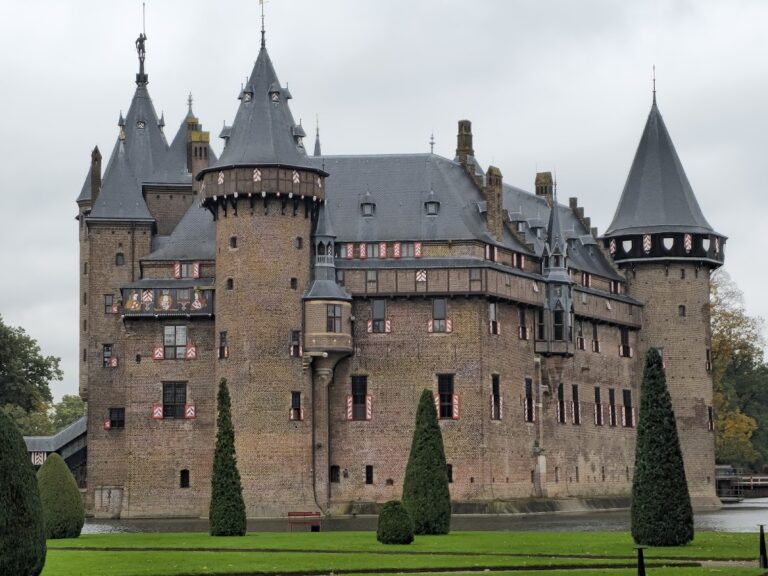
Nijenrode is enclosed by a moat and surrounded by water, reflecting its character as a water castle, a fortified or aristocratic residence protected in part by surrounding water or water-filled channels. Two drawbridges provide access to the castle. The central part of the complex contains the main tower, a courtyard, and associated outbuildings, while the grounds also include a gatehouse and a coach house. The castle combines medieval defensive architecture with later residential construction and retains Dutch Renaissance features. Repeated rebuilding, enlargement, and alteration have shaped the complex over time, while its interiors were renewed and adapted for educational use.
Gatehouse and coach house
The gatehouse forms the entrance to the estate and belongs to the later development of the complex. The coach house, restored during the ownership of Michiel Onnes, carries a relief of the knight Gisbregt van Nijenrode above its entrance. The building is also associated with the continuation of musical activity at Nijenrode, where performances took place after the concert tradition was revived in 2009.
Gardens and estate structures
The estate contains a garden pavilion and a park arranged with a labyrinth. Its other landscape features include an entrance gate, a service dwelling, a boathouse, a summer house, garden pavilions and ornaments, an orangery, greenhouses, a garden wall, a heating cellar with chimney, a water well, a garden vase, a playhouse, and a tennis house.
Further estate structures include a deer enclosure with a stable, a duck house, a feeding shelter, a pheasantry, and a volière, or aviary. The grounds also contain a longhouse-type farm, a landscape-style garden, a rose garden, and a kitchen garden with forcing houses. Together, these structures form an extended estate setting around the central castle complex.
Nearby sites