Fort V in Poznań: A Nineteenth-Century Fortress Work


Site at a Glance
- Rating
- 4.6
- Popularity
- Low
- Country
- Poland
- Primary era
- Modern
- External website
- Open
- Eras represented
- Modern
- Civilizations
- German
- Site type
- Military
- Remains
- Fort
On this page10 sections
History
Construction and modernization
Fort V in Poznań, Poland, was one of the 18 forts built for the Poznań Fortress, a nineteenth- and early-twentieth-century system of defensive works around the city. Hans von Biehler, a German military engineer and fortification designer, prepared its designs, and construction took place between 1879 and 1883 during the fortress system’s first building stage. The fort was named Waldersee I after Alfred von Waldersee, a German field marshal and military commander. It was also known as the Mycielski family fort.
After 1888, Fort V was modernized. Its front caponier, a fortified structure projecting into or beside a moat to fire along the ditch, was demolished and replaced by a reverse caponier, which protected the fort from the rear or gorge side. This solution was used only at Fort V within the fortress system. The fort’s walls and ceilings were strengthened during the same modernization phase.
Changing names and wartime use
In 1931, the fort’s patronage was changed from the German field marshal Alfred von Waldersee to the Polish Mycielski family, a Polish noble family. During the Second World War, Fort V was probably used first as a prison and later as a hospital.
During the Battle of Poznań, units of the 246th Infantry Regiment and batteries of 203 mm howitzers attacked Forts IVa, V, and Va from the north during the night of 13–14 February 1945. Fort V surrendered after 10 hours. Its garrison was evacuated, while approximately 250–300 wounded people remained in the fort.
Destruction and protection
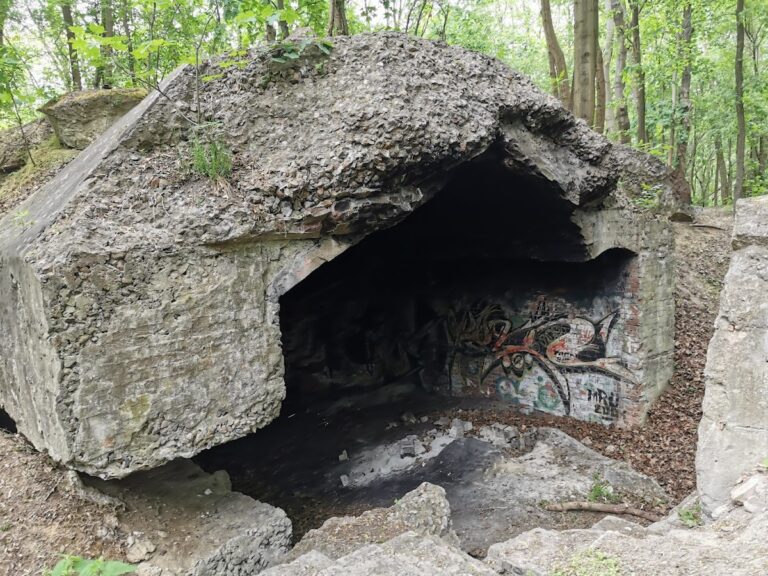
In 1939, a concrete observation-and-combat shelter was built beside the shelter of the left battery. During the war, the ditches were roofed and used as ammunition stores for the DWM, a German arms-manufacturing company, also known as H.C.P. After the war, Fort V was blown up and dismantled between 1952 and 1960. The remaining sections of the ditches were filled in as part of preparations for a northern bypass of Poznań, a project that was never built.
Fort V was entered in the heritage register as monument A-245 on 25 May 1983. Its grounds also form part of the Natura 2000 protected area “Fortifications in Poznań” (PLH300005).
Remains
Layout and defensive earthworks
Fort V stands in the Naramowice area, north of the Wichrowe Wzgórze housing estate, with the Za Fortem housing estate built to its north. The two sections of the front meet at an angle of 140 degrees. Their elongated shoulders created space for an infantry parapet, a raised protective earthwork behind which infantry could take cover. The fort’s powder magazine occupied a central position beneath the axial earthwork, the embankment along the main axis, beside the central postern, or covered passage through the fortification.
The earth battery on the right shoulder was originally arranged with six gun positions and was later enlarged to ten. An earth battery is a gun emplacement protected chiefly by earthworks. On the central remise, a covered military shelter associated with artillery positions, an observation post designated P.B.St.87 was built within the artillery rampart.
Surviving structures and access routes
Front caponier
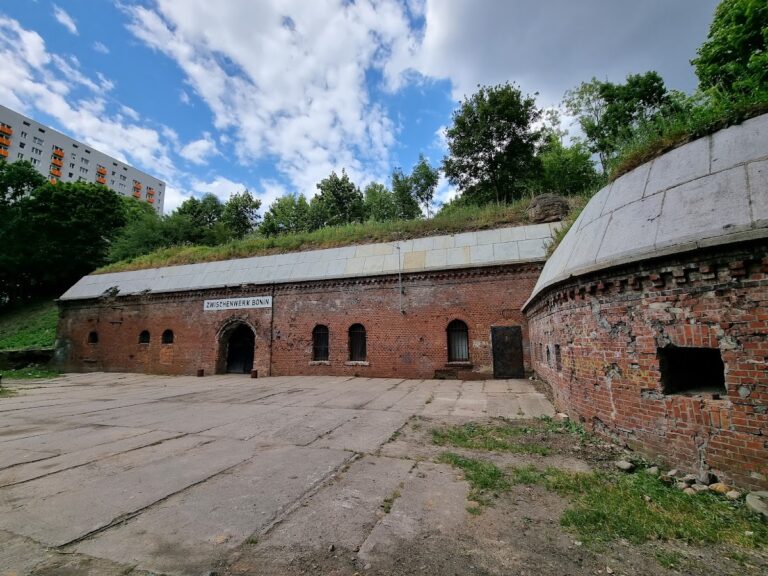
A front caponier survives with partial roofing. It is the remaining physical expression of the fort’s original ditch-defense arrangement, before the structure was replaced by the reverse caponier during modernization.
Artillery exits
Both artillery exits leading to the parade ground remain. They preserve part of the internal connection between the artillery positions and the fort’s central open area.
Observation post
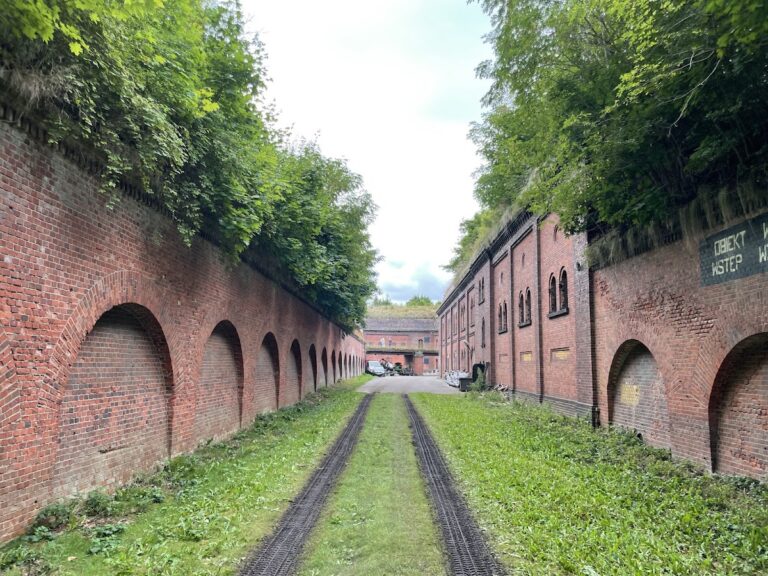
Remains of the P.B.St.87 observation post survive in the central remise of the artillery rampart. The fortification road leading to Fort V is partly preserved, while the road running along the wider line of fortifications corresponds to present-day Lechicka Street.
Nearby sites