Burg Plau: A Medieval Castle and Fortress in Germany


Site at a Glance
- Rating
- 4.3
- Popularity
- Very Low
- Country
- Germany
- Primary era
- Medieval
- Eras represented
- Medieval, Early Modern, Modern
- Civilizations
- Holy Roman Empire
- Site type
- Military
- Remains
- Castle
On this page11 sections
History
Burg Plau is a medieval lowland castle in Germany, standing at the northeastern edge of Plau’s old town beside Lake Plau. Built under Nikolaus II von Werle in the late thirteenth century, it began as a princely residence before becoming a fortified ducal stronghold and Mecklenburg’s first state fortress.
Princely foundation and Werle rule
The castle was first mentioned in a document issued there on 6 May 1287, which described it as newly completed. Its construction created immediate tension with the town because several houses and part of the urban area had to be surrendered for the new residence. The dispute ended in 1288 when the townspeople paid a substantial penalty. In return, Nikolaus II confirmed Plau’s municipal rights and promised support for replacing the town’s mainly wooden palisades with a solid wall.
A Vogt, an official who could hold administrative, judicial, and military responsibilities, named Johannes Koß had been recorded at Plau in 1273. The historian Georg Christian Friedrich Lisch later suggested that Johannes, also known as Henning von Plau, may have built the castle while serving as Vogt in 1303 and 1304. This attribution remains a supposition rather than an established fact.
Control of Plau shifted among the Werle dynasty and its creditors during the following decades. Nikolaus II pledged his possessions at Plau to the knight Hermann Ribe from 1293 to 1295 and to Wizlaw II, Prince of Rügen, until 1298. After Nikolaus died, the property passed in 1316 to his brother Johann II von Werle and in 1337 to Johann’s son Nikolaus III.
In 1356 Nikolaus III and his brother Bernhard II pledged the castle, town, and surrounding territory to Duke Albrecht II of Mecklenburg. During a conflict with Duke Erich II of Saxe-Lauenburg, Erich captured the castle on 24 August 1358. Peace followed in October, but Albrecht did not redeem Erich’s claim until 31 March 1359, when he paid 200 marks of fine silver. On 2 June 1361, Albrecht subpledged the castle to Heinrich von Stralendorff, Otto von Dewitz, and Danquardt von Bülow. The von Bülow family retained it as a pledge until March 1403.
Expansion under Mecklenburg
After the House of Werle became extinct in 1436, its territories were reunited with Mecklenburg through the agreement of its co-heirs, Johann III and Heinrich of Mecklenburg-Stargard. Duke Heinrich IV strengthened his position at Plau by acquiring land from the town on 8 May 1442, enlarging the castle moat on the northern side.
In 1448 Heinrich IV commissioned Lüdeke Hahn, his former Vogt at Stavenhagen, to transform the princely house into a fortified castle. The work responded to repeated raids from the nearby Mark Brandenburg, including attacks associated with the brothers Dietrich and Johann von Quitzow. Following a survey and building consultation on 30 May 1448, Hahn took possession of the castle and territory as Vogt on 24 August. The rebuilding had advanced enough for him to move into the castle by 21 October 1449.
Heinrich IV settled Hahn’s remaining debt of 1,600 Lübeck marks on 13 January 1463, after which Hahn returned to his family estate at Basedow. On 16 February 1464 the duke granted the castle for an initial six years to his eldest sons, Albrecht VI and Johann VI of Mecklenburg. The property also formed part of Margarete’s widow’s provision and was designated as her residence for the years 1466 to 1471.
The vineyard and the ducal fortress
Viticulture began at Plau on 28 July 1507, when the jointly ruling Dukes Heinrich V and Erich II appointed Hans Peetz, also called Pietsch, as a vineyard servant. Peetz obtained vines in Franconia in 1508, and Paul Khune, or Köne, became a second vintner in 1511. The vineyard moved in 1513 from land north of the castle to the more suitable southern slope of Klüschenberg, using ground ceded by the town. Khune became vineyard master in 1527, Hans Brandenburg succeeded him in 1532, and the ultimately unsuccessful cultivation ended in 1571. The reversal of the agreement with the town was not completed until 1767.
A more lasting transformation began on 1 May 1538, when Heinrich V contracted the mason Wulf Krebel to construct a new gatehouse and gun house according to plans by Gabriel Wulf of Boizenburg. The castle was expanded into a major fortress. Its parapets were raised, its walls strengthened, and the northern moat deepened. Under a contract dated 7 September 1541, the hydraulic engineer Diedrich Bergmann created additional moats along the western and southern sides facing the town. These works made the castle effectively an island.
The fortress became the first ducal state fortress. A drawbridge connected it with the town wall near the northern town gate, while soil excavated from the moats raised the surrounding rampart. Ludwig Wichtendal, an experienced red-brass founder, gunsmith, and master of weapons, was appointed to the fortress. In 1543 Lüdecke von Maltzahn of Grubenhagen was charged with strengthening its walls. The garrison in 1550 comprised a captain, a weapons master, a watch master, and ten Landsknechts, professional infantry soldiers commonly employed by European rulers, together with servants and other support staff.
After Heinrich V died on 6 February 1552, his nephew Johann Albrecht I of Mecklenburg-Güstrow had the fortress occupied by Werner Hahn of Basedow. A succession dispute between Johann Albrecht and his brother Ulrich ended with the Ruppin ruling of 1556. Plau and its fortress then passed to Ulrich’s inheritance. In 1582, a long period of peace was blamed for declining attention to fortress service, and the duke issued regulations to restore peacetime discipline.
Renewed defenses and the Thirty Years’ War
When Johann Albrecht II gained sole rule of Mecklenburg-Güstrow in 1611, he renewed attention to Plau. In 1612 he appointed a powder maker and converted the outer mill on the Elde into a powder mill. Three years later he appointed a rampart master, an official responsible for maintaining defensive earthworks, to repair the neglected defenses. The Plau office and fortress were pledged to Land Marshal Andreas Buggenhagen on 20 April 1617 and to Land Councillor Gregor Bevernest of Lüsewitz in 1625.
The Thirty Years’ War, the major European conflict of 1618 to 1648, brought repeated sieges, occupations, requisitions, plundering, and disease to Plau. The town and fortress experienced eight sieges. A company of Danish cavalry occupied them for 24 weeks during the winter of 1626 and 1627. Three companies of Imperial troops captured the fortress on 9 and 10 August 1627, and about 300 Imperial infantry under Colonel Rudolph, Baron von Tiefenbach, remained through the following autumn and winter with support from the inhabitants.
Gregor Bevernest, although he served on the Imperial council appointed by Wallenstein, surrendered his pledge on 10 July 1629. Imperial commanders and troops continued to occupy the town and fortress. Pappenheim’s regiment arrived on 19 September, troops under Heinrich Johann Guyard, Baron of Saint Julien, followed, and Savelli’s regiment brought plague to Plau on 29 November. The epidemic killed about 600 of the town’s approximately 1,500 inhabitants during the following year, while the fortress remained under Imperial control.
Swedish troops entered Plau on 30 June 1631 and besieged the fortress, placing artillery on the church tower. The Imperial captain Horchhammer responded by setting fire to the Burgtor quarter. Scottish troops under Colonel Robert Munro of Obsdale, serving in the MacKay Regiment, reinforced the Swedish force and compelled the Imperial garrison to withdraw under an agreement allowing free passage. Additional Swedish and French-Swedish units quartered in the town during 1631 and 1632.
Once Imperial troops had been driven from Mecklenburg, the fortress was found nearly devastated and was repaired on the duke’s orders. Swedish troops retreating under Field Marshal Johan Banér reoccupied and plundered it on 28 October 1635. Gregor Bevernest was arrested after being forced to surrender the fortress and died in June or July 1636.
Electoral Saxon troops under Commander Caspar Haschitz captured Plau on 12 November 1635 and stormed the fortress three days later. Johann Caspar von Rohrscheidt became commander, but he surrendered it to Swedish troops under Kaspar Kornelius Mortaigne de Potelles on 3 October 1636. Further occupations involved forces under Erasmus von Platen-Hallermund and Colonel Gustav Gustavson. The town chronicle records thirteen Imperial and two Swedish plunderings in 1636.
Imperial forces expelled the Swedes in the autumn of 1637. Under Captain Erasmus Warasiner, a garrison of 270 soldiers held the fortress until late July 1639 and further strengthened its defenses. Warasiner ordered the tower of St. Mary’s Church to be demolished for building material, but General Matthias Gallas stopped the work with a counter-order on 25 April 1638. Instead, fifty houses were demolished, and fifty inhabitants with five teams of draft animals were compelled to provide labor.
Swedish troops under Lieutenant Colonel Peder Lindormsson Ribbing, Baron of Zernava, besieged the fortress from 23 July 1639. Warasiner surrendered on 5 August. The Swedish captain Ulrich Reppenhagen commanded until 14 April 1642, followed by the majors Erich Turssohn and Christoph Trapman. Trapman handed the fortress and town-gate keys to the ducal councillor Joachim von Nessen on 18 August 1650, returning the site to ducal control.
Decline, dismantling, and later uses
By 1650 the buildings and defenses were already in poor condition. On 3 January 1651 Duke Gustav Adolf, under his mother’s guardianship, withdrew the guards and handed the town keys to the magistrate. The fortress had lost its military importance and stood almost empty. A proposed demolition failed in 1657 because renewed unrest and troop movements during the Swedish-Polish War made the defenses temporarily relevant. After the Peace of Oliva in 1660, however, parts of the fortifications and buildings were dismantled between 1660 and 1668.
The outer ring wall, small watchtowers, gatehouse, gate vault, and arsenal ruins were removed, while the inner rampart walls and castle tower survived. The Plau office subsequently passed through a series of pledges to creditors of the Bevernest family, the Hamburg merchant Johann Erlenkamp and his sons, Joachim Christoph Stisser of Wendhausen, and Gottlieb Heinrich von Brandt and his creditors. The Prussian pledge ended in 1787.
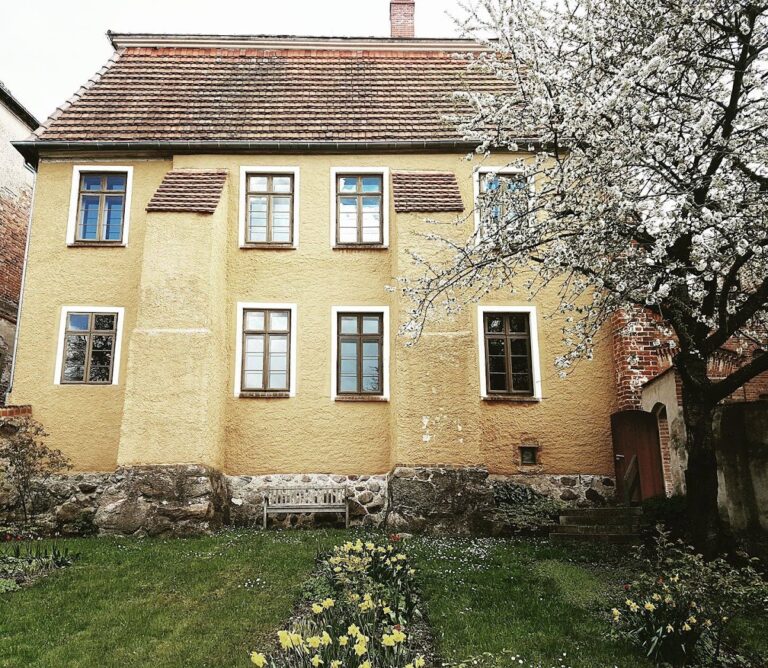
That year Duke Friedrich Franz I appointed Carl Friedrich Schnell as ducal office secretary. After the domain office moved to Goldberg in 1810, Schnell received the abandoned castle grounds in hereditary lease. His son Carl Christoph Schnell later became postmaster, and a new postmaster’s house was built in 1820 and 1821 on the foundations of the former arsenal. A postal station operated there with daily routes to Krakow am See, Malchow, Meyenburg, and Parchim. By 1883 or earlier it had moved elsewhere, and the grounds were thereafter used only for agriculture.
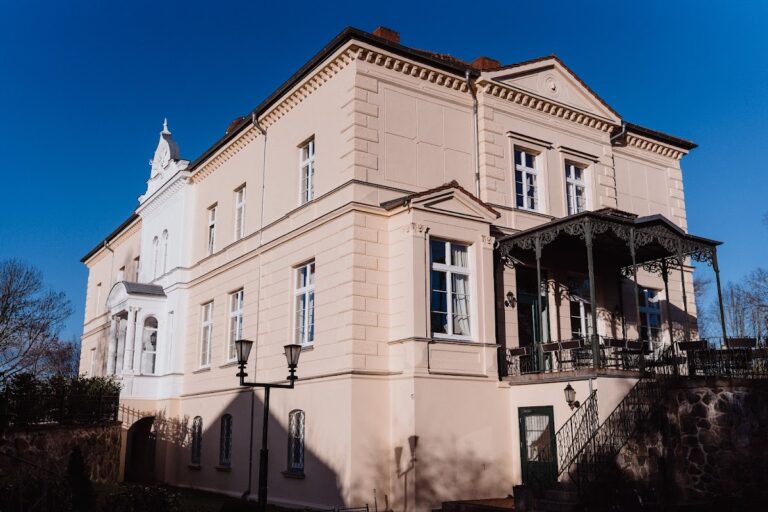
The site acquired new civic functions in the twentieth century. A pig-fattening facility installed in the courtyard in June 1952 was moved in late 1953 because of serious wastewater problems. The main building had served temporarily as Plau’s town hall from 1945 and later became an outpost of the nearby hospital, with 35 beds in ten rooms. It opened in November 1954 and operated until 1994, most recently as a senior citizens’ home from October 1991. The building later housed several uses, including the town library until the end of 2016.
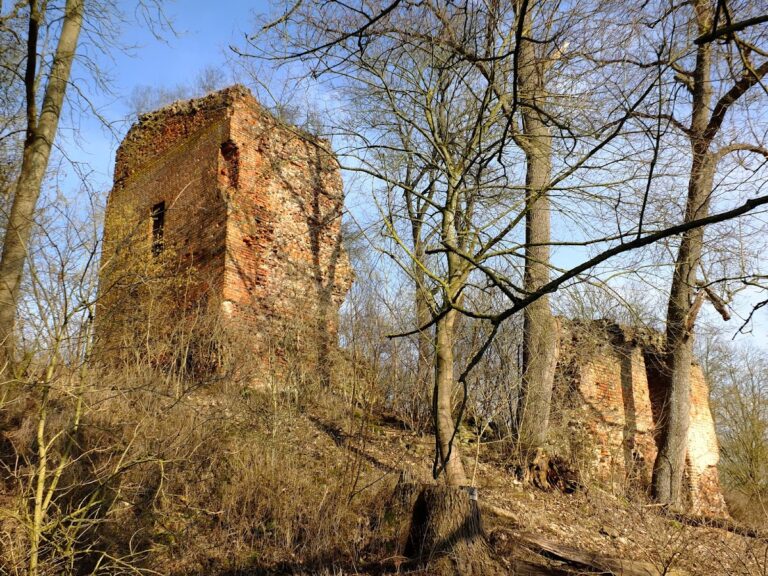
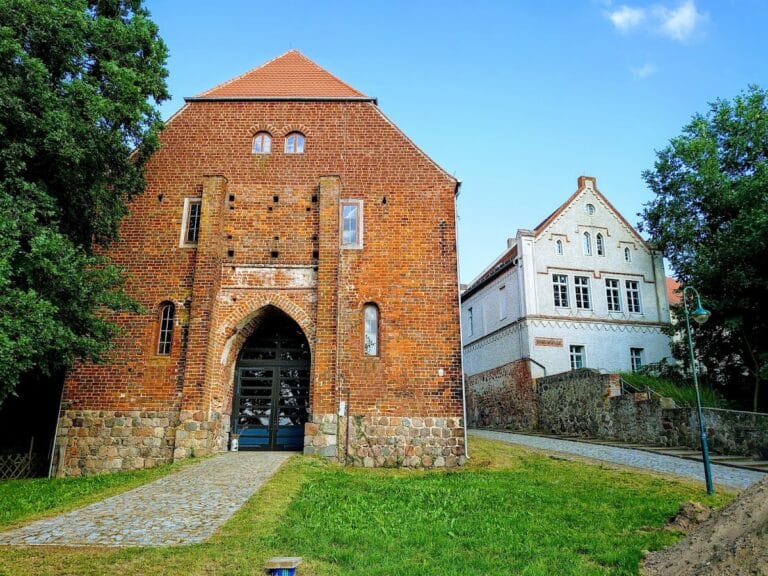
The former barn has housed the Plau Castle Museum since 2002. Restoration of the main building began in 2017 and was completed in 2019, preparing it for use as a public visitor center, town information office, and library. The castle tower was repaired in 1869 during the rise of castle romanticism, when its upper wall crown and battlements were rebuilt. Frost damage later caused further deterioration, including the collapse of a large section of masonry in 1917. A conical roof added in the early 1920s gave the tower its present appearance. Further repairs in 1985 cleared rubble from its 11-meter-deep dungeon, and the tower has since served as a museum.
Remains
Burg Plau occupies a lowland setting on the northeastern edge of the old town beside Lake Plau. Its original arrangement is largely lost, but the surviving castle grounds preserve the tower, ramparts, sections of rampart walls, the main building, the postmaster’s house, and later agricultural and service structures. The defensive layout was defined by a northern moat and by western and southern moats on the town side. Soil removed during their excavation was used to raise the ramparts, and the completed system made the fortress effectively an island.
The castle tower
The surviving castle tower was produced by the rebuilding of 1448 and 1449. It retains the core of the medieval fortified complex and now carries a reconstructed battlement crown from 1869. A conical roof was added in the early 1920s after earlier deterioration, including the collapse of a substantial section of masonry in 1917. Repairs in 1985 cleared rubble from the tower’s 11-meter-deep dungeon. The tower is now used as a museum and forms one of the principal surviving elements of the castle.
Moats, ramparts, and walls
The northern moat was enlarged during the fifteenth-century expansion and deepened during the fortress works of 1538. The western and southern moats were created along the side facing the town under the 1541 contract with Diedrich Bergmann. The fortress walls were built of fieldstone and were described in 1715 as approximately 14 feet thick. The defenses included raised earthworks, inner rampart walls, palisades, bastions, and an outer ring wall with small watchtowers. Much of this system was dismantled after the fortress lost its military purpose, but portions of the inner walls and the defensive earthworks remain.
Entrances and surviving passages
Access toward the northern town gate, also called the castle gate, used a drawbridge set within the town wall. A passage beneath the rampart survives from the direction of the former vineyard north of the castle and continued across a bridge over the moat. In 1715, a long, low, dark vaulted passage measuring about 70 paces led through the approach to the castle. The gatehouse and its vaulted passage belonged to the sixteenth-century fortress expansion but were later demolished.
Former arsenal and later buildings
The arsenal was among the structures dismantled after the fortress ceased to have military importance. Its foundations were reused for the postmaster’s house erected in 1820 and 1821. Later agricultural use added stables, barns, and sheds. Some ancillary buildings deteriorated and were demolished, while the former barn was adapted for the Plau Castle Museum in 2002.
The main building, postmaster’s house, surviving earthworks, and later service structures now occupy the former castle grounds. Restoration of the main building between 2017 and 2019 prepared it for public, civic, and cultural functions. Together with the tower and museum installations, these remains express the site’s successive uses as a princely residence, fortified stronghold, administrative center, postal station, agricultural holding, medical facility, residential-care home, and cultural institution.
Nearby sites