Castle Heimenburg, Hainburg an der Donau: A Danube Hilltop Fortress


Site at a Glance
- Rating
- 4.8
- Popularity
- Medium
- Country
- Austria
- Primary era
- Medieval
- External website
- Open
- Eras represented
- Medieval, Early Modern
- Civilizations
- Habsburg, Holy Roman Empire, Kingdom of Bohemia
- Site type
- Military
- Remains
- Castle
On this page9 sections
History
Castle Heimenburg, also called Hainburg, is a ruined hilltop castle in Austria above Hainburg an der Donau, whose new fortress was ordered around 1050 on Schlossberg. Its position above the Danube placed it near the historic border with the Kingdom of Hungary and enabled it to monitor shipping on the river.
Legend and the frontier castle
A foundation legend connects Heimenburg with Heimo, the cupbearer of Arnulf of Carinthia, a late ninth-century ruler of the East Frankish kingdom who later became emperor. Arnulf was said to have commissioned Heimo to build a church and castle at an earlier site in present-day Bad Deutsch-Altenburg. That predecessor castle was destroyed in 1042 by Heinrich III, the German king and later Holy Roman Emperor.
In 1043, the area formed part of the Hungarian March, a frontier territory on the eastern border of the German Empire. Bishop Gebhard took part in campaigns against the Magyars in 1044 and 1049, but the Magyars ravaged the castle in 1050. Around that time, at a court assembly in Nuremberg, Heinrich III ordered a new castle on Schlossberg at Hainburg and entrusted its rebuilding to Gebhard. The bishop was arrested in 1055 for joining a rebellion against the emperor. As the Hungarian March later lost importance, the military need for the castle may also have declined.
The chronicler Hermann of Reichenau described Heimenburg and Pressburg as densely populated cities. In 1065, the castle passed to the Counts of Sulzbach, and in 1188 it came to the Babenbergs, the dynasty that ruled Austria. Leopold V planned to enlarge the castle with ransom money received from Richard I of England, but construction began only after Leopold V’s death, under Duke Leopold VI, around 1200.
Babenberg residence and dynastic politics
From 1248, Margarete of Babenberg lived at Hainburg. In spring 1252, she married the 23-year-old Ottokar II Přemysl, king of Bohemia and margrave of Moravia, in Hainburg’s Pankratius Chapel. The marriage supported Ottokar’s claims to the Babenberg inheritance after the dynasty’s extinction. He frequently stayed at the castle, negotiated there with Béla IV, and built or enlarged its residential tower in 1260. After Margarete rejected Ottokar, she withdrew to Krumau am Kamp in 1261 and died there in 1266. Ottokar’s successor, Rudolf II, held further negotiations with the Magyars at Hainburg in 1277.
Habsburg rule and military transformations
Hainburg entered Habsburg possession in 1282 and was thereafter administered by appointed captains. From the middle of the fourteenth century, the castle and its associated lordship were pledged almost continuously to aristocrats. Between 1629 and 1652, Hainburg’s citizens held the pledge over the lordship.
Matthias Corvinus, king of Hungary, captured the castle in 1482, and Maximilian I of Habsburg recaptured it in 1490. Ottoman forces ravaged it in 1529. A major fire caused by lightning in 1569 was followed by reconstruction with bastions, projecting fortifications designed to provide defensive fire along the walls, and casemates, protected vaulted spaces for troops, weapons, or storage. Gábor Bethlen, prince of Transylvania, besieged Hainburg in 1619 and 1620, when the castle withstood three sieges.
During the Second Ottoman Siege in 1683, the castle complex was stormed. A reported 8,432 townspeople and refugees from the surrounding area who had sought shelter there were allegedly killed. Emperor Leopold I sold the castle in 1703 to Count Johann Jakob von Löwenburg, who began its restoration. The castle chapel was repaired in 1709. After 1742, the fortress declined as a military site because a new palace at the foot of Schlossberg made it militarily obsolete. The municipality purchased the ruins in 1977 and reconstructed them.
Remains
Hilltop setting and fortified layout
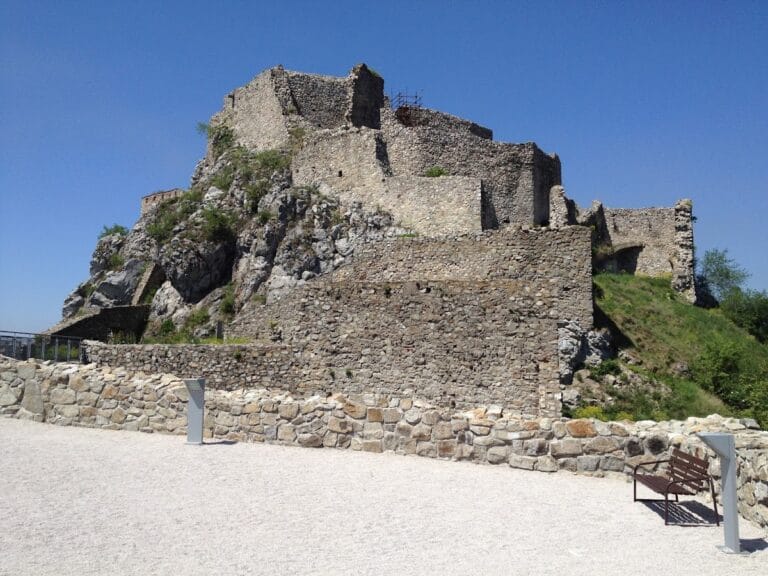
Heimenburg survives as a reconstructed group of castle ruins on Schlossberg above Hainburg an der Donau in Lower Austria. The hilltop position rises above the Danube and near the historic Hungarian frontier, while the fortress’s placement allowed control of river shipping. The present castle occupies the Schlossberg site selected to replace the earlier fortress at Bad Deutsch-Altenburg.
Chapel and residential buildings
Pankratius Chapel
Hainburg’s Pankratius Chapel, dedicated to Saint Pancras, an early Christian martyr, was the setting for Margarete of Babenberg’s marriage to Ottokar II Přemysl in 1252. The chapel was repaired in 1709 during Count Johann Jakob von Löwenburg’s restoration of the castle.
Residential tower and later defenses
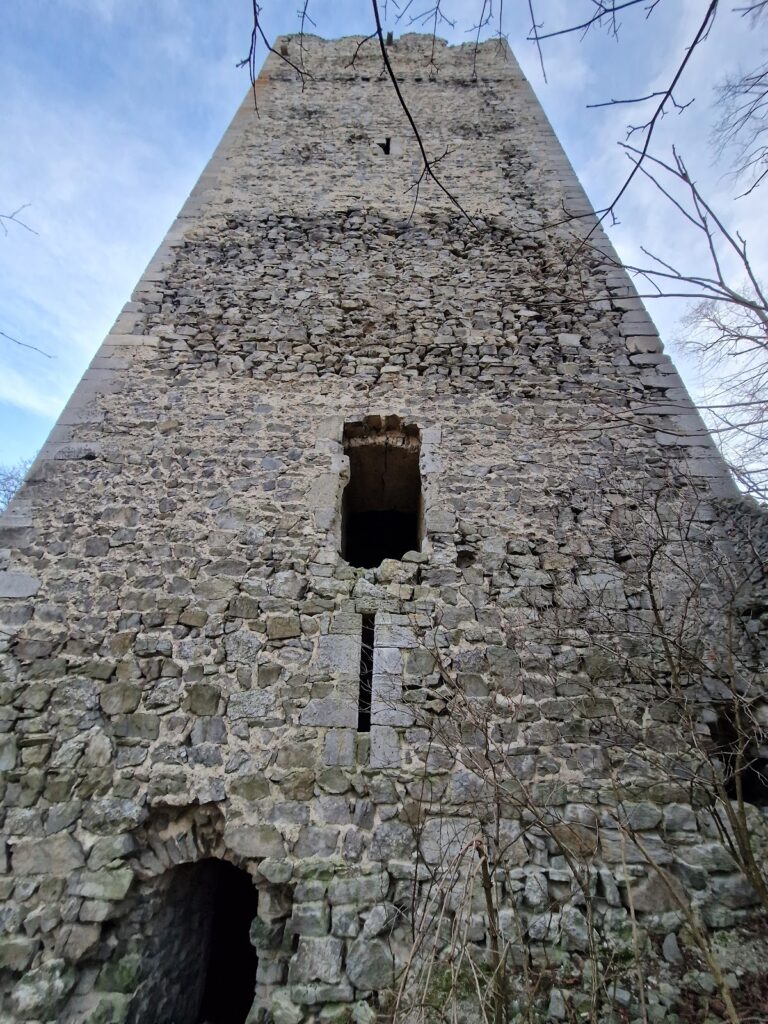
Ottokar II built or expanded the castle’s residential tower in 1260, strengthening the accommodation associated with his stays and negotiations at Hainburg. After the lightning fire of 1569, the fortress was rebuilt with bastions and casemates. These later defensive works form part of the surviving castle ruins, which underwent reconstruction after the municipality acquired the site in 1977.