Castle Batenstein: The Van Brederode Residence in Vianen


Site at a Glance
- Rating
- 4.6
- Popularity
- Very Low
- Country
- Netherlands
- Primary era
- Early Modern
- Eras represented
- Early Modern
- Civilizations
- Unclassified
- Site type
- Domestic
- Remains
- Castle
On this page15 sections
History
Castle Batenstein was a princely residence in Vianen, Netherlands, and the principal seat of the Van Brederode family. Its earliest construction date is uncertain, with 1286 and around 1370 both associated with the site. Around 1370, Gijsbrecht van Vianen left an earlier fortress and commissioned a new castle at the northwestern edge of Vianen, beside the River Lek.
From the Castle on the Bol to Batenstein
The earlier Castle on the Bol stood about 350 metres south of Vianen’s old town. Gijsbrecht van Vianen, a medieval lord, abandoned that fortress for the new residence. He was married to Beatrix van Egmond, also known as Beate or Bate, and the name Batestein may have been derived from her name.
The castle’s principal keep, known as the Saint-Pol Tower, was financed by the ransom Gijsbrecht received after capturing the Count of Saint-Pol at the Battle of Baesweiler in 1371. In 1414, Gijsbrecht’s granddaughter Johanna van Vianen married Walraven I van Brederode. Through this marriage, Batenstein passed into the possession of the Van Brederode family and became their principal residence. The Van Brederodes were a prominent noble family whose members held important military and political offices, including the viscountship of Utrecht and the title Count of Brederode.
Hendrick van Brederode and the Dutch Revolt
Under Hendrick van Brederode, a sixteenth-century nobleman and leader of the Geuzen, Batenstein reached its greatest splendour. The Geuzen were opponents of Spanish rule during the early stages of the Dutch Revolt. Hendrick expanded the castle into an extensive residential complex and created a Renaissance garden.
In 1565 and 1566, Hendrick van Brederode, William of Orange, and other opponents of the Spanish Crown met at Batenstein. The Geuzen gathered there to prepare and draft the Compromise of Nobles, a political petition presented in 1566 to Margaret of Parma, the Spanish-appointed Governor of the Netherlands. Hendrick later presented the petition to her.
In 1567, Vianen came under Spanish control. The city was dismantled, and the Van Brederode family’s goods were confiscated. After the Eighty Years’ War, the castle returned to the family, which had fought on the side of the States, the Dutch provinces opposing Spanish rule.
Seventeenth-century revival
Johan Wolfert van Brederode, a nobleman and field marshal in the States army, revived the neglected castle. Between about 1630 and 1650, he transformed it into a modern residence and enlarged its gardens. The States army was the military force associated with the Dutch provinces during the Eighty Years’ War.
Wolfert maintained close relations with the court of the princes of Orange. Among the prominent guests received at Batenstein were Prince Frederick Henry, Amalia of Solms-Braunfels, members of the Nassau and Solms families, the Viscount Dohna, and members of the States of Holland. Wolfert’s death in 1679 ended the Brederode lineage. The property first passed to the von Dohna family and then, in 1687, to Simon Henry, Count of Lippe, who was married to Amalia of Dohna-Vianen.
Fire, sale, and demolition
On the night of 11 to 12 September 1696, fireworks set off by a clerk in the courtyard caused one or more rockets to enter through an open window. The castle quickly caught fire, destroying much of the complex. Only the most important documents were saved.
Rebuilding was considered, but financial difficulties prevented it. In 1725, Simon Henry Adolph, Count of Lippe-Detmold, sold Batenstein and the lordship of Vianen to the States of Holland and West Friesland, the governing assembly of the province of Holland and the associated region of West Friesland. The furnishings, including about sixty paintings, were sent to his castle at Detmold. An inventory from 1685 had listed 250 paintings.
During the eighteenth century, the damaged castle served at different times as a barracks and military hospital. The Saint-Pol Tower was demolished in 1771. Demolition of the remaining castle fabric began shortly after 1828, while the furnishings and interior decoration were dispersed or lost. Some paintings from Batenstein remain at Braunfels Castle, and the Dohnas’ Brederode Room survived at Schlobitten Palace until that palace was destroyed in 1945.
Archaeology and garden reconstruction
The earlier Castle on the Bol was investigated between 1969 and 1971, when its remains were uncovered. A partial reconstruction of Batenstein’s gardens is being developed by the local foundation Hof van Brederode Vianen. The municipality made land available for the project in 2019, and the planned reconstruction draws on historical images, archaeological evidence, and cadastral sources, which are land and property records concerning boundaries, ownership, and land use.
Remains
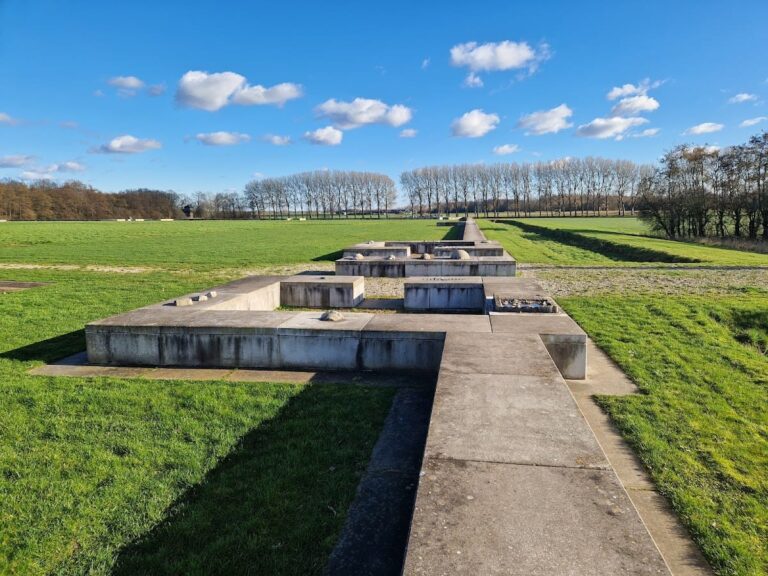
Castle Batenstein stood on the northwestern edge of Vianen beside the River Lek. The brick complex was organized around a large keep, the Saint-Pol Tower, with additional wings added during Hendrick van Brederode’s expansion. Its gardens developed from a Renaissance layout into extensive ornamental grounds reaching toward the river. The surviving remains include the Hofpoort, a pump dated 1648 on the Hofplein, and parts of the castle walls.
Earlier fortress and castle complex
Castle on the Bol
The earlier Castle on the Bol consisted of an irregular octagon about 30 metres in diameter. A moat, a ditch intended to hinder access, surrounded the fortress, and a tower stood at its southwestern corner. Archaeological investigation in 1969 to 1971 uncovered remains of the site.
Saint-Pol Tower
The Saint-Pol Tower was the great keep of Batenstein and dominated the castle complex. It was financed through the ransom obtained by Gijsbrecht van Vianen after the Battle of Baesweiler in 1371. Several wings were later built around the tower, creating the extensive residence associated with the Van Brederodes. The tower was demolished in 1771.
Hofpoort and surviving fabric
The Hofpoort, or Court Gate, dates from around 1650 and belongs to Johan Wolfert van Brederode’s rebuilding campaign of about 1630 to 1650. It formed a decorative connection between the residence and its gardens and now links the Lekdijk, known locally at this point as the Langendijk, with the Voorstraat. Parts of the castle walls also survive, together with a pump dated 1648 on the Hofplein.
Gardens and interiors
Castle gardens
Hendrick van Brederode laid out a Renaissance garden at Batenstein. Johan Wolfert later enlarged it into large ornamental grounds extending toward the Lek. Their design was inspired by the gardens developed by Prince Maurice and Prince Frederick Henry around The Hague, including the Buitenhof and Honselaarsdijk. Historical images, archaeological evidence, and cadastral records provide the basis for a partial reconstruction of the gardens.
Interior furnishings
The residence had richly furnished interiors, with walls covered by tapestries and gold wallpaper. Paintings formed a major part of the decoration, with the 1685 inventory listing 250 works. Historical representations, including paintings by Jan van Goyen from 1624 and approximately 1630, preserve evidence of the castle’s appearance.
Amaliastein country estate
Amaliastein was a separate country estate built west of Vianen around 1560 by Hendrick van Brederode for his wife, Amalia of Neuenahr. Johan Wolfert van Brederode substantially developed its gardens in the seventeenth century. The estate was demolished around 1830. A sundial, part of the woodland, and the moated grounds survive, while seventeenth- and eighteenth-century maps and drawings preserve evidence of its former layout.