Artilleriewerk Naters: A Swiss Fortress Artillery Work


Site at a Glance
- Rating
- 4.7
- Popularity
- Very Low
- Country
- Switzerland
- Primary era
- Modern
- External website
- Open
- Eras represented
- Modern
- Civilizations
- Swiss
- Site type
- Military
- Remains
- Fort
On this page9 sections
History
Artilleriewerk Naters is a former Swiss fortress artillery work in Switzerland, built from 1939 to defend the Brig transport junction, the road over the Simplon Pass, and the northern portal of the Simplon Tunnel during the Second World War. The installation formed part of the Upper Valais fortress area of Border Brigade 11 and entered service in stages, with troops occupying its first completed sections in 1940. Together with the Brig-Simplon Tunnel and Simplon Axis positions, it belongs to a group classified as military-historical monuments of national importance.
Alpine routes and earlier defenses
The strategic value of the Alpine crossings increased after Napoleon Bonaparte, the French emperor and military leader, crossed the Great St Bernard Pass in May 1800 during his second Italian campaign. General Antoine de Béthencourt crossed the Simplon with 1,000 men during the same period. Napoleon then ordered a road over the Simplon in September 1800, and the road was completed in October 1805. These developments strengthened the military and transport importance of the routes later defended from Naters.
Defensive preparations along the Simplon route preceded the construction of Artilleriewerk Naters. A machine-gun position was installed at the newly opened northern portal of the Simplon Tunnel in 1906, while work on Fort Gondo, on the Simplon Pass road, began in 1909. These positions formed part of the strategic setting in which the larger wartime fortress system was developed.
Construction and wartime role
The fortress, designated A 9000 by the Swiss Army, was built to control the Brig basin and the northern tunnel portal. Its artillery covered the exit from the Goms, a valley in Upper Valais, and the Simplon region. Two additional western guns later extended its fire toward the Simplon Pass road. The original armament consisted of four 7.5 cm guns. Between 1941 and 1943, a new western section received two 10.5 cm fortress guns, allowing the pass road to be engaged by artillery fire.
Artilleriewerk Naters was operated by Fortress Company 26 of Mountain Brigade 11. From 1978, responsibility passed to Fortress Battalion 26 of Border Brigade 11, which included Fortress Artillery Company 26, Fortress Detachment Company 26, and Infantry Company I/26. The installation was repeatedly modernized after its wartime construction. Its last regular military refresher course took place in the 1990s, and the fortress was released from military secrecy in 2002.
From military installation to museum
The municipality of Naters purchased the fortress from the Swiss Confederation in 2005. Since 2008, the Association of Friends of the Fortress has operated it as the Simplon Fortress Museum. Some rooms were adapted for wine and cheese storage, while other military spaces were given new cultural uses. Two former ammunition magazines for the 10.5 cm guns have housed the Swiss Guard Museum since 2006. A cultural space opened in 2011, and from 2012 the Kulturfels presented image sequences while the film hall showed accounts by 555 contemporary witnesses of the Second World War. The Swiss Crystal Museum opened in 2016, and the fortress museum expanded in 2018 with displays on the medical room, mortuary, Swiss National Bank currency reserves, and fortress guards.
Artilleriewerk Naters belonged to a wider defensive network. The Brig-Simplon Tunnel position protected the northern portal within a system of roughly 20 objects. During the Second World War, preparations were made on both sides of the national border for the possible destruction of the tunnel tubes. Part of the system was disarmed in 1997, and explosive charges beneath the tracks in the Swiss section were removed in 2001. The Simplon Axis positions extended from Schallberg near Ried-Brig to San Marco near Gondo on the Italian border. The Simplon Pass position included more than 20 standardized installations and also has national military-historical importance.
Remains
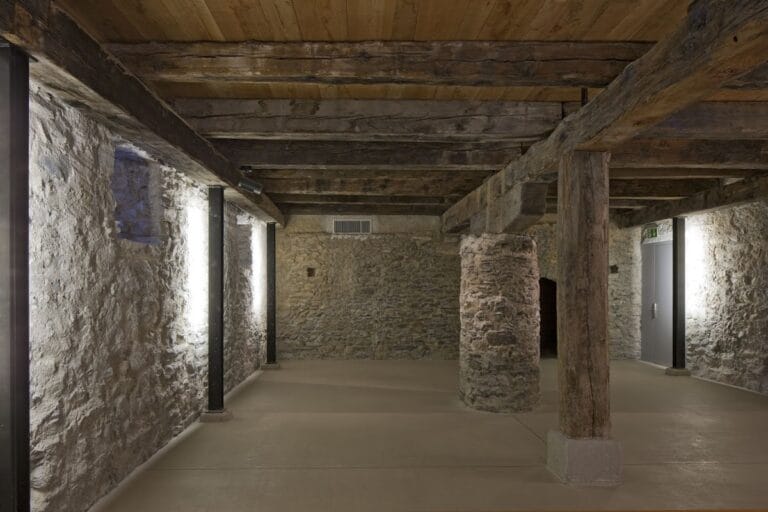
Artilleriewerk Naters is a rock installation built on two levels above Naters, on the north side of the transport routes and the Brig junction. A narrow road reaches the fortress, whose interior contains approximately one kilometre of galleries connected by cross-passages. The installation covers about 4,000 square metres and preserves both combat positions and the working spaces needed to sustain a garrison. The museum route leads through 15 locations containing original fortress equipment.
Galleries and internal facilities
The galleries contain artillery positions, a ventilation room, a machinery room, a mortuary, kitchens, a dining hall, sleeping quarters, an officers’ mess, a detention cell, a post room, a fire-control station, and communications centers. The machinery room held three Sulzer ZG 3 marine diesel engines. The fortress also contained an air-defense evaluation center. In the eastern section, a small room served as a treasury for gold and valuables belonging to the Swiss National Bank. Former military rooms now present displays about the fortress, the Second World War, the bank reserves, medical facilities, the mortuary, and fortress guards.
Outer defense
The outer defense used eastern and western flank bunkers that covered one another. These caponiers were protected fortifications projecting from the main defensive position, allowing fire along or across approaches. The eastern caponier held a machine gun. The western caponier combined a 9 cm antitank gun with a machine gun. Twenty-millimeter antiaircraft guns protected the eastern and western sides of the installation, and a barricade could close the access road. The fortress provided accommodation for as many as 200 personnel.
Simplon Tunnel defenses
The fortress was physically associated with the defenses of the Simplon Tunnel’s northern portal. The tunnel system included entrance structures for a machine-gun position, a large mine chamber about one kilometre from the northern portal, and protected accommodation for the demolition detachment. A long gallery led from that accommodation toward the demolition target. Grilles and armored gates could close the tunnel tubes.
Near the Italian border, at the center of the tunnel, a small barracks contained lighting equipment for inspecting trains. The tunnel defenses also included a derailment device and two demolition installations. Together, these structures connected the artillery work above Naters with a broader system designed to control movement through the tunnel and prepare it for destruction if military circumstances required.
Former ammunition magazines
The two former magazines built for the 10.5 cm guns now house the Swiss Guard Museum. The Swiss Guard is the military corps that serves as the pope’s personal guard and protects Vatican City. Their conversion preserves the original underground spaces while giving them a new museum function within the fortress complex.