Vechten Fort: A Nieuwe Hollandse Waterlinie Defence Fort in the Netherlands


Site at a Glance
- Rating
- 4.5
- Popularity
- Low
- Country
- Netherlands
- Primary era
- Modern
- External website
- Open
- Eras represented
- Modern
- Civilizations
- Dutch
- Site type
- Military
- Remains
- Fort
On this page11 sections
History
Vechten Fort is a Dutch military fort in the Netherlands, built between 1867 and 1870 as part of the Nieuwe Hollandse Waterlinie, a defensive system that combined controlled flooding with forts and other works. It formed part of the forward defensive line east of Utrecht, where its 19th-century fortifications addressed the difficulty of defending the relatively high Houtense Vlakte.
Defending the Houtense Vlakte
The waterline relied on inundation to create a broad defensive barrier, but flooding could not completely cover the Houtense Vlakte. Vechten Fort was therefore positioned to close this vulnerable area. Its location east of Utrecht was also intended to hinder artillery attacks on the city and on defensive works farther behind it.
The fort had a further role if an enemy broke through. Retreating Dutch troops could be received inside Vechten Fort, regroup there, and potentially begin a counter-offensive. Nearby Rijnauwen Fort was assigned the same function, linking the two strongpoints within the wider defensive system.
Roman predecessor and frontier
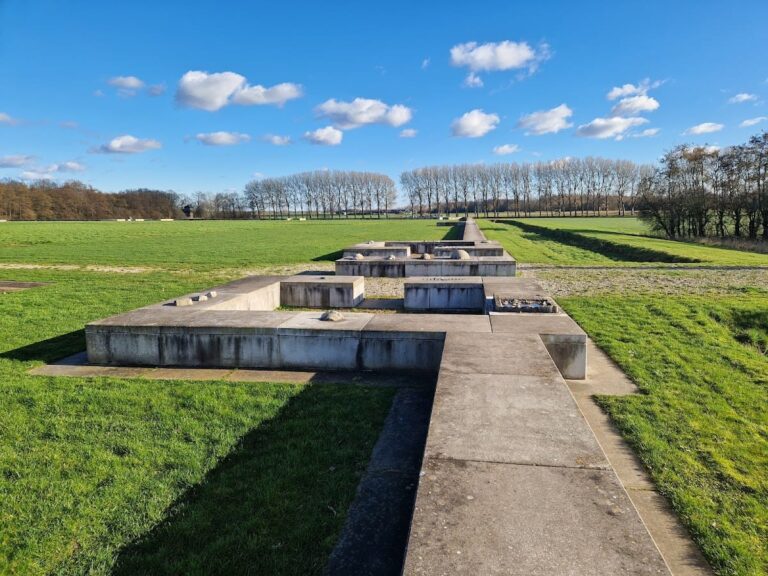
Construction brought Roman remains to light, both beneath the fort and in its immediate surroundings. During the Roman period, a military fort known as Fectio stood at the site. A votive stone, an inscribed offering connected with religious practice, was found in 1869. A modern memorial stone beside an access road marks the former Roman frontier zone, or limes, and its associated military infrastructure.
Military storage and later use
From 1950 to 1996, Defence used Vechten Fort as the 150th depot for non-ferrous and ferrous metals, as well as rubber inner and outer tyres. Staatsbosbeheer has owned the fort since 1996. The Waterlinie Museum Fort bij Vechten opened there on 10 October 2015, and the complex now combines museum, nature, and activity functions. Vechten Fort is protected as a national monument. Twenty-four components are entered in the national monuments register, while ten further components of the Nieuwe Hollandse Waterlinie in the surrounding area, including the intermediate positions toward Hemeltje Fort and Rijnauwen Fort, also have protection.
Remains
Layout and defensive system
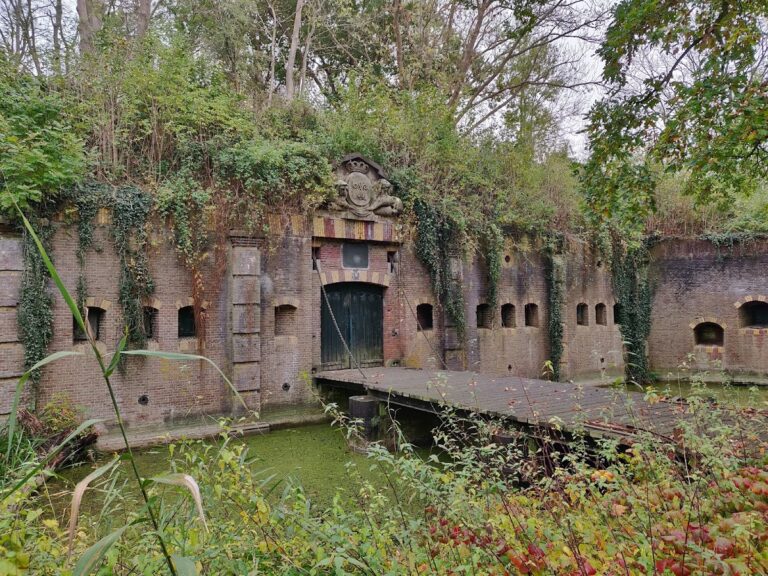
Vechten Fort covers approximately 23 hectares within its boundary markers and 17 hectares inside the moat. A broad, deep moat surrounds the complex, while a high rampart encloses the interior. The fort combines polygonal and bastioned defensive systems and includes 22 buildings constructed with approximately 16 million bricks. Its principal elements include flank and reverse batteries, a bombproof barracks, guard buildings, protected storage buildings called remises, a redoubt, and a glacis, the gently sloping outer defensive earthwork that exposed attackers to fire from the fort.
Several flank batteries are built into the rampart. These gun positions were designed for close defence and could direct fire across the moat around the fort. Reverse batteries covered the rear side of the defensive work. On the western, rear side, three bridges once crossed the moat. All three have disappeared and were replaced by an earthen dam.
Inner defensive work
Five-sided redoubt
The five-sided redoubt is a brick defensive structure surrounded by its own moat. Its thick walls were intended to protect the garrison if other parts of the fort were captured, while guns inside could fire on an enemy who had entered the complex. Numerous loopholes pierce its exterior walls, and a large postern, a protected passage through a fortification, occupies the centre.
The redoubt contained its own kitchen, drinking-water supply, accommodation rooms, and magazines. These provisions enabled the garrison to continue resisting for a long period and made the structure a final defensive position within the larger fort.
Roman and natural features
Roman remains
The Roman remains associated with Fectio form an earlier archaeological layer beneath and around the later fort. The votive stone found during construction in 1869 provides a surviving object connected with the Roman-period military settlement.
Bat habitat
The fort grounds support five bat species: whiskered bat, Natterer’s bat, common pipistrelle, brown long-eared bat, and Daubenton’s bat. These habitats form part of the present natural character of the former defensive complex.
Nearby sites