Gleiberg Castle: A Medieval Hilltop Fortress in Germany


Site at a Glance
- Rating
- 4.6
- Popularity
- Medium
- Country
- Germany
- Primary era
- Medieval
- External website
- Open
- Eras represented
- Medieval, Early Modern
- Civilizations
- Holy Roman Empire
- Site type
- Military
- Remains
- Castle
On this page10 sections
History
Gleiberg Castle is a ruined hilltop fortress in Germany, on the 308-metre Gleiberg in Wettenberg, Hesse. Used by the Conradines, an influential noble family in the early medieval East Frankish and German kingdoms, the site developed into the seat of the County of Gleiberg in the tenth century. Its surviving structures reflect medieval rebuilding and later sixteenth-century additions.
Conradine stronghold and the County of Gleiberg
The Conradines used Gleiberg as a fortified site. The fortress may have been built by Otto, brother of King Conrad, as a stronghold against the Popponids, a rival aristocratic family associated with the region, although this attribution remains uncertain. In 949, Heribert of the Wetterau made the castle his residence and established it as the center of the County of Gleiberg.
After Heribert’s death, the castle passed to his son-in-law Friedrich, who founded the Luxembourg line of counts. Gleiberg is considered a possible birthplace of Empress Cunigunde around 980. Cunigunde later became a Holy Roman Empress in the early eleventh century.
Destruction and dynastic division
King Henry V captured Gleiberg Castle in 1103 and ordered its destruction. Henry V was a medieval German king who also became Holy Roman Emperor. The fortress was rebuilt during the twelfth century after a second line of the Counts of Gleiberg separated from the Counts of Luxembourg.
Clementia of Gleiberg, a twelfth-century noblewoman, founded the Augustinian Canons’ foundation on Schiffenberg near Gießen in 1129. After the Counts of Gleiberg became extinct in the late twelfth century, control of the castle and county was divided. Hartrad II of Merenberg received the western half, while the eastern half passed to the Counts Palatine of Tübingen, high-ranking territorial lords whose title originally referred to authority exercised for a ruler.
The Merenbergs later acquired the eastern half, and Gleiberg remained their seat for about 150 years. When the Merenberg line ended with the death of Hartrad VI, the castle passed to the House of Nassau-Weilburg in the fourteenth century. It became the center of the territory known as the Land on the Lahn, although it no longer served as a residence.
Destruction, exchange, and preservation
Troops of Amalie Elisabeth, the ruling landgravine of Hesse-Kassel, destroyed Gleiberg Castle in 1646 during the Thirty Years’ War, the European conflict fought from 1618 to 1648 through religious, dynastic, and territorial struggles. Since the castle no longer had military importance, it was not rebuilt.
On June 30, 1816, the ruin passed by exchange from the Duchy of Nassau to the Kingdom of Prussia. During the eighteenth and nineteenth centuries, students of the University of Gießen frequently marched to Gleiberg. The Gießen Free Students’ Association, now the Gießen Student Fraternity Adelphia, was founded in the ruin on May 7, 1870.
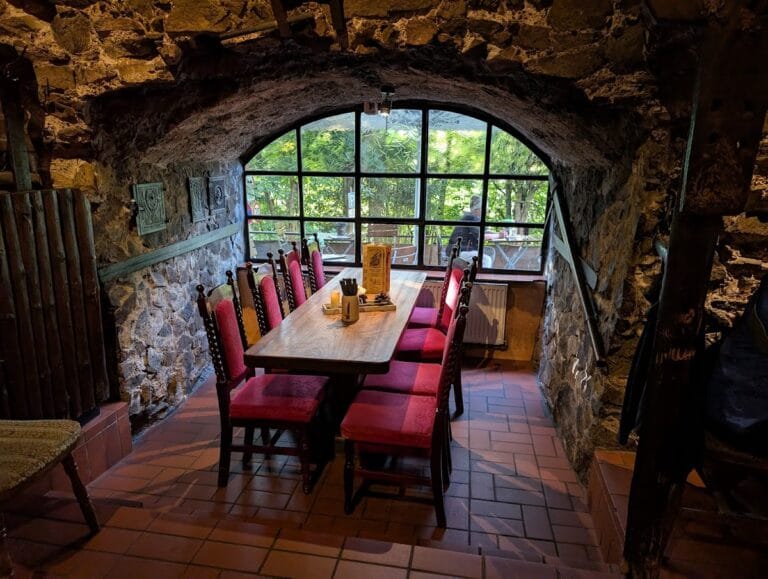
The inn at the foot of the castle was known in the sixteenth century as Zur Spiesspforte and has been called Zum Schwarzen Walfisch since about 1860. The Gießen Wingolf was founded there on August 15, 1852, and tradition also identifies the inn as the founding place of the Gesangverein Hermanus Gleiberg in 1879. The Gleiberg Association has owned the ruin since 1879 and preserves it. Gleiberg Castle is designated as a cultural heritage monument in Hesse. The keep underwent thorough renovation in 2013.
Remains
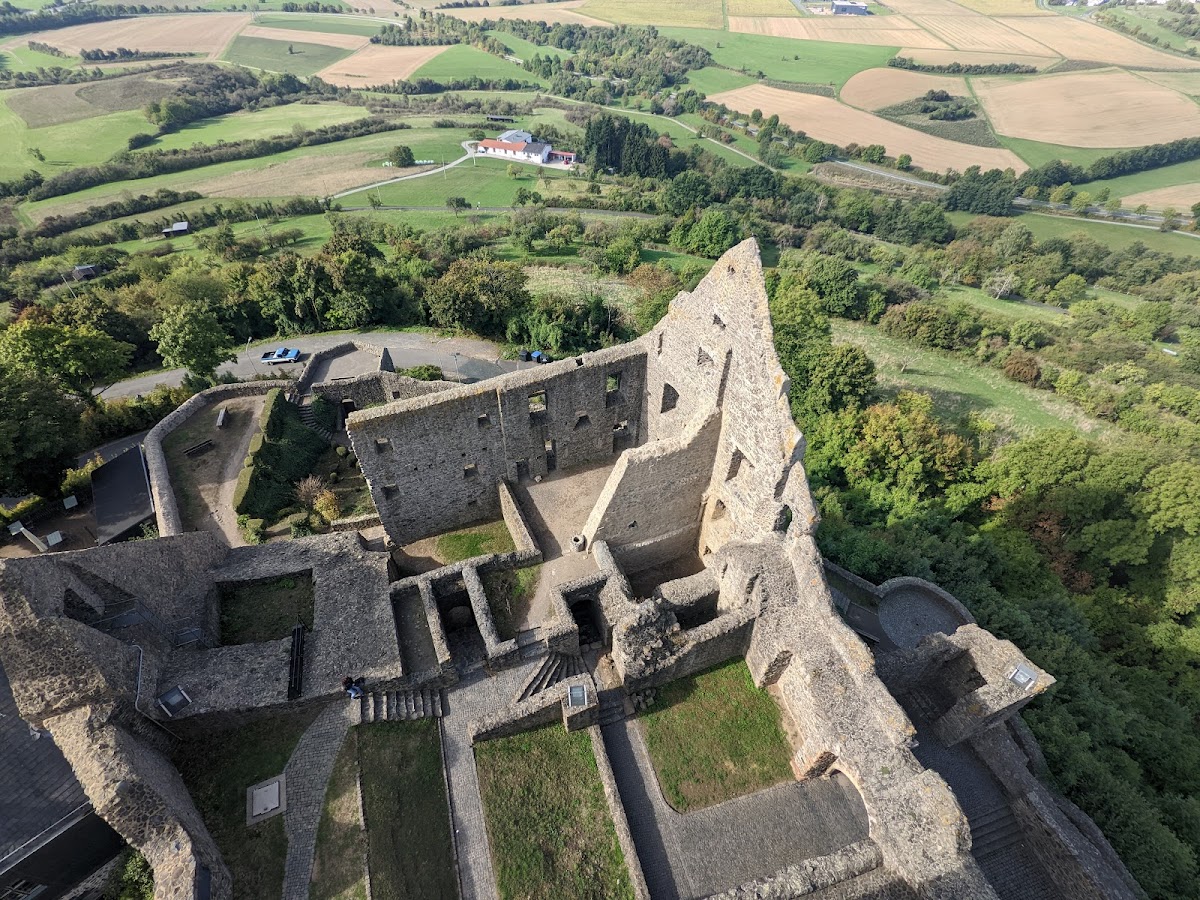
Gleiberg Castle occupies slightly higher ground on the hill and forms an independently defensible complex enclosed by a surrounding curtain wall, a defensive wall around the castle. The remains comprise an Upper Castle dating to about 950 and a Lower Castle built in the sixteenth century. The Albertus Building and Nassau Building were added in the Lower Castle during the second half of the sixteenth century.
Upper Castle
Keep
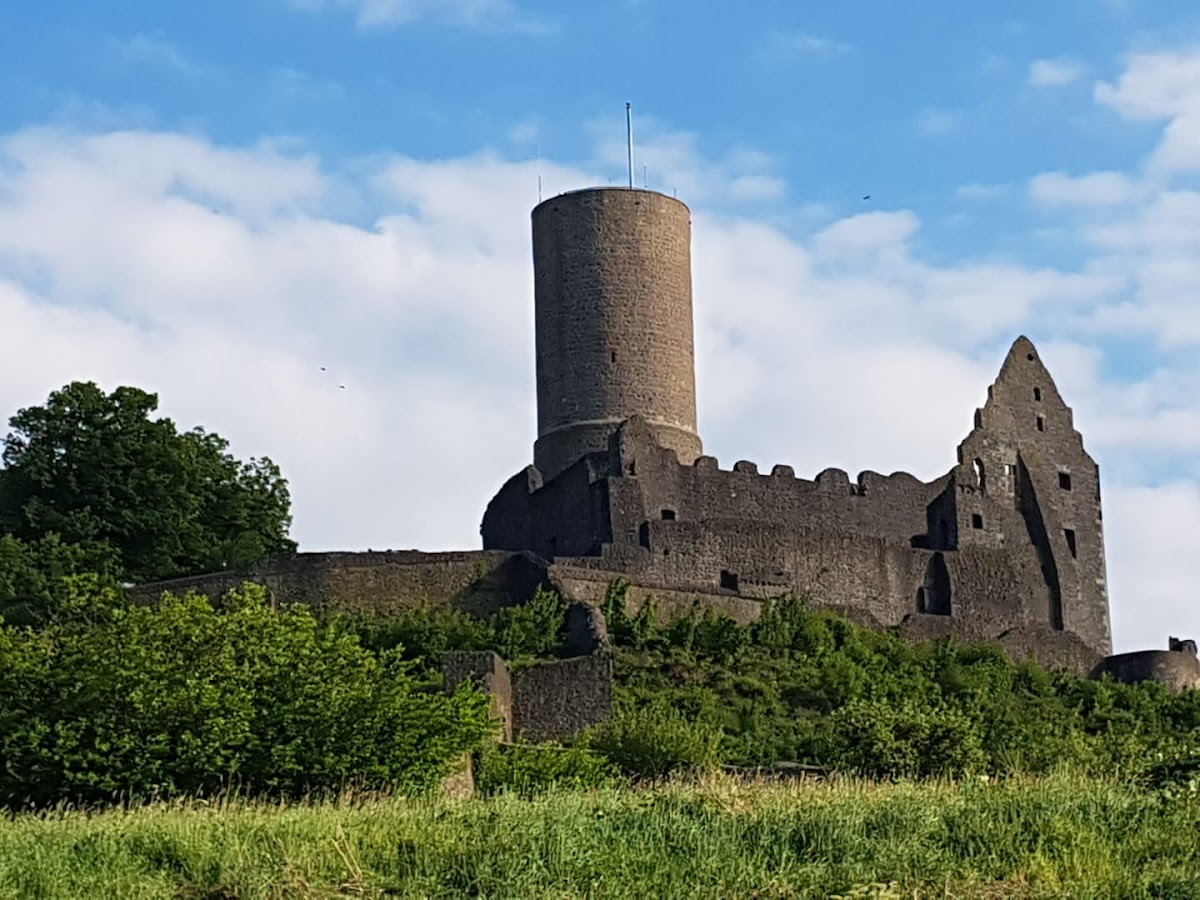
The keep, the castle’s principal fortified tower, was built around 1200. It rises 30 metres and has a projecting, rounded mantle wall. At the level of the former high entrance, 15 metres above the ground, the tower is about 12 metres in diameter. Above that point it narrows to 11 metres, while the walls are just over 4 metres thick at the present entrance.
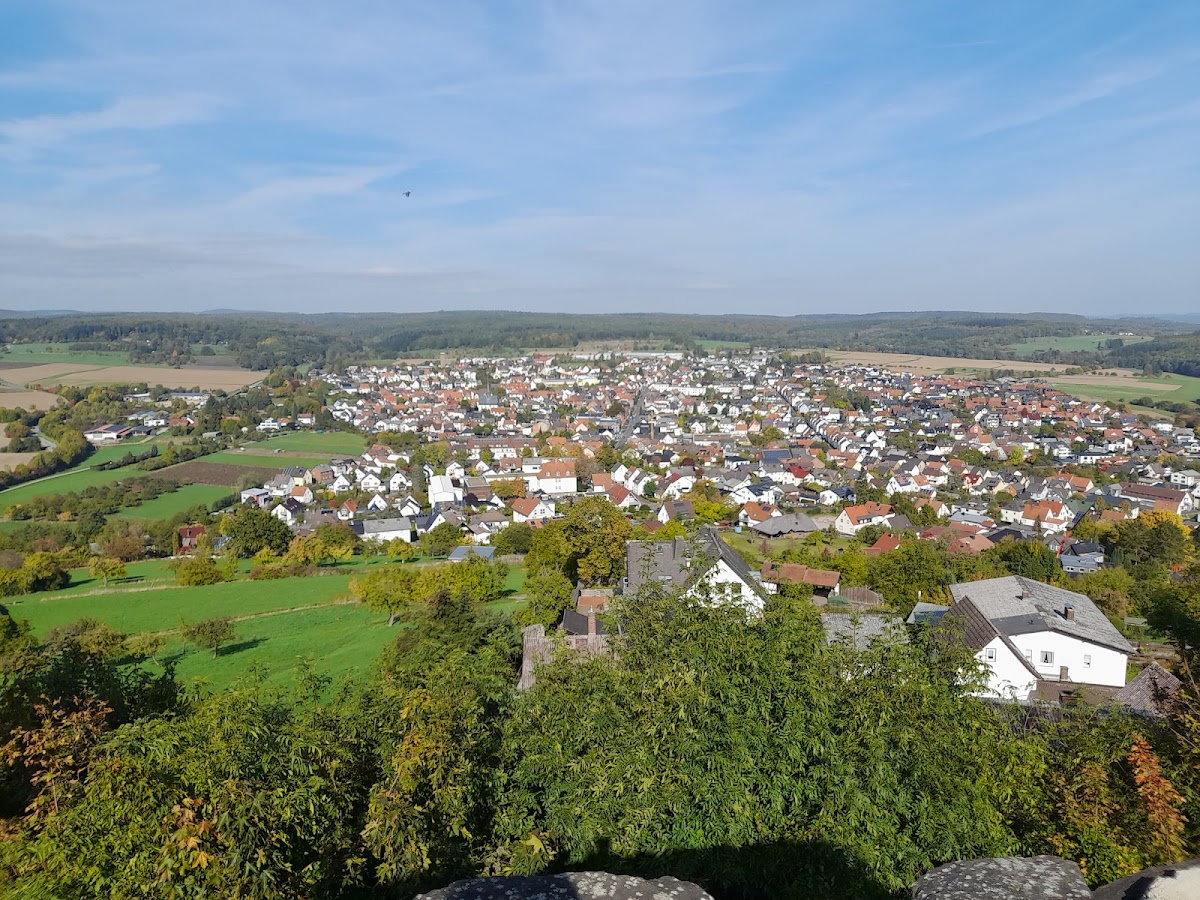
A concrete staircase of 150 steps leads through the keep to the viewing platform. The final 54 steps form a counterclockwise spiral staircase. The interior diameter expands from 3.7 metres to 5.7 metres, after which the stairway continues through straight sections and landings to a roofed exit on the platform. Motion-sensor lamps illuminate the stairway, and a glazed opening in the platform floor provides additional light. A metal-grid pyramid protects the opening, and a permanently installed telescope stands on the platform. Views extend across the Gießen Basin toward the Vogelsberg, Westerwald, and Taunus.
Palas
The Palas, the main residential and representational building of a medieval German castle, survives as a thirteenth-century ruin. Its gable wall remains standing, together with pointed-arch doorways. Light slits in its vaulted cellars are also visible.
Lower Castle
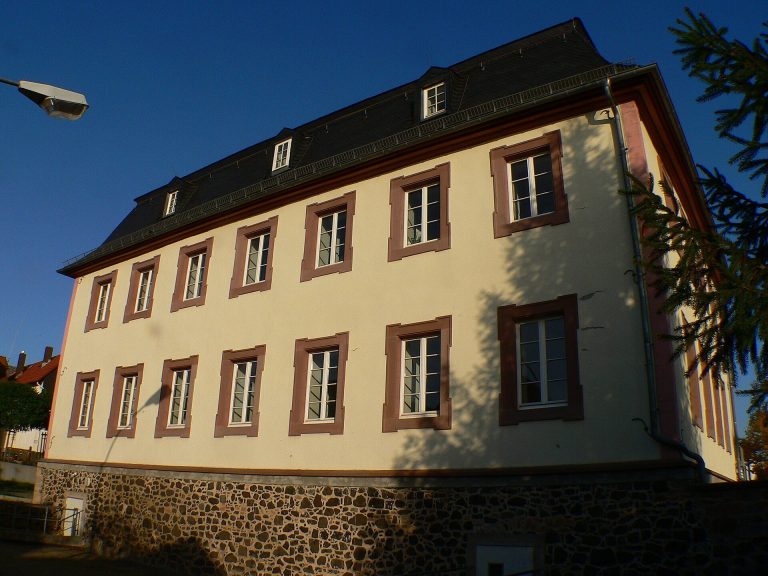
The Lower Castle was built in the sixteenth century within the enclosing wall. Its Albertus Building and Nassau Building date from the second half of that century, forming the principal surviving architectural group from the castle’s later period.
Nearby fortified site
The ruin of Vetzberg Castle lies between Gleiberg and the Dünsberg. It was formerly a second castle belonging to the Counts of Gleiberg.