Castillo de Encinas de Esgueva: A Medieval Fortress and Grain Silo in Spain


Site at a Glance
- Rating
- 4.4
- Popularity
- Low
- Country
- Spain
- Primary era
- Medieval
- External website
- Open
- Eras represented
- Medieval
- Civilizations
- Crown of Castile
- Site type
- Military
- Remains
- Castle
On this page6 sections
History
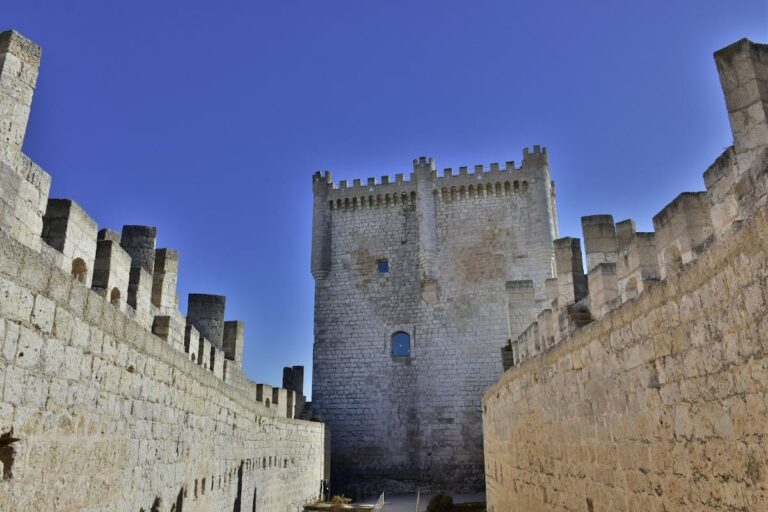
Castillo de Encinas de Esgueva is a medieval fortress in Spain, in the municipality of Encinas de Esgueva, Valladolid Province. Construction began in the fourteenth century, when the castle formed part of the defensive line of the Esgueva and helped protect access to the river valley.
Medieval lordship
The fortress originally belonged to the Merindad del Cerrato, a medieval territorial and administrative district in Castile. Alfonso Díez and Gonzalo Gutiérrez, medieval lords associated with the castle, held lordship over it. The coat of arms carved on its walls belongs to the House of Aguilar, a Castilian noble lineage.
Later ownership and agricultural reuse
The castle was inhabited in 1850 and was then owned by the Marquis of Lorca. In the mid-twentieth century, Cándido Moyano sold it to the Ministry of Agriculture. Through the National Wheat Service, a state grain organization under Francoist Spain, the administration rehabilitated the fortress for cereal storage. It entered service in 1945 within the National Network of Silos and Granaries and continued in use until the 1970s.
The municipal council of Encinas de Esgueva received the castle in 1994. It is now owned in equal shares by the municipality and National Heritage. The fortress is protected as an Asset of Cultural Interest, a formal Spanish heritage designation, and is included among the castles of Valladolid Province.
Remains
Fortified structure
The surviving building is a fortified structure with a recorded area of 575 square metres. It stands near the Encinas de Esgueva reservoir, and its walls preserve the Aguilar coat of arms, linking the physical remains to the noble lineage associated with the medieval castle.
Grain-storage adaptation
During its agricultural phase, the adapted fortress functioned as a silo, a building used to store bulk grain, with a capacity of approximately 1,200 tonnes. The building has since been completely restored, and its later use for temporary exhibitions has given the former grain-storage structure a new function.
Nearby sites