Castle of Canillas de Esgueva: A Frontier and Seigneurial Fortress in Spain


Site at a Glance
- Rating
- 4.5
- Popularity
- Very Low
- Country
- Spain
- Primary era
- Medieval
- External website
- Open
- Eras represented
- Medieval, Early Modern
- Civilizations
- Crown of Castile, Spanish
- Site type
- Military
- Remains
- Castle
On this page5 sections
History
A frontier in the County of Castile
Castle of Canillas de Esgueva in Spain defended Canillas de Esgueva as part of a strategic defensive line along the valley. In the late ninth century, Count Nuño Núñez, a nobleman associated with the early expansion and frontier organization of the County of Castile, established a defensive frontier there as a forward position facing territories already conquered in the Arlanza Valley.
A later seigneurial stronghold
The ruins visible today belong to a much later seigneurial castle or tower, probably built between 1487 and 1510, during the fifteenth or sixteenth century. The structure may have been associated with the Valladolid school of castle architecture, a regional architectural tradition. Its role therefore extended beyond the earlier frontier system, representing a later phase of fortified lordship in the valley.
Spain’s generic heritage declaration of 22 April 1949 protects the castle, which is also covered by Law 16/1985 on Spanish Historical Heritage and classified as a Property of Cultural Interest. The property is divided equally between the Canillas de Esgueva municipal government and Patrimonio Nacional, Spain’s public institution for administering and preserving assets belonging to the Crown and the state.
Remains
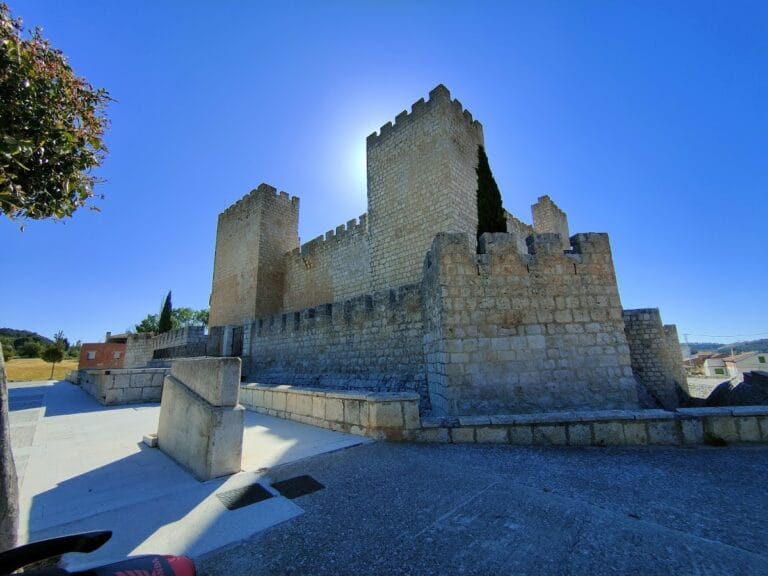
The surviving structure is now represented by two isolated corner towers from what was formerly the keep, the main fortified tower and the strongest defensive and residential element of a medieval or early-modern castle. A connecting section of wall stood between the towers until the 1970s, after which it disappeared. Together, the towers preserve part of the keep’s former outline and provide the principal physical evidence of the castle.
Surviving corner towers
Only two corner towers of the former keep remain standing as separate ruins. Their position identifies them as elements of the castle’s principal fortified block, while the loss of the intervening wall leaves the towers isolated within the surviving remains.
Nearby sites