Palacio de los Zúñiga: A Fortified Gothic Palace in Spain


Site at a Glance
- Rating
- 4.1
- Popularity
- Low
- Country
- Spain
- Primary era
- Medieval
- Eras represented
- Medieval
- Civilizations
- Crown of Castile
- Site type
- Military
- Remains
- Castle
On this page8 sections
History
Palacio de los Zúñiga is a fortified Gothic palace in Spain, in the town of Curiel de Duero, Valladolid Province. Construction began in the fifteenth century, and the lower castle of Curiel was completed in 1410 by Diego López de Zúñiga, founder of the powerful Castilian House of Zúñiga. The building belonged to the family and formed one of two castles associated with the town. The other, Castillo de Curiel de Duero, stands on a high promontory and was also owned by the Zúñiga family.
The Zúñiga palace and local justice
The palace was known as the “Palace of the Chief Justice” because it housed the administration of justice for the Community of Villa and Land of Curiel. This medieval and early-modern territorial institution linked a principal town with associated settlements through shared administrative and judicial arrangements. The palace retained this role until the disappearance of the Ancien Régime after 1812, when Spain’s pre-modern political and social order gave way to liberal constitutional changes.
Its history also includes the detention of notable prisoners. Among those held at the palace were the sons of Pedro I, the fourteenth-century king of Castile, the English nobleman and military figure John Hastings, 2nd Earl of Pembroke, and James IV, the medieval king of Majorca.
Traditions, ownership, and decline
A local tradition connects the palace with the Battle of Las Navas de Tolosa in 1212, when a Christian coalition defeated the Almohad caliph Muhammad al-Nasir, known by the title Miramamolín. According to the tradition, Christian knights from Curiel who took part in the battle brought back chains said to have surrounded the Almohad leader’s tent. The chains were later displayed on the palace walls during part of its prosperous period.
The property later passed to the ducal House of Osuna, which sold it in 1866 to Indalecio Martínez Alcubilla. It is now owned by the municipality of Curiel de Duero. During the second decade of the twentieth century, the palace underwent irreversible deterioration after valuable features, including plasterwork and coffered ceilings, were removed. Decorative elements were subsequently dispersed among the National Archaeological Museum in Madrid, a private estate in Torrelodones, the Alcázar of Segovia, and a location in California. The palace is registered as an Asset of Cultural Interest and appeared on the Red List of Endangered Heritage from 2016 to 2019. Its condition is progressively ruinous.
Remains
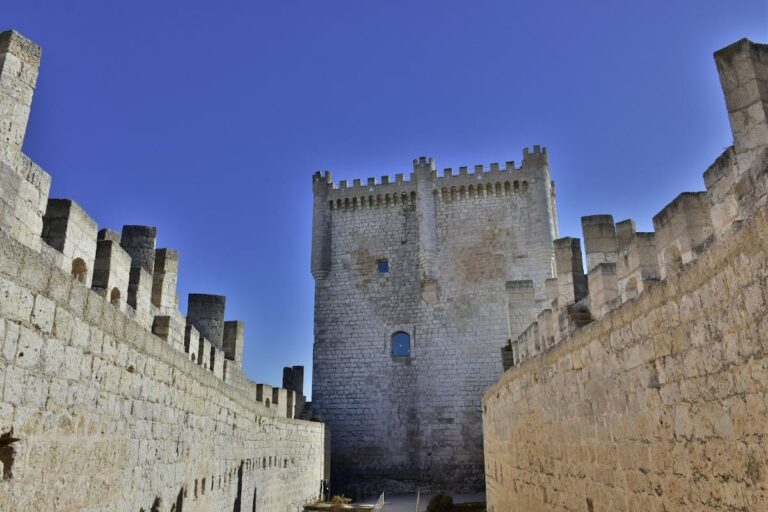
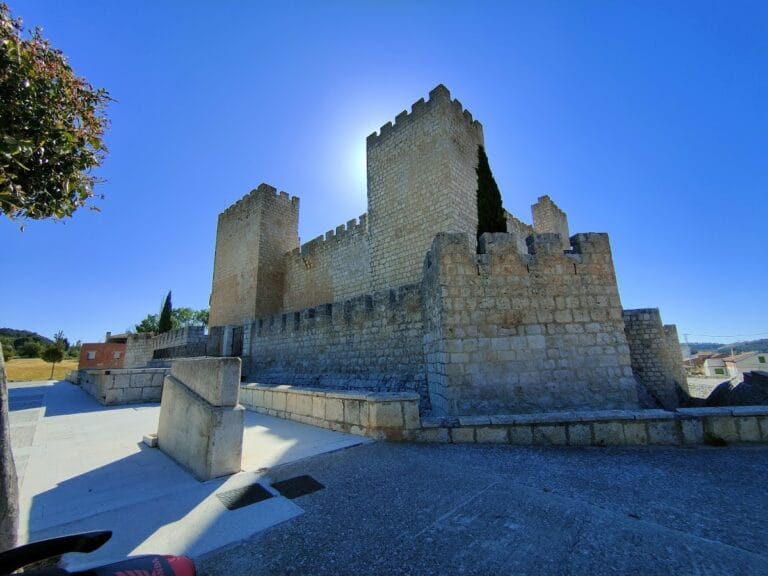
The palace was arranged as a rectangular fortified complex with large towers at its corners and a central courtyard surrounded by an arcade. The arcade was supported by octagonal columns. The interior has been destroyed, and the surviving fabric is described as the façade flanked by two towers, together with elements associated with the former entrance and the space before the building.
Façade and defensive entrance
Principal doorway
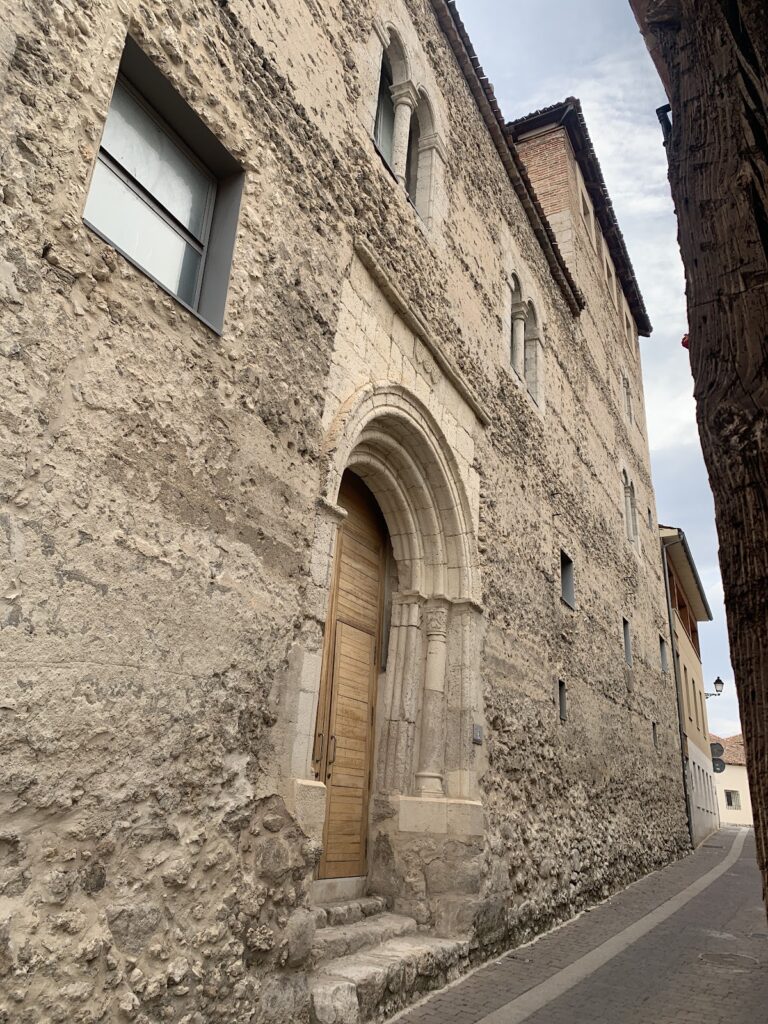
The principal entrance is a pointed arch formed from ashlar voussoirs, precisely cut masonry blocks arranged to create the arch. Above the doorway, a historical description records a projecting element approximately 35 feet high. It contained six openings and loopholes overlooking the entrance, allowing defenders to drop boiling water, stones, or other objects on attackers approaching the palace. The exact architectural name of this projecting feature was considered uncertain.
Justice Roll
A Justice Roll once stood in front of the palace. Such a monument publicly represented a town’s authority to administer justice. The roll itself has disappeared, but its steps remain before the building.
Dispersed interior decoration
The palace’s removed plasterwork and decorated coffered ceilings were separated from the building and relocated. A courtyard was reassembled at a private estate in Torrelodones, while one coffered ceiling was installed in the Alcázar of Segovia and another is located in California. Other decorative fragments are preserved in the National Archaeological Museum in Madrid.
Nearby sites