Castillo de Corbó: A Medieval Rock Castle in Spain


Site at a Glance
- Rating
- 3.9
- Popularity
- Very Low
- Country
- Spain
- Primary era
- Medieval
- Eras represented
- Medieval
- Civilizations
- Almohad
- Site type
- Military
- Remains
- Castle
On this page7 sections
History
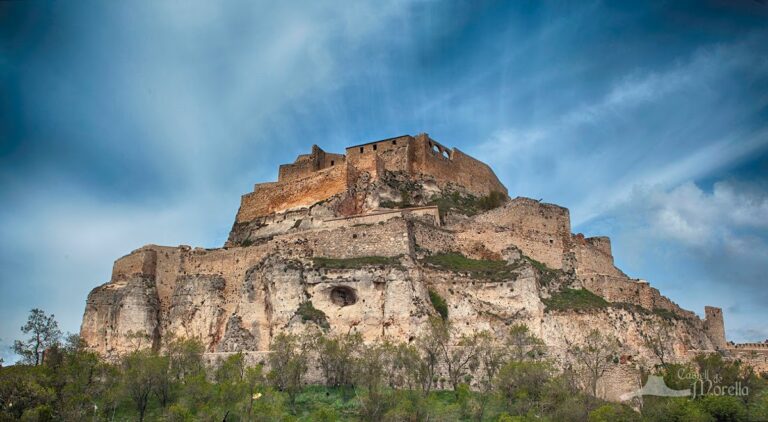
Castillo de Corbó is a medieval rock castle in Spain, northwest of Benasal, that was already standing in the twelfth century. The fortress occupied a strategic outcrop later controlled by Muslim forces, the Crown of Aragon, the Knights Templar, and the Order of Montesa.
Conquest and royal control
Peter II of Aragon conquered the castle from Muslim forces in 1210. By 1229, it was apparently in the possession of James I of Aragon, who transferred it by agreement to Abu Zayd, the former Muslim governor of Valencia and an ally of the Christian king. Documents from 1231 describe the castle as security for a loan taken out by James I, suggesting that it had probably returned to royal possession by then.
The 1239 Carta Puebla, a charter defining rights, duties, and settlement arrangements for a newly organized territory, placed Pedro Daroca as feudal lord of the mountain massif around the castle. Corbó formed part of the territorial district of Castillo de Culla, linking its administration to the wider organization of the surrounding lands.
Templar and Montesa domains
In 1303, the Knights Templar, a military religious order active in the Christian states of medieval Iberia, purchased Culla and its territories from the indebted Guillem de Anglesola. Corbó consequently became part of the Templar domains.
During the persecution of the Templars ordered by James II of Aragon, Corbó surrendered in December 1307 together with several other castles in the region. In 1319, it passed to the Order of Montesa, a later Iberian military religious order that received former Templar possessions in the Crown of Aragon. In 1321, the castle housed a garrison and a castellan, the governor responsible for administering and defending a medieval fortress.
Depopulation and protection
The castle was completely depopulated in 1612. Its historical and architectural value later brought it protection as a Bien de Interés Cultural, a Spanish designation for cultural heritage of special interest. The declaration dates from 25 June 1985, and the Valencian General Directorate of Artistic Heritage recorded it on 3 June 2002 under registration number R-I-51-0010797.
Remains
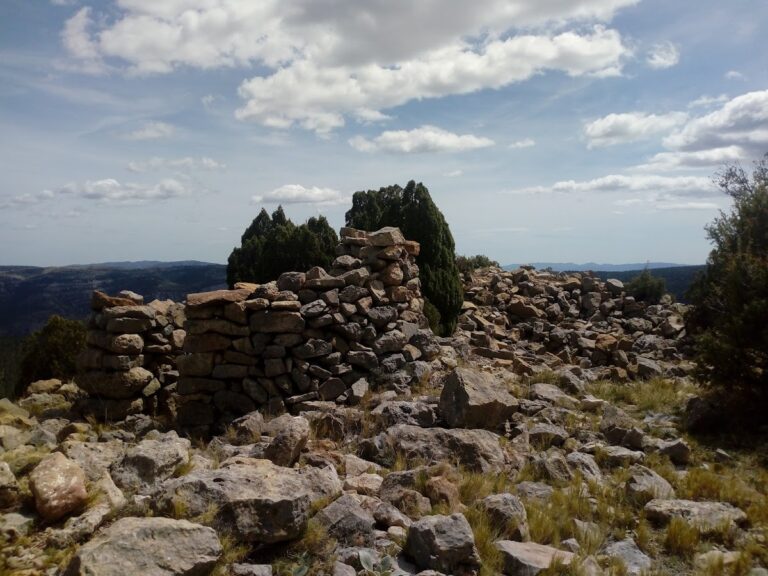
Castillo de Corbó occupies a rocky outcrop at about 1,060 metres above sea level, northwest of Benasal in Castellón Province’s Alto Maestrazgo comarca. It overlooks the headwaters of the Enramos ravine. The medieval fortification was practically inaccessible and is now completely ruined, with its surviving traces scattered across an extensive area.
Earlier occupation and defensive layout
The castle stands on a site first occupied during the Bronze Age and later used in the Iberian and Roman periods. A Muslim settlement also existed at the foot of the mountain. The medieval fortification consisted of a single walled enclosure, probably small, with two matching square-plan barbican towers, outer defensive structures protecting the entrance or a vulnerable approach. A main tower contained a cistern, a built tank for storing water. Only very limited sections of the walls survive. The southern side rises in a very steep slope, so the entrance was placed on the north side.
Local tradition
A local legend tells of an underground passage linking the castle with a cave at the foot of the mountain, where a spring emerges. The same tradition claims that great treasures remain hidden within the castle.
Nearby sites