Palacio de San Esteban: Former Jesuit College and Seat of Murcia’s Regional Government
Site at a Glance
- Popularity
- Medium
- Country
- Spain
- Primary era
- Early Modern
- Eras represented
- Medieval, Early Modern
- Civilizations
- Crown of Castile, Spanish
- Site type
- Civic
- Remains
- University
On this page10 sections
History
Palacio de San Esteban is a Renaissance complex in Murcia, Spain, founded in 1555 as a college of the Society of Jesus, the Catholic religious order commonly called the Jesuits. It became one of the order’s earliest colleges in Spain. Bishop Esteban de Almeyda of Cartagena helped establish it through financial support and personal initiative, and the college was named in his honor. Its main body was completed in 1557, followed by the church in 1569.
The Jesuit college
During Bishop Sancho Dávila’s episcopate, the Jesuits founded an adjoining College of Our Lady of the Annunciation in 1599. San Esteban became a center for religious, scientific, and humanistic learning. Its curriculum included grammar, philosophy, theology, scripture, and scholastic moral philosophy, which applied philosophical and theological reasoning to ethical questions. Over two centuries, students included figures from the Kingdom of Murcia, the historic territory in southeastern Spain, such as writer and historian Francisco Cascales and sculptor Francisco Salzillo.
Military, charitable, and devotional uses
After the Jesuits were expelled from Spain in 1767, the former college was used as barracks for a company of the Queen’s Dragoons, soldiers trained to fight on horseback and on foot. A charitable House of Mercy opened in the buildings in 1777, and an adjoining Provincial Asylum was built later. The complex was declared a National Monument, a Spanish heritage designation, in 1931.
A folk-costume museum operated in the building for a period and has since closed. In 1949, the Brotherhood of the Most Holy Christ of Mercy, a lay association organized around devotional activity, was founded. Its principal devotional image was a sixteenth-century crucifix by Domingo Beltrán, kept in the building. The brotherhood’s procession leaves from the church on Good Friday afternoons.
Government seat and archaeological discovery
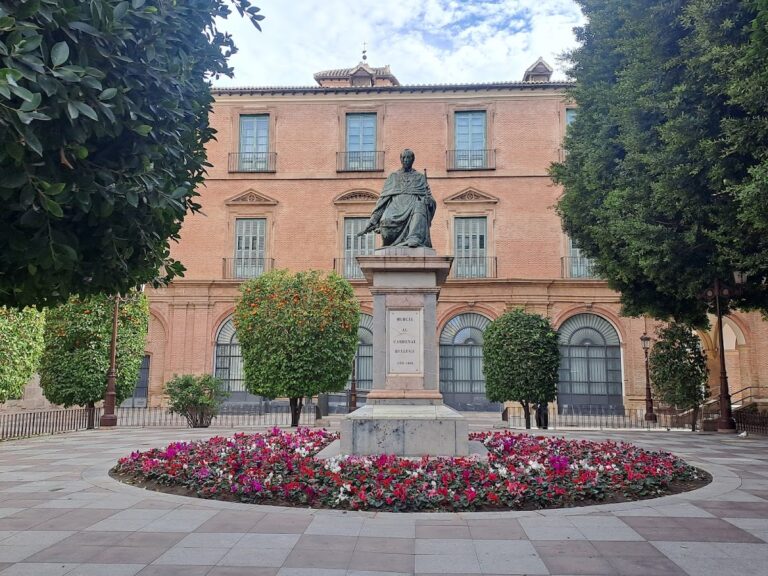
In 1972, the college building’s ruinous condition led to a proposal to demolish it. In 1984, it was designated as the seat of the Presidency and Council of Government of the Region of Murcia, and became known as Palacio de San Esteban. The former church was adapted for temporary exhibitions, while the Jesuit orchards and the site of the former asylum became the public San Esteban Garden. The former college-convent is no longer consecrated for religious use.
Remains of an Arab quarter were discovered in the garden in 2009. Following public protests and a judicial order, regional president Ramón Luis Valcárcel announced that a planned underground car park would not be built. The archaeological site was declared an Asset of Cultural Interest, a formal Spanish heritage-protection category, on 11 January 2010.
Remains
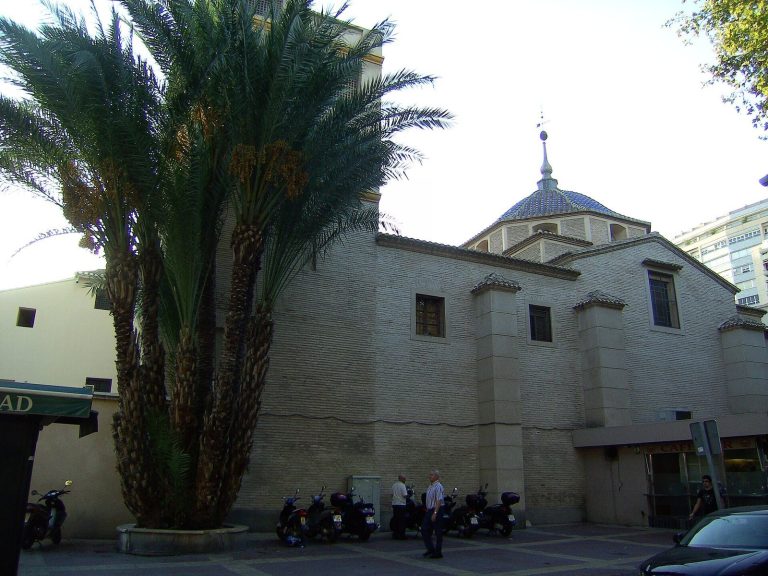
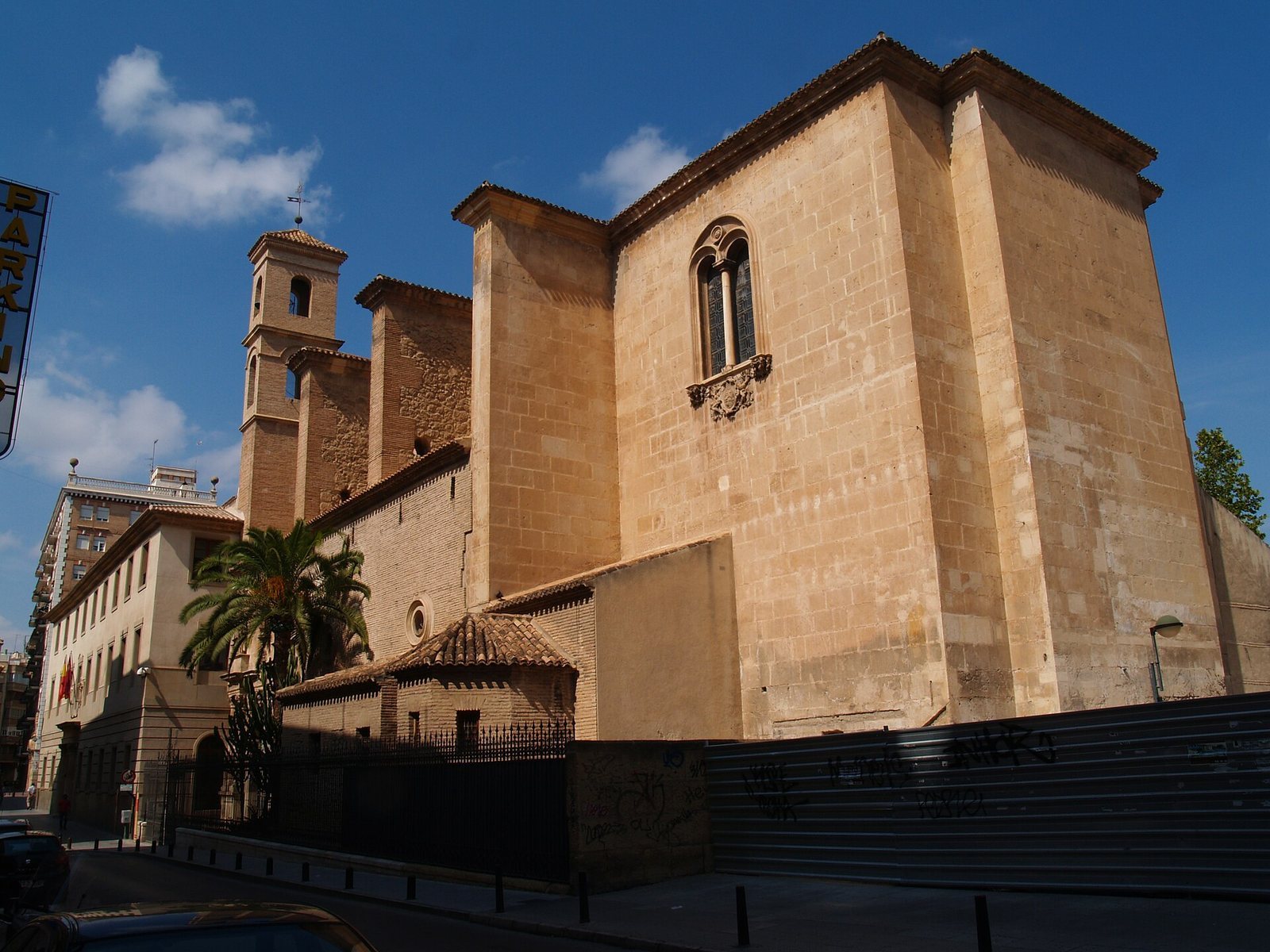
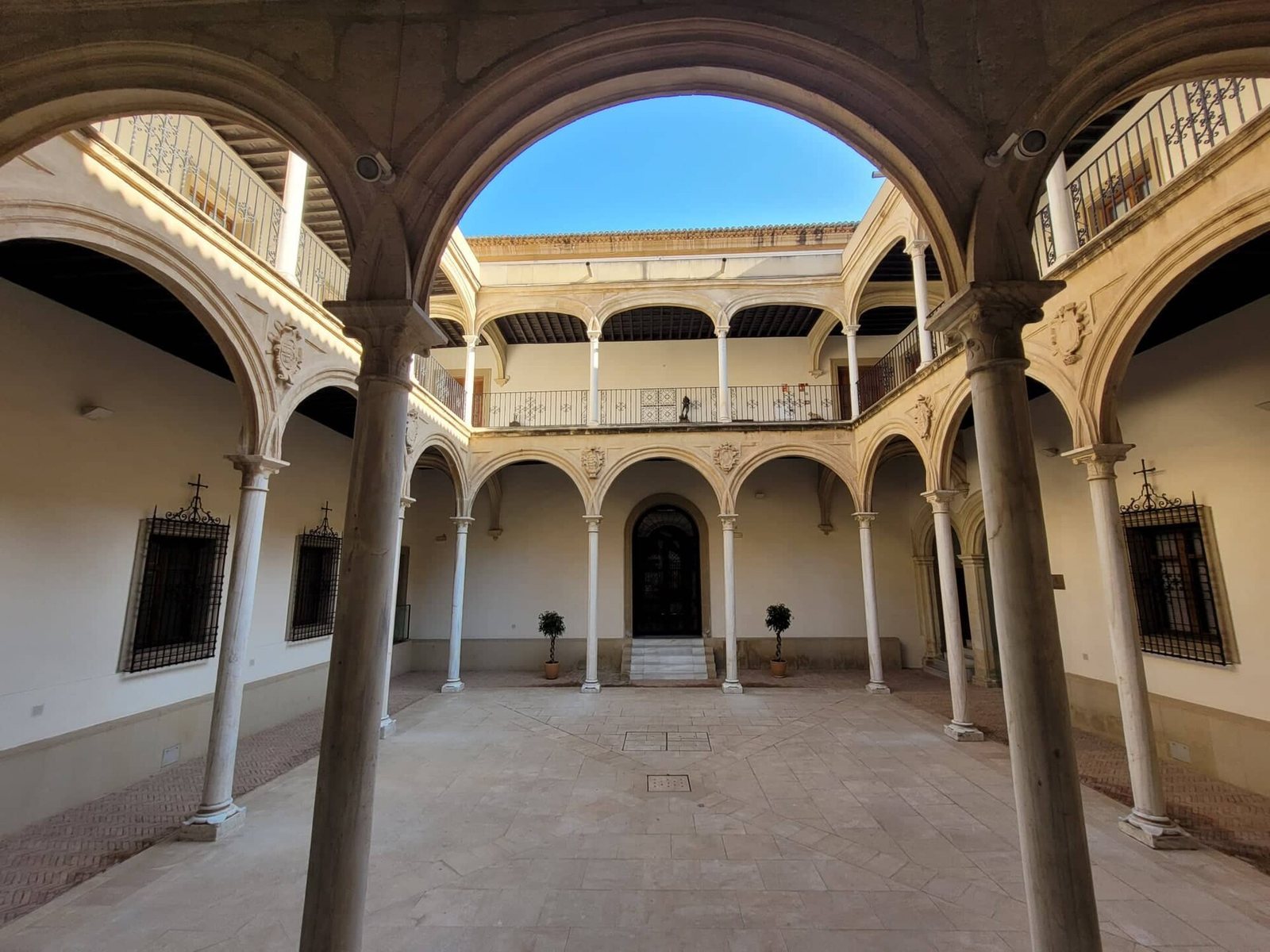
The complex stands between Acisclo Díaz Street and San Esteban Garden, near the parish church of San Miguel, in the area of Murcia’s former Arrixaca suburb. Its Renaissance buildings include the former college-convent and church, while the garden contains archaeological remains. The college-convent is arranged around two courtyards.
The college courtyards
The first courtyard was completed in 1557. Its Renaissance design uses Tuscan columns, a relatively plain classical column type, made of marble and arranged according to Andalusian models. The second courtyard was built later and has more elaborate Baroque ornament, reflecting a later European art and architectural style.
The church
Portal and interior
The church portal follows a triumphal-arch composition modeled on monumental Roman arches. Statues of Saint Ignatius, founder of the Jesuits, and Saint Francis Xavier, a Jesuit missionary, were added above it in the late seventeenth century. Between the columns are figures of Saint Luke, traditionally identified as an evangelist, and Saint Catherine. Inside, the church has a monumental interior with slender proportions. Its vaults use an archaic Gothic approach, referring to a medieval European architectural style, and a Renaissance window includes low-relief carvings.
Tomb and altarpieces
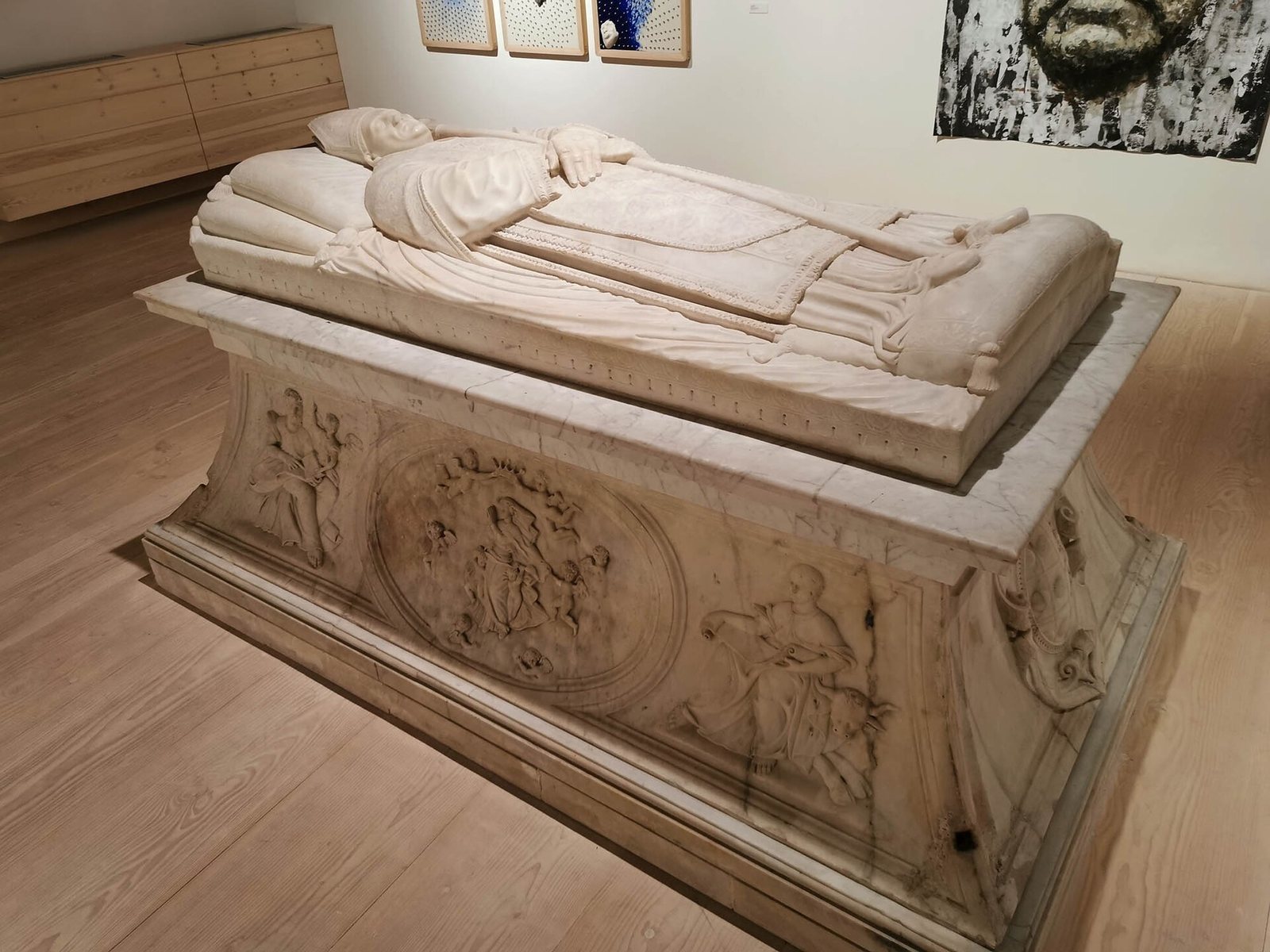
Bishop Esteban de Almeyda’s tomb was installed in the church in 1572. The Renaissance work, made by Italian sculptor Bartolomé de Lugano, was removed when the church was converted into an exhibition space. The side-chapel altarpieces, decorated structures placed behind or above altars, belong to early eighteenth-century Murcian Baroque work that continued a tradition begun in the late seventeenth century. Their balanced compositions have dense ornament, and they were concealed during the church’s adaptation for exhibitions. The high-altar altarpiece is an important Renaissance work in the region, notable for its architectural design and partial construction in stone. Its central wooden section was gilded and painted in several colors by Jerónimo Espinosa and Jerónimo de la Lanza.
Archaeological remains in the garden
The garden contains remains of an Arab quarter in the Arrixaca suburb dating to the twelfth and thirteenth centuries.