Castello Sforzesco in Vigevano: A Historic Fortress and Ducal Residence
Visitor Information
Google Rating: 4.5
Popularity: Medium
Official Website: www.vigevanowelcome.it
Country: Italy
Civilization: Early Modern, Medieval European, Modern
Site type: Military
Remains: Castle
History
The Castello Sforzesco in Vigevano, Italy, sits atop the highest point of the town and traces its origins back to an ancient fortified settlement that once belonged to the village known as Vicogebuin. Its early defenses began as wooden structures and were later replaced with brick walls before the 10th century. The first castle, or recetto, appeared as a square enclosure separated from the village by a moat, initially serving as shelter for forage and animals and acting as a last refuge during siege or attack.
During the late 13th and early 14th centuries, the castle became the residence of the Visconti family, prominent rulers in the region. Luchino Visconti, holding office as podestà in 1319 and again in 1337, sought to strengthen Vigevano’s defenses by integrating it into their wider military network. In 1341, he constructed a new fortress known as the Rocca Vecchia and transformed the older castle into a fortified ducal residence with battlemented walls, corner towers, and a central entrance tower. By 1347, a fortified covered road called the Strada Coperta, stretching 164 meters, linked the castle and Rocca Vecchia, enabling swift communication and movement.
Control of the castle passed to the Sforza family after 1449, following a siege involving Bartolomeo Colleoni and Francesco I Sforza. The new rulers repaired damage from the conflict and expanded the central keep, or maschio, outward, incorporating parts of a destroyed southeastern tower. Under Duke Galeazzo Maria Sforza from 1466, the maschio evolved into a formal ducal palace. This era saw new constructions such as houses set within the outer moat under height restrictions, upgrades to stables featuring double colonnades and vaulted ceilings, the creation of the loggia bridge in 1475, and the beginning of the falconry building’s development, later completed by Ludovico il Moro.
Ludovico il Moro, born in Vigevano and a key figure in the castle’s history, completed its transformation into a Renaissance residence. He cleared old village buildings from the courtyard and commissioned a third stable, known as the Scuderia di Ludovico, along with new kitchens replacing the demolished Sant’Ambrogio church. Covered bridges connected various buildings, while the maschio was extended eastward to include a hanging garden enclosed by two porticoed buildings designed by the renowned architect Bramante. Only the southern portico, the Loggia delle Dame, survives today. Bramante also enhanced the castle’s decoration, adding frescoes to the Ludovico stable and redesigning the municipal tower, raising it with battlements and an octagonal spire to house bells salvaged from the demolished Santa Maria church.
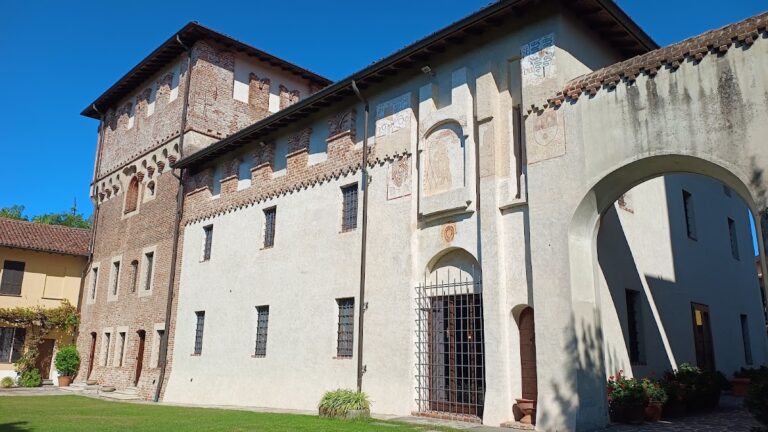
The artistic efforts of the Sforza period continued under Francesco II Sforza, completing the castle’s decorative scheme. In the 19th century, significant changes reflected shifting needs and tastes. The western moat was filled in, sections of the maschio’s walls and ravelin were demolished, and the gate near San Pietro Martire church closed. The maschio’s collapsed parts were rebuilt in Tudor style by engineer Inverardi in 1855, who also created a neo-Gothic entrance atrium incorporating parts of the eastern stable. Adaptations for military use included the construction of a large indoor riding hall in the old Rocca Vecchia in 1836, the raising and repurposing of former kitchens and ovens as an officers’ club, alterations to bridges, lowering of the hanging garden to the current courtyard level, and reconstruction of structures along the covered road. A smaller northern riding hall was demolished following a collapse in 1979.
After the castle ceased military functions in 1968, it was abandoned for about a decade before restoration efforts began in 1980. The site later became home to the National Archaeological Museum of Lomellina in 1998, housed in the third stable and expanded in 2018. In 2009, the International Shoe Museum Pietro Bertolini opened in rooms above the second stable, linking the castle’s historic fabric to the cultural identity of the region.
Remains
The Castello Sforzesco complex extends over more than two hectares atop Vigevano’s highest ground, covering roughly 70,000 square meters across five floors. Its layout includes interconnected structures forming a unified whole, combining defensive features with residential and service buildings that reflect centuries of architectural evolution.
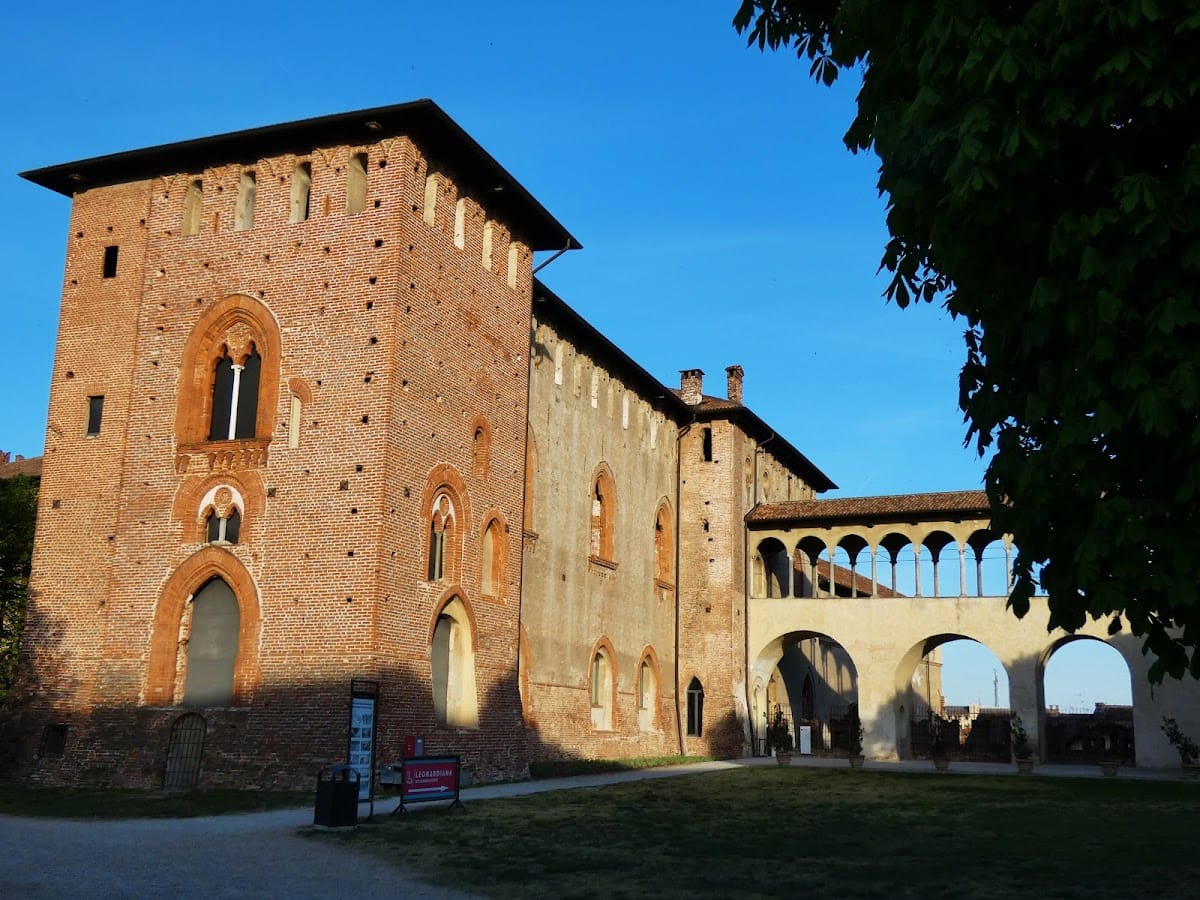
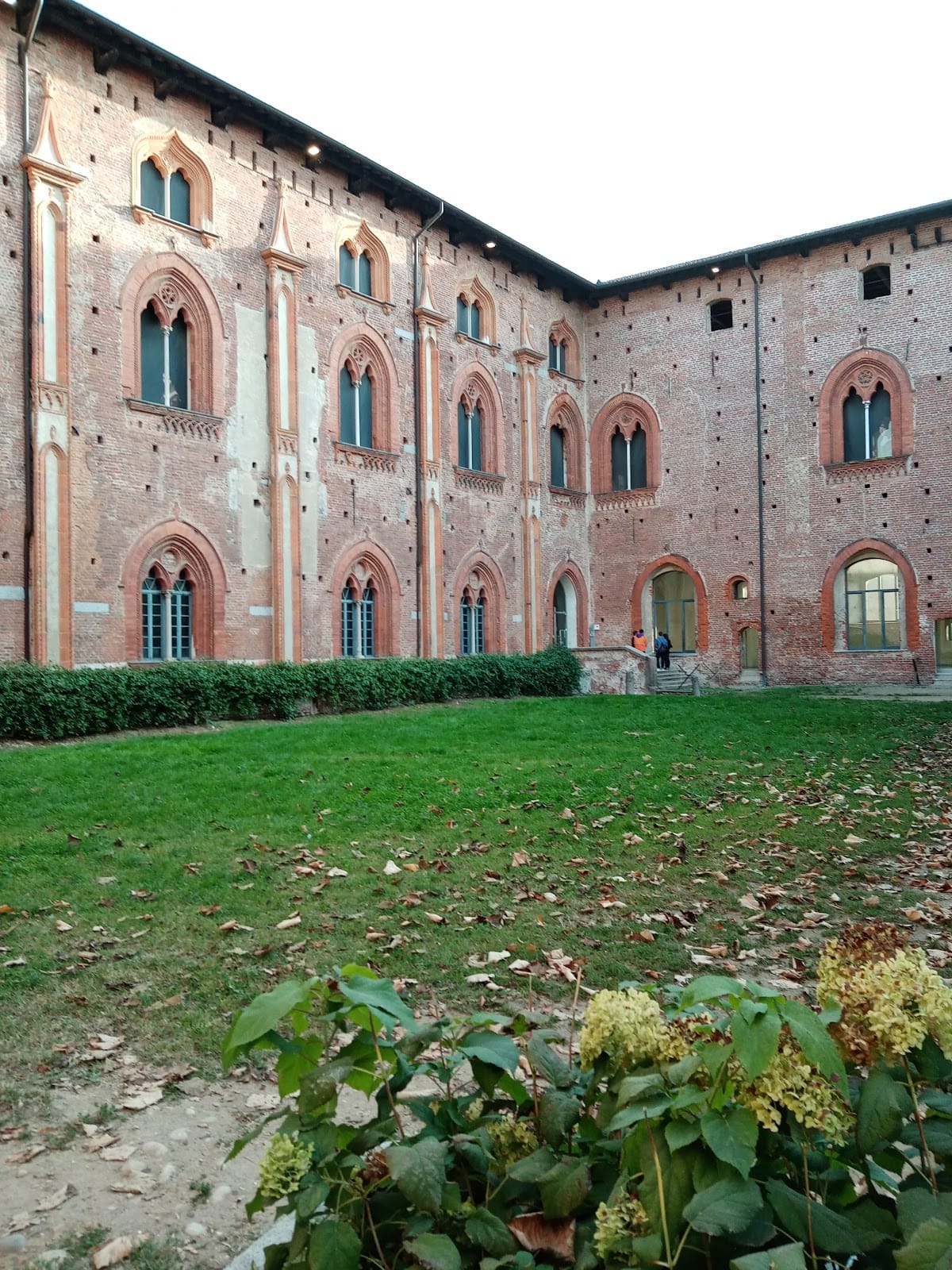
The main keep, or maschio, follows a U-shaped plan with two wings enclosing a central courtyard. Built up during Visconti and Sforza rule, it features enhancements such as an eastern extension that housed a hanging garden surrounded by two porticoed buildings designed by Bramante. Today, only the southern portico known as the Loggia delle Dame survives from this garden enclosure. The maschio has undergone multiple modifications including expansions, repairs, and 19th-century Tudor-style reconstructions.
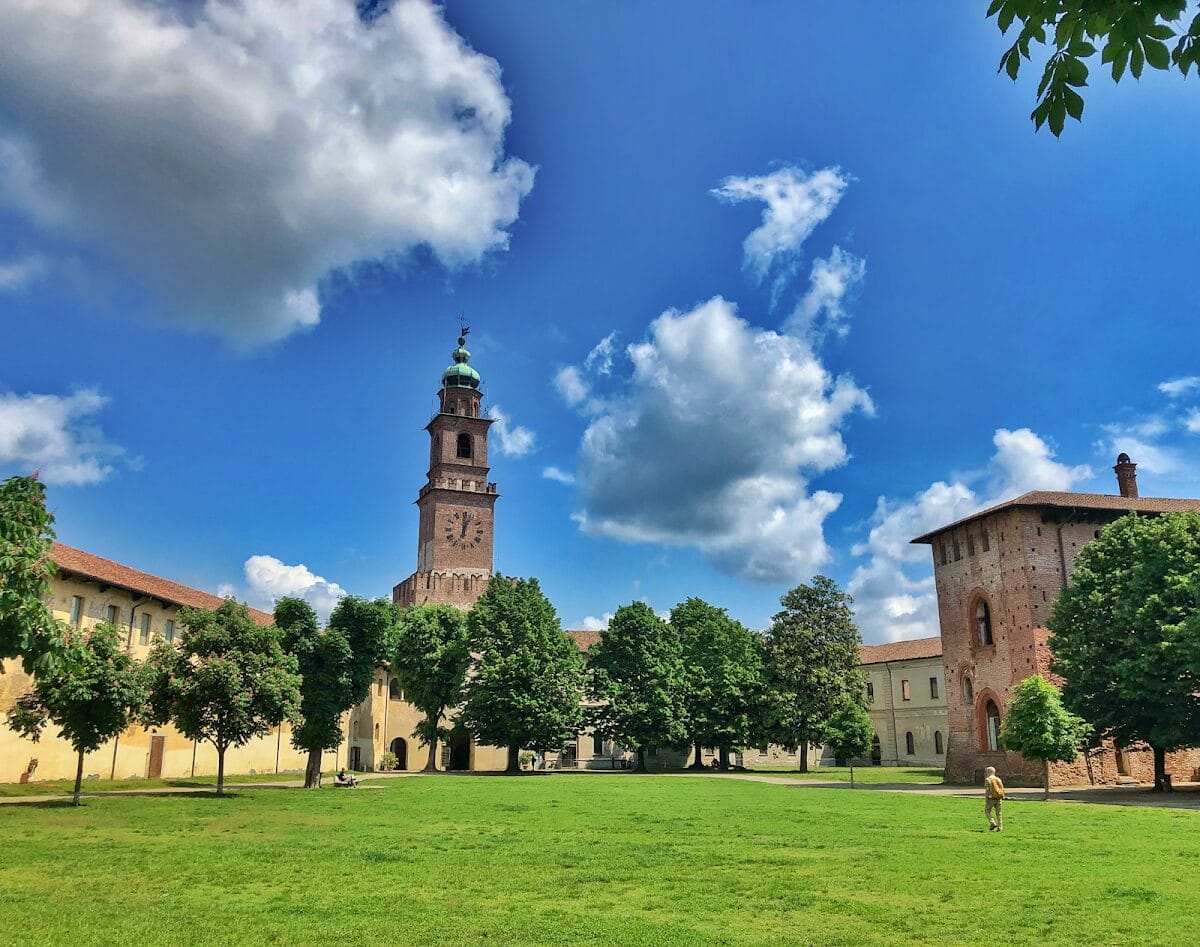
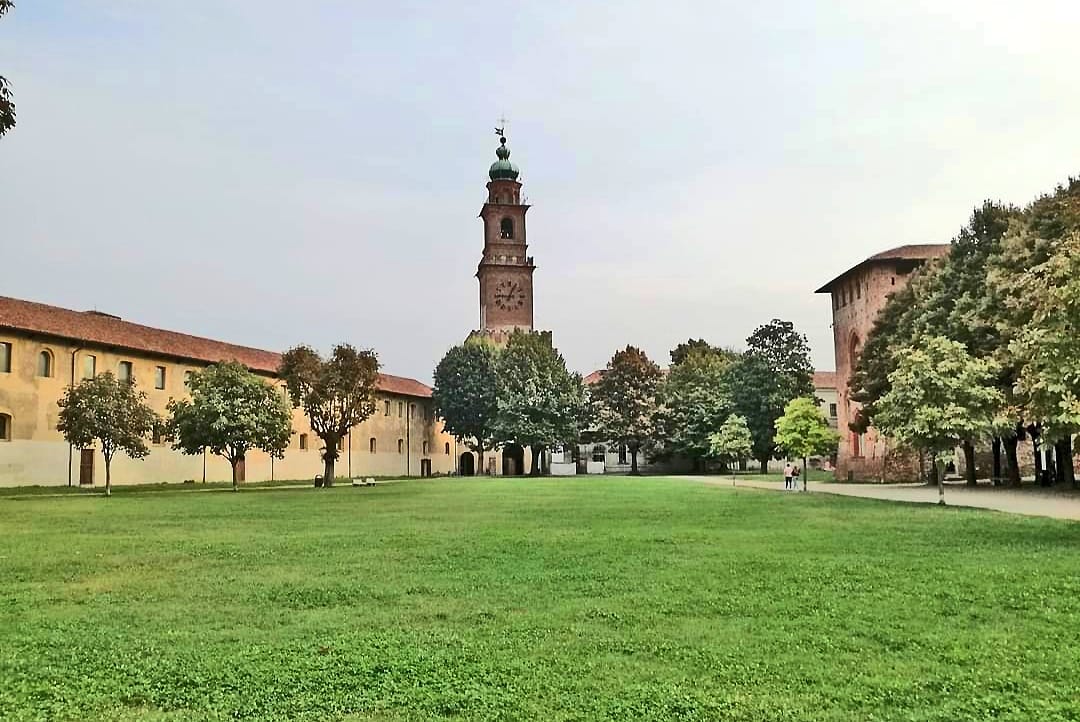
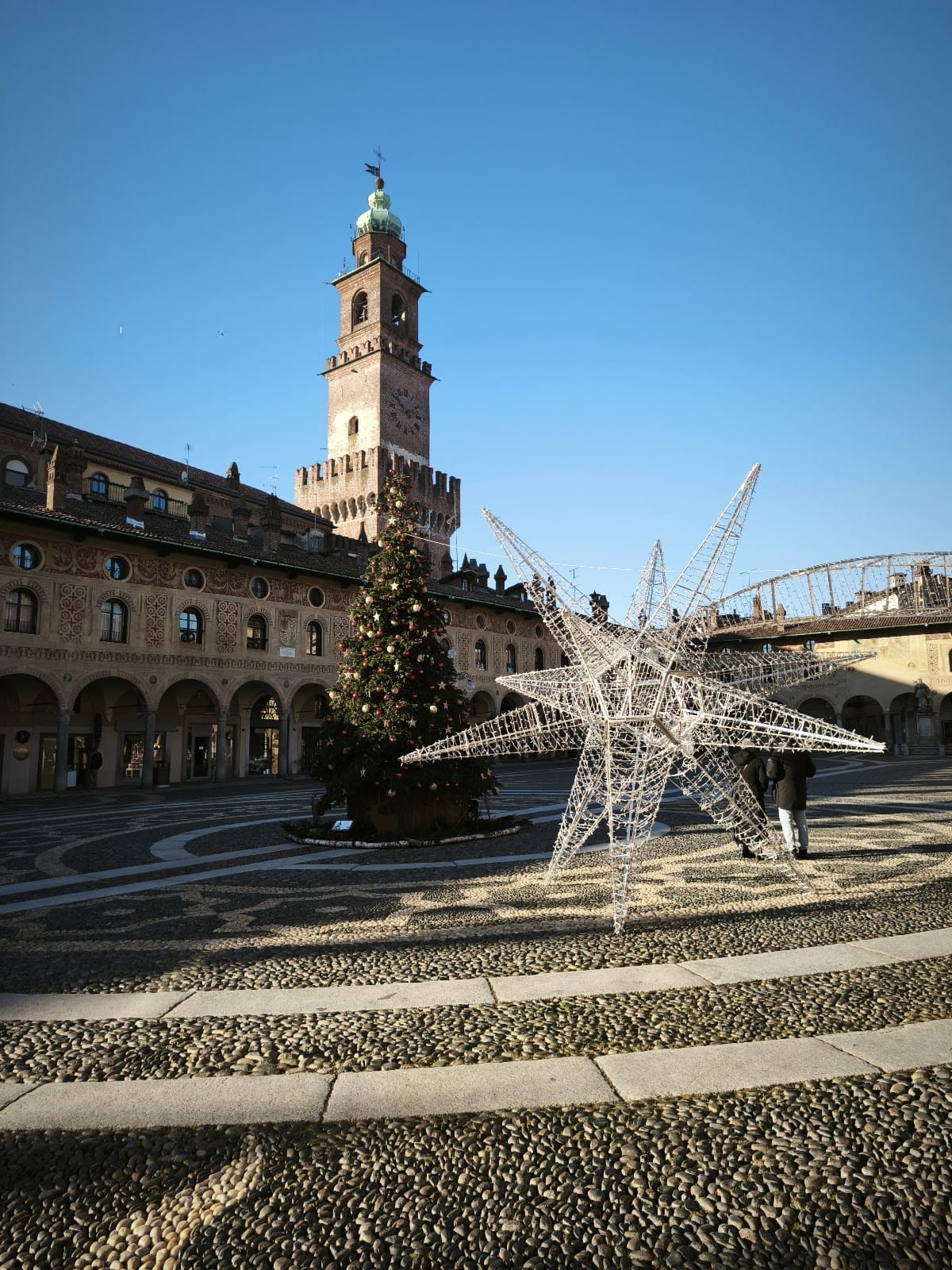
Rising prominently is the Bramante Tower, originally dating back to 1198 and completed in its present form in the late 15th century by Bramante. This tower soars about 75 meters above the surrounding piazza and 57 meters above the castle courtyard, making it the tallest structure in Vigevano. It is composed of three stacked levels that narrow toward the top: a terrace with distinctive Ghibelline battlements crowning the first part, a clock section above, and a bell chamber capped by an octagonal belvedere. The large 17th-century bell inside, known as “il campanone,” was intentionally cracked in the 19th century to lower its volume following residents’ complaints, yet it continues to sound every fifteen minutes.
The castle grounds contain three large stables, including the Ludovico stable near the tower, which holds traces of frescoes attributed to Bramante. These stables served as essential service buildings during the Renaissance renovations and remain integral to the castle complex. Adjacent to the maschio is the falconry building, connected by a covered loggia that exemplifies the blending of functional and elegant design.
One of the castle’s most remarkable features is the Strada Coperta, a covered fortified road measuring 164 meters in length and 7.5 meters wide. It links the castle proper with the Rocca Vecchia to the east and sheltered fast and secure passage between these parts. The Rocca Vecchia itself encloses a grand indoor riding hall, or cavallerizza, built in 1836 for military equestrian training. A smaller northern riding hall once stood nearby but was demolished after structural failure.
Nineteenth-century modifications reshaped parts of the castle’s defensive landscape by filling in the western moat, adjusting bridges—some replaced by three-arched structures on the falconry bridge—lowering the hanging garden to its current courtyard height, and rebuilding corridor buildings along the covered road. The western side also gained a neo-Gothic entrance atrium that recycles portions of the old eastern stable.
Today, the castle’s preserved features provide insight into its layered history, combining medieval fortifications, Renaissance residential expansion, and military adaptations. Its extensive courtyards, towering keeps, and covered passages remain a testament to Vigevano’s development from a fortified village to a refined ducal seat.
Nearby sites