Castello di Romena: A Medieval Fortress in Pratovecchio Stia, Italy
Visitor Information
Google Rating: 4.5
Popularity: Medium
Official Website: www.castellodiromena.it
Country: Italy
Civilization: Medieval European
Site type: Military
Remains: Castle
History
The Castello di Romena is located in the municipality of Pratovecchio Stia, Italy. Built initially in the medieval period, it was established by local medieval nobility who sought to control the surrounding Casentino valley.
The earliest recorded mention of the castle dates back to 1088, when it served as the residence of Count Guido Alberto from the Marchesi di Spoleto family. From this fortress, Guido Alberto expanded his authority over the Casentino region during the 11th century. By the 12th century, the property passed into the hands of the Counts Guidi, a powerful noble family in the area. Following the death of Count Guido Guerra III in 1213, a cadet branch known as the “Counts Guidi di Romena,” descended from Aghinolfo, took residence here. The castle functioned as their seat, playing a key role in their regional influence.
A significant event in the castle’s history took place in 1281, involving Mastro Adamo da Brescia, a resident who was involved in producing counterfeit Florentine gold coins on behalf of the Guidi family. He was eventually captured and executed near the castle in a location later called Omomorto. This episode gained wider recognition through its mention in Dante Alighieri’s “Inferno,” specifically in the 30th canto.
Dante himself had a direct connection to the castle. During his exile from Florence, starting in 1301 and lasting until his death in 1321, he lived under the protection of the Guidi family. Although he primarily stayed at the nearby Castello di Porciano, he maintained ties to the Romena stronghold and its lords.
The Guidi retained control of the castle until 1357, when it was acquired by the Florentine Republic. By the 14th century, the castle had developed into a fortified complex featuring a lordly residence, a central keep (known as the “cassero”), along with three concentric defensive walls and as many as fourteen towers. It supported a community of about a hundred inhabitants and included facilities such as a hospital serving pilgrims and the poor.
In 1440, the castle suffered partial destruction during military action led by Niccolò Piccinino, commander of the Visconti forces of Milan. Following this attack, the number of towers was reduced from fourteen to five. Control soon returned to Florence, and the castle’s fate became closely linked to that of the Florentine Republic and later the Grand Duchy of Tuscany.
The castle was further damaged by a severe earthquake in 1579, leaving it in ruins. More than a century later, in 1768, ownership passed to the Goretti de Flamini counts, who remain the custodians to this day. Despite its condition, the castle’s grounds were still cultivated with vineyards and olive trees by 1889, with small peasant houses adjacent to its outer walls.
Count Ottaviano Goretti de Flamini took steps in the late 19th or early 20th century to halt further deterioration through conservation efforts. The castle also gained literary significance when Gabriele D’Annunzio stayed there in 1901 and composed much of his work “Alcyone.” During World War II, the site was heavily bombed by Allied forces aiming to expel German troops entrenched inside the castle.
Extensive restoration projects were carried out in the following decades, allowing the castle to reopen to the public in 2007.
Remains
Castello di Romena crowns a hill at 621 meters above sea level, overlooking the Casentino valley and the town of Pratovecchio. Its name, “Romena” or “Ormena,” is derived from an ancient Etruscan term, hinting at the area’s long-standing human occupation. Archaeological excavations in the surrounding grounds have uncovered fragments of pottery and various everyday tools that attest to earlier habitation.
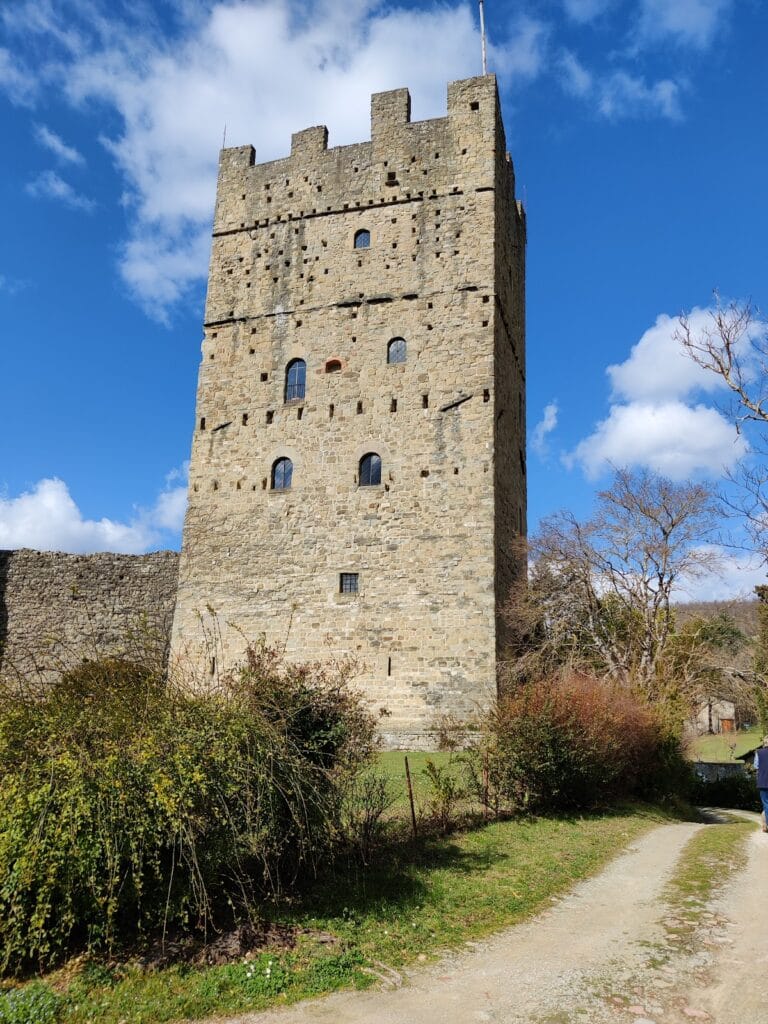
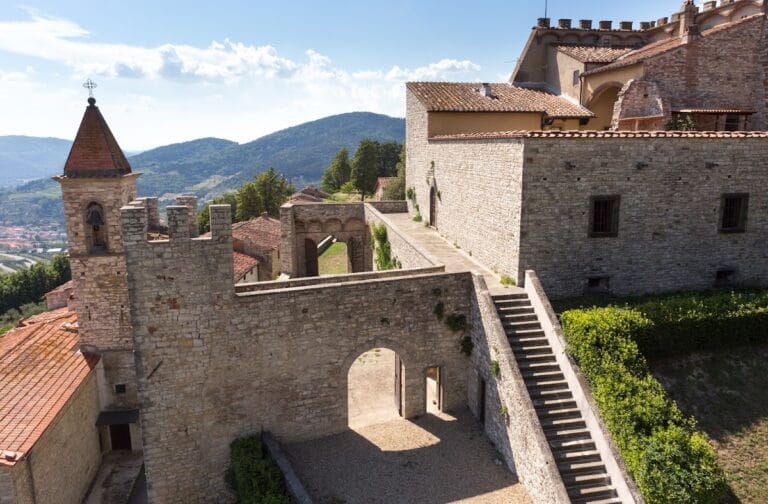
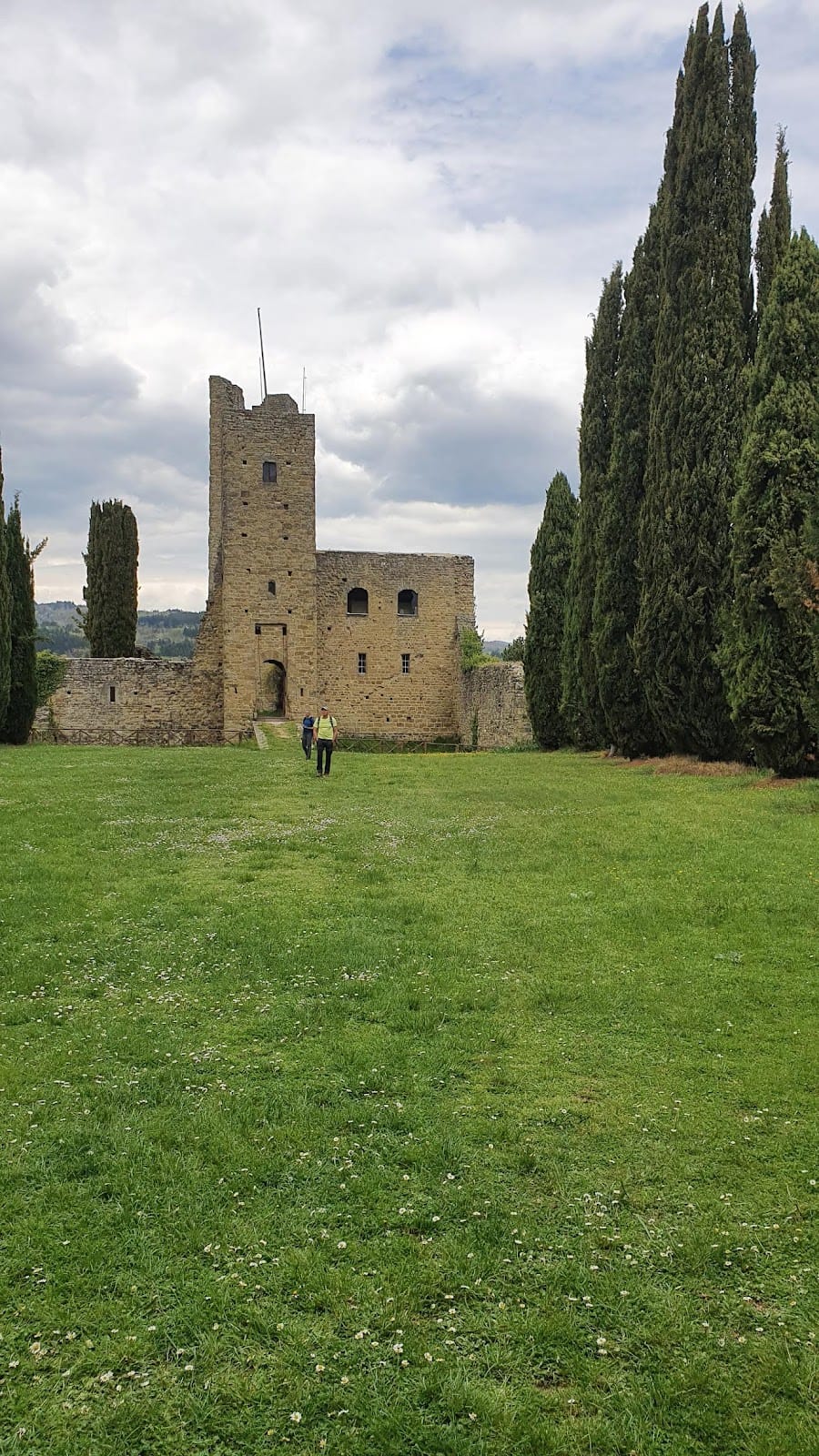
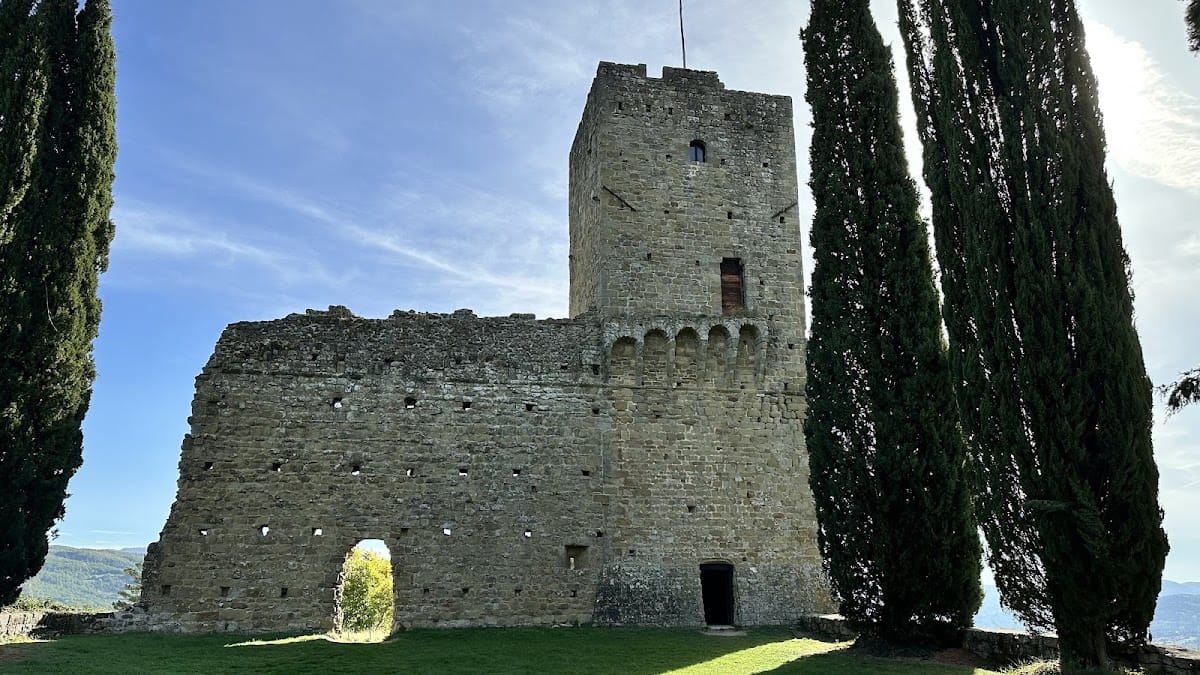
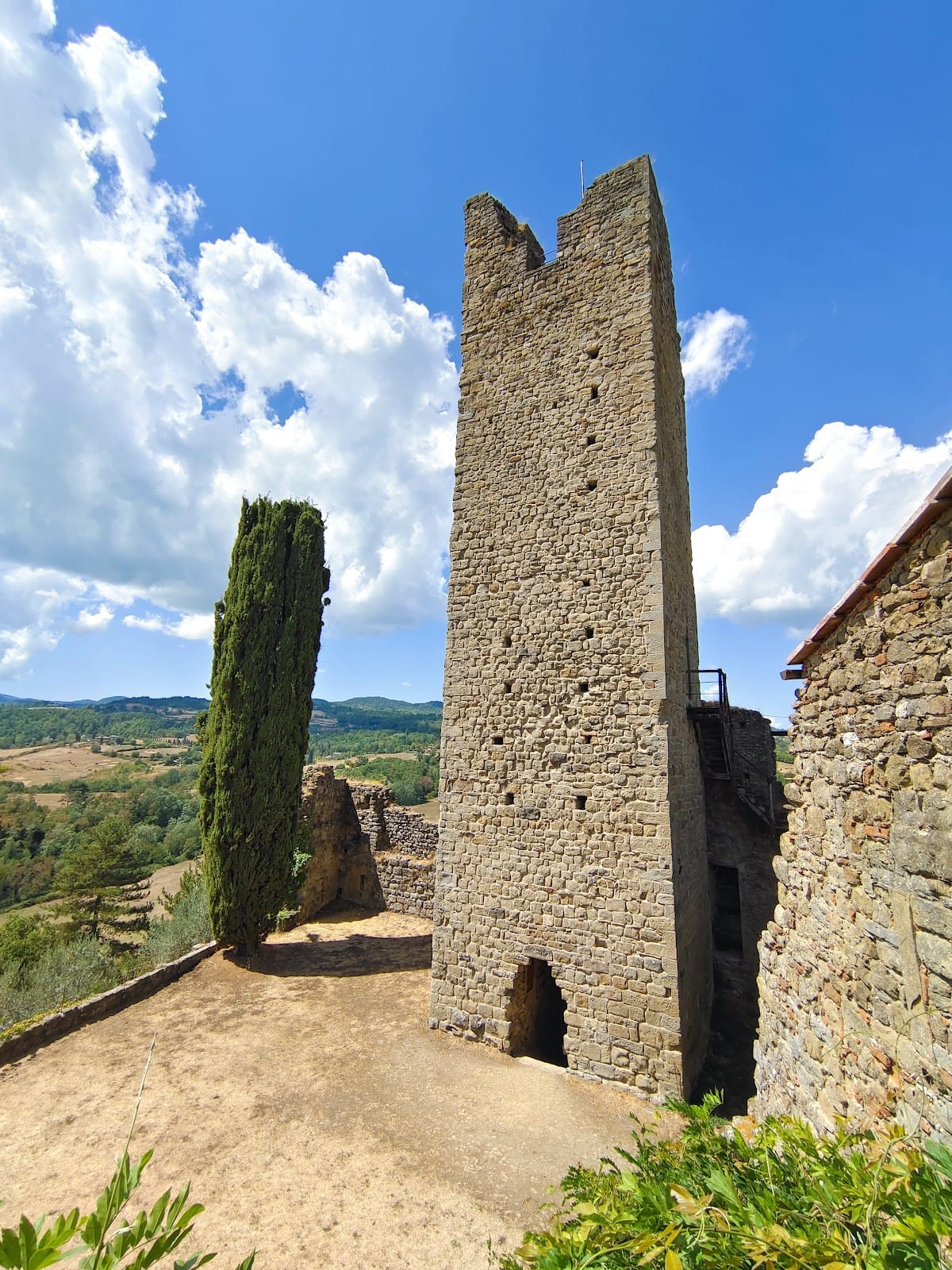
The present remains include the castle’s central keep, known as the cassero, along with three towers and parts of the original three concentric defensive walls. These features have all undergone restoration efforts, particularly under the care of Count Ottaviano Goretti de Flamini, preserving their medieval character.
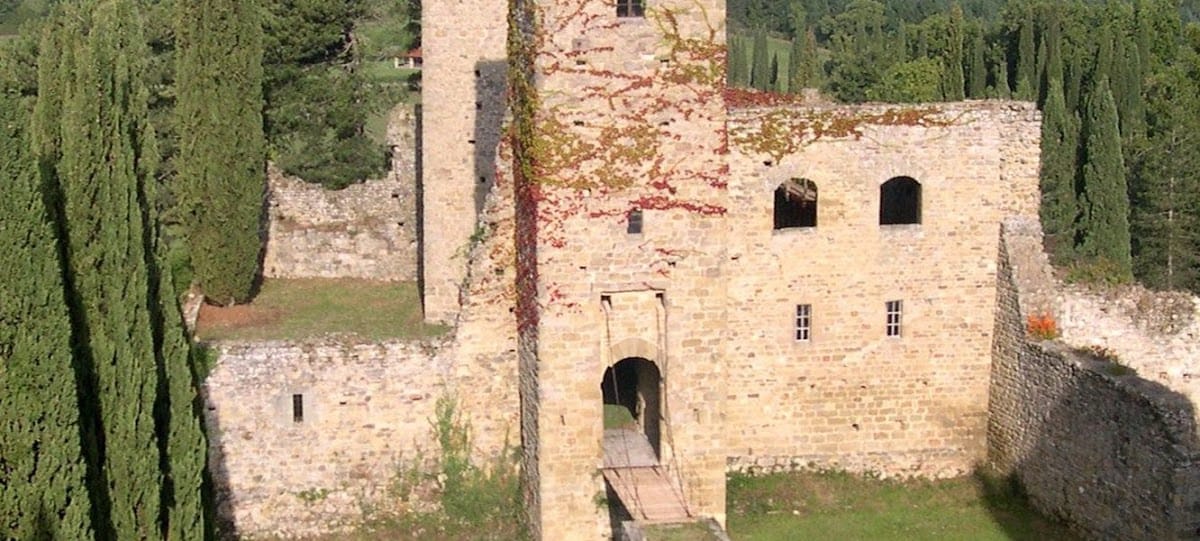
Access to the castle is gained through the northern side via two gates named Porta Gioiosa and Porta Bacia. The main approach to the keep passes over a drawbridge spanning a moat, reached by way of an adjacent tower, reflecting typical medieval defensive architecture.
Within the walls stand two principal building complexes. One is called the “Casa del Podestà,” which served as the residential palace of the Counts Guidi di Romena. This structure now hosts a carefully constructed scale model that reconstructs the castle’s appearance as it was in the 13th century, providing a visual interpretation of its historical layout. The other key feature is the mastio, the tallest and most heavily fortified tower, symbolizing the stronghold’s defensive core.
The castle also contains a cistern designed to collect rainwater, an essential element for water supply during sieges. An underground tunnel once extended from within the walls to the outside, offering a secret route for escape or communication, although the current condition or length of this tunnel is not detailed.
The surviving defensive walls still exhibit corbels, locally called beccatelli, which originally supported wooden walkways used by guards for patrolling the ramparts. These wooden structures have been restored in the 19th century to reflect their historical function.
Between the keep and the third remaining tower lies a large open space known as the piazza d’armi or parade ground. This area witnessed notable use when Gabriele D’Annunzio camped there during his stay in 1901.
The last standing tower is referred to as the “Torre delle Prigioni,” meaning Prison Tower, likely indicating its former use for holding captives or prisoners.
Together, these features present a layered historical record of the castle’s evolution, military importance, and domestic life from the medieval period through modern times.
Nearby sites