Montozzi Castle: From Medieval Ghibelline Stronghold to Tuscan Villa


Site at a Glance
- Rating
- 4.7
- Popularity
- Low
- Country
- Italy
- Primary era
- Early Modern
- External website
- Open
- Eras represented
- Medieval, Early Modern, Modern
- Civilizations
- Grand Duchy of Tuscany, Italian
- Site type
- Domestic
- Remains
- Elite Residence
On this page13 sections
History
Montozzi Castle is a medieval fortification in Italy, near Laterina in the Upper Valdarno, built and developed under the influence of the Ubertini family of Arezzo from the twelfth century onward. It became a Ghibelline stronghold, one of the fortified positions involved in the medieval rivalry between Ghibellines, who generally supported imperial authority, and Guelphs, who generally supported the papacy. After centuries of military conflict, the castle was transformed into an aristocratic residence and the center of the Bartolini Baldelli estate.
Origins and the Ubertini castle
Montozzi was first mentioned in 1036 in connection with the fortified settlement of Bulgari, which stood near the present castle. Bulgari was associated with the Bulgari, allies of the Lombards who occupied part of Tuscany during the sixth century. The name Mons Teuzi was linked to Teuzzo, son of Ildebrando of the Sassi family, the lords of Bulgari. The Sassi later held Montozzi, but from 1186 they disappear from its documented history and were replaced by the Ubertini, an influential Aretine family closely connected with the bishopric and political leadership of Arezzo.
The Ubertini established a new castle on the highest part of the hill at Bulgari. Construction began in the twelfth century, and Montozzi is described as an established castle in the thirteenth century. An agreement of 1221 between the Ubertini and the Guidi required the Guidi to leave Montozzi in the Ubertini’s peaceful possession. Its position overlooking the Upper Valdarno and the Valdambra gave it a military role in the struggle between Arezzo and Florence.
Conflict with Florence and Arezzo
In 1303 the Florentines captured and destroyed Montozzi during their conflict with Arezzo. The Ubertini restored it, but the castle suffered a second capture and destruction in 1326 after the family rebelled against Guido Tarlati, the bishop and ruler of Arezzo. The Ubertini then radically rebuilt the stronghold. In 1335 the Aretine bishop Buso degli Ubertini submitted to Guelph Florence, bringing the Valdambra under Florentine authority. Two years later, the Florentines built a new road along the valley floor to improve communication with Florence.
Montozzi was still described in 1350 as the most important Ghibelline sentinel against Florentine expansion. In 1385 Azzo di Franceschino degli Ubertini submitted the castle to Florence, after which it became part of the Podesteria of Valdambra, a territorial jurisdiction administered by a podesta for local judicial and administrative government. Montozzi rebelled against Florence in 1399 and was definitively re-subjugated by the Florentine Guelphs. Its military importance then declined, the power of the Ubertini waned, and the walls and keep were abandoned and fell into ruin, while the surrounding village continued to exist.
From fortified settlement to estate
Florentine rule brought political stability and economic activity to the Valdarno and Valdambra. As fortified settlements partly declined, open rural settlements and houses spread beyond the former fortified village to support agriculture. A statute for the community of Montozzi was drawn up in 1454, and the first known local land contract using sharecropping, an arrangement in which tenant and landowner divided the farm’s produce, dates from the late fifteenth century.
In 1555 the whole Valdambra became part of the Grand Duchy of Tuscany, the Tuscan state ruled by the Medici and later by the Lorraine dynasty until Italian unification. The Bartolini Baldelli family began acquiring property and land at Montozzi during the first half of the sixteenth century. During the seventeenth century they acquired much of the village and the surrounding territory. In 1660 Francesco and Ottavio Bartolini Baldelli began converting the castle remains into a residential palace and reorganized the village as the center of their estate. The site’s military function consequently gave way to an aristocratic residence and agricultural center.
Francesco Maria Bartolini Baldelli, who lived from 1646 to 1711, embellished the palace with frescoes, added a double garden loggia decorated with stucco, and built a new church dedicated to Saints Martin and Lucy on its western side. He obtained the church’s patronage from Cosimo III, the Medici grand duke of Tuscany who ruled from 1670 to 1723. The new church became the parish church in place of the older Church of Saint Martin of Tours outside the village, which was later demolished.
Modern development and survival
In 1825 Bartolomeo Bartolini Baldelli commissioned engineer Pietro Municchi to assess the Montozzi property. The estate then contained 360 inhabitants in 46 families. Engineer Eugenio Falciani prepared several maps, including a land register with 34 plates showing the farm and its 32 tenant holdings. Around 1860 Bartolomeo commissioned a romantic English-style park around the castle and built a new church near the cemetery. In 1866 he built the present cemetery Chapel of Saint Martin on the site of an earlier Romanesque chapel.
In 1892 Luigi Bartolini Baldelli completed the family’s interventions at Montozzi by adding new stables and related buildings on the southern side of the village. The palace was damaged during the German occupation and by retreating German troops during the Second World War. Carlo, Francesco, and Cesare Bartolini Baldelli restored it after 1945. Montozzi is now incorporated into the seventeenth-century villa belonging to the Bartolini Baldelli family, whose archive is preserved there.
Remains
Castle core and residential palace
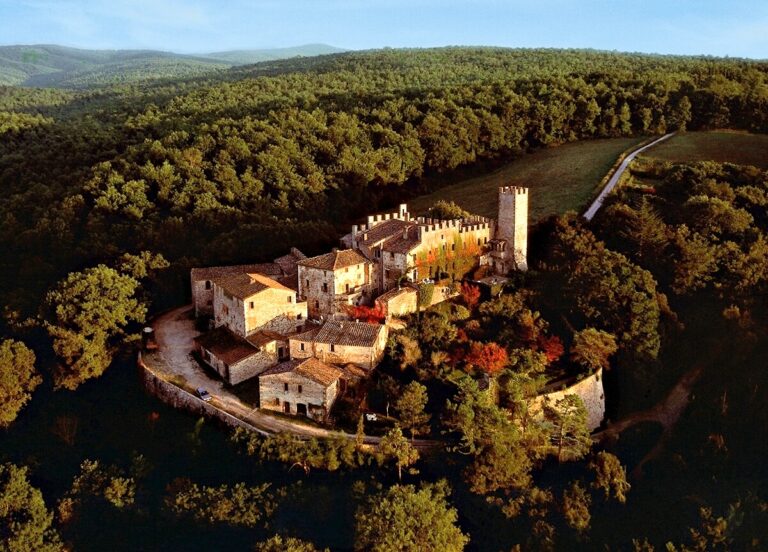
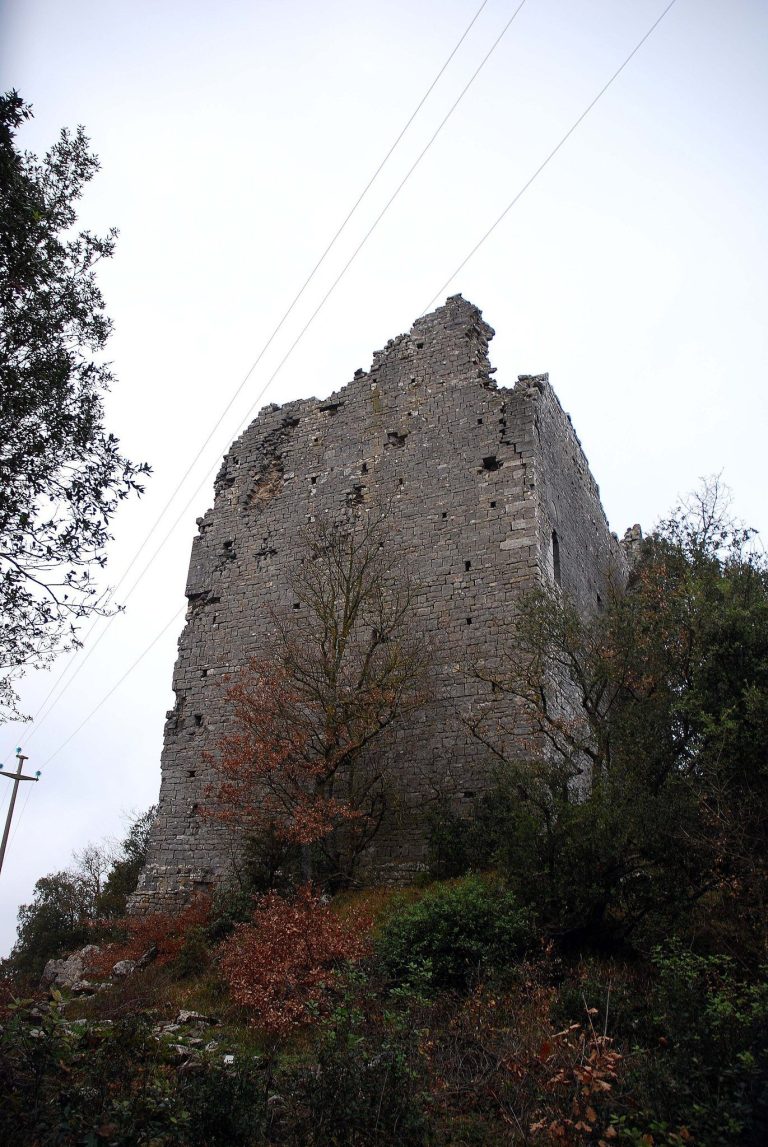
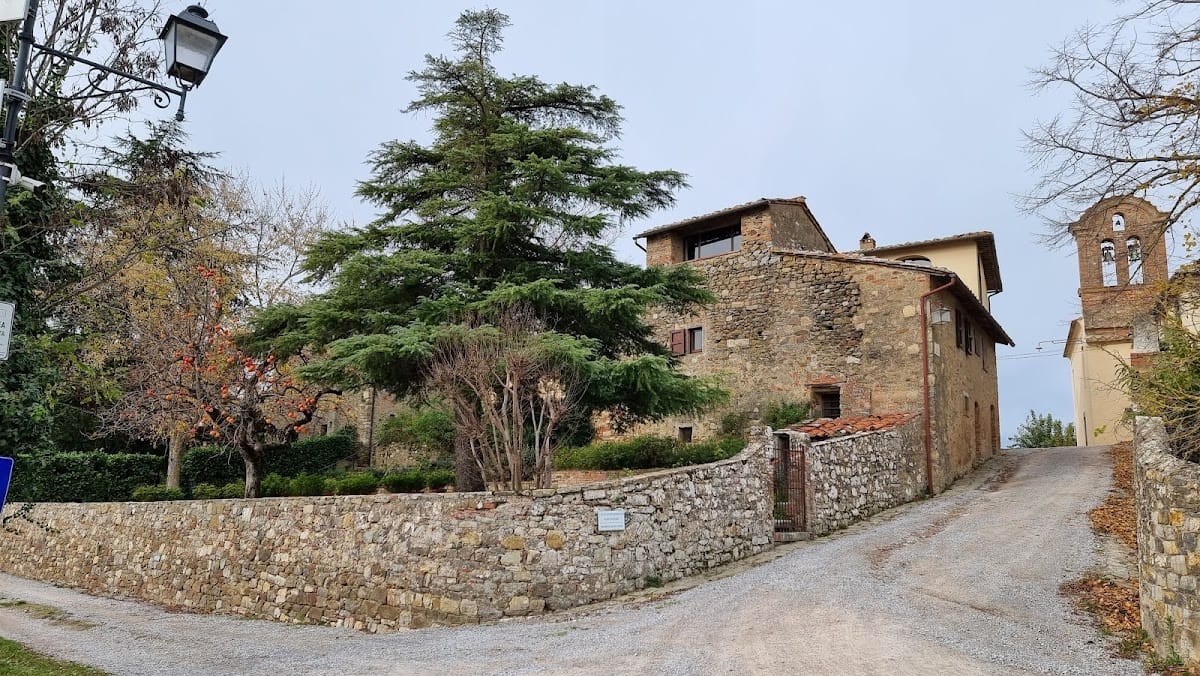
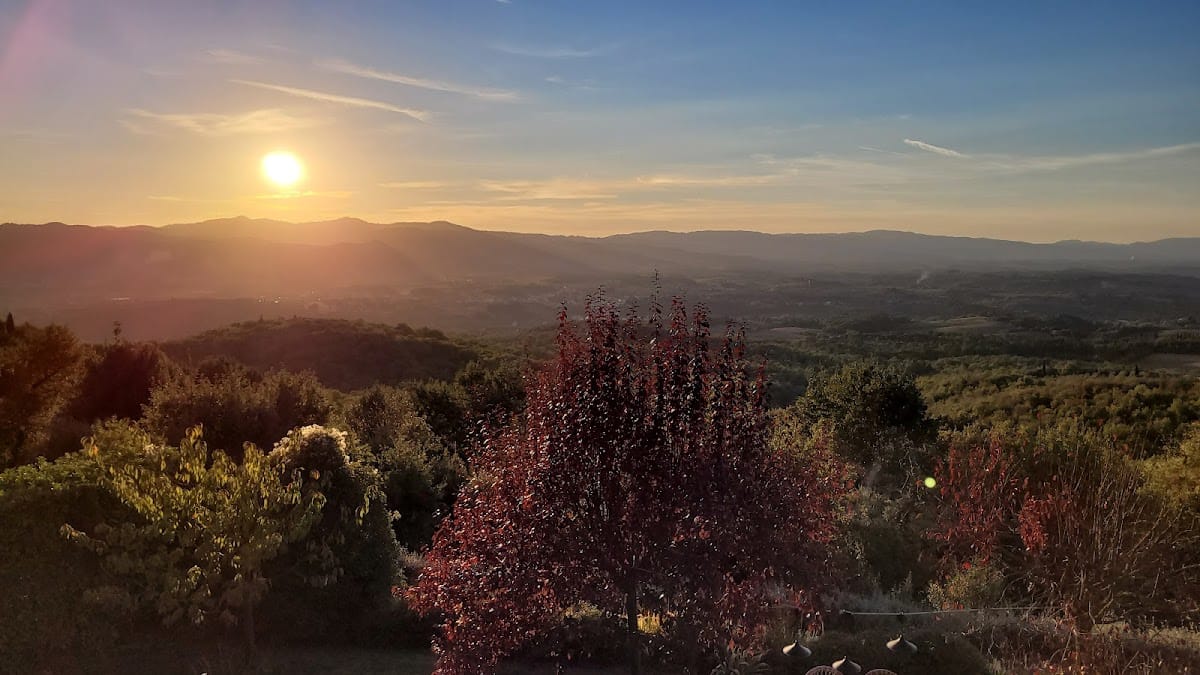
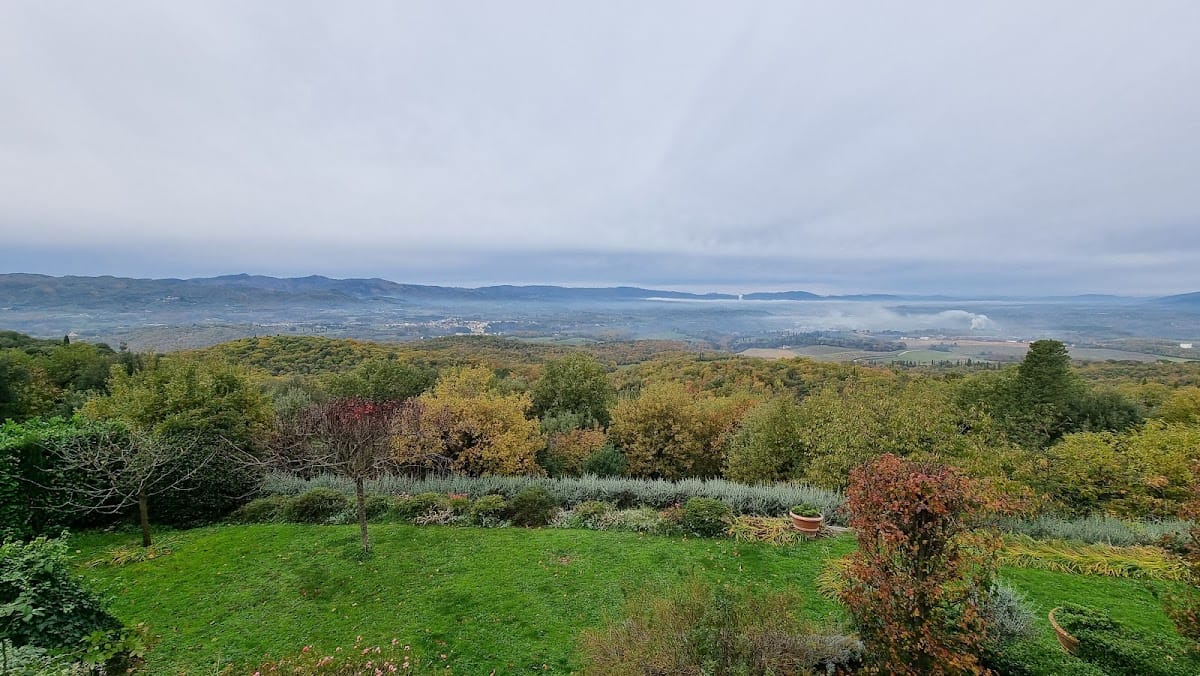
Montozzi stands at approximately 450 metres above sea level on a hill overlooking the Upper Valdarno and the Valdambra. The medieval fortification occupied the summit and was arranged within an elliptical enclosure wall around a broad central open space, or piazza. A keep, or fortified central tower, formed part of the castle, and its surviving ruins were incorporated into the later Bartolini Baldelli palace.
Bartolini Baldelli villa
The principal building is a rectangular seventeenth-century villa constructed from 1660 onward by incorporating part of the old keep. Its northwestern facade faces the former castle piazza and gives access to the old cellar. The main facade has a staircase with symmetrical flights, a portal with a carved keystone, and the Bartolini Baldelli coat of arms above the entrance. Five windows have sills supported by brackets.
A double loggia was added to the rear facade at the beginning of the eighteenth century, together with a chapel, a granary, and other buildings associated with the estate’s agricultural work. The interiors received stucco reliefs attributed to Giovan Martino Portogalli and frescoes by Giovan Camillo Sagrestani. For the visit of Grand Duke Leopold II and Grand Duchess Maria Antonia in 1843, the central salon’s original terracotta floor was replaced by Venetian-style marble terrazzo. A large Neo-Medieval fireplace was added later. Rooms severely damaged by German troops during the Second World War were remodeled after 1945.
Church of Saints Martin and Lucy
The Church of Saints Martin and Lucy was built from 1702 against the western side of the palace, incorporating an earlier oratory dedicated to Saint Lucy. Its facade has a simple portal, originally crowned by a broken pediment and a Bernardine monogram, a Christian emblem associated with Saint Bernardino of Siena. A simple arched window is set above it. The damaged pediment and monogram were undergoing restoration.
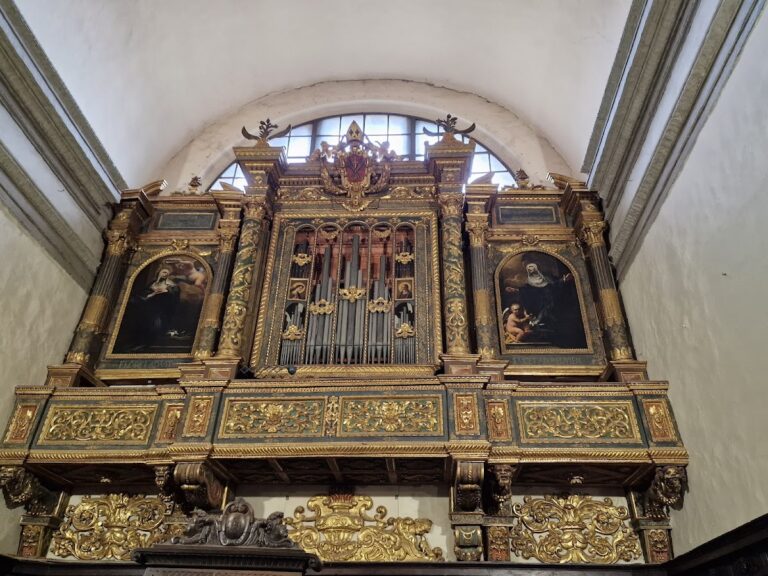
The church has a single nave and three carved altars made of pietra serena, a gray sandstone widely used in Tuscan architecture. The left altar contains a fresco by Giovanni Camillo Sagrestani depicting Saint Bartholomew freeing the wife of the king of Armenia from a demon. A fresco of Saint Lucy formerly stood above the right altar; in 1806 it was destroyed to create the present niche containing a Madonna of the Rosary. The central altar is surmounted by an early eighteenth-century Florentine-school painting of the Virgin and Saints Martin and Lucy interceding with the Trinity.
A fifteenth-century sandstone tabernacle stands on the church’s left side after being transferred from the former Church of Saint Martin of Tours. An eighteenth-century plaque on the counterfacade records the Bartolini Baldelli family’s patronage rights. A small choir loft links the church with the first floor of the palace.
Cemetery chapel and gardens
Chapel of Saint Martin
The Chapel of Saint Martin in the cemetery outside Montozzi has eclectic Classical forms. Its simple interior hall is reserved for the local population, while two symmetrical side staircases lead to an upper level dedicated by the Bartolini Baldelli family to commemorative plaques, which continue to be updated. A door behind the altar leads to the cemetery chapel containing the family burials.
Bandita park and formal garden
The Bandita park was laid out around the palace in the mid-nineteenth century as an English-style landscape, using irregular paths and planted woodland to create a naturalistic setting. Holm oaks line the park, which is entered through a gate flanked by sandstone columns topped with vases. Angiolo Pucci, a nineteenth-century Italian horticulturist and gardener of Florence’s Boboli botanical garden, assisted with its creation.
The formal upper garden around the palace was divided into eight compartments by box hedges. During the second half of the nineteenth century, cedars of Lebanon were planted in large circles of sponge stone, along with rare trees including a giant thuja, a dwarf thuja, yews, and a giant Californian pine, which disappeared in 1995.
Agricultural estate
The estate associated with Montozzi includes extensive woodland and farmland. Its agricultural production includes vineyards producing Chianti and IGT wines, as well as olives, cereals, and fodder. Wildlife is protected through a hunting and wildlife-management estate, and production has been entirely organic since 2010.