Castello di Popoli: A Medieval Enclosed Fortress in Italy


Site at a Glance
- Rating
- 4.3
- Popularity
- Very Low
- Country
- Italy
- Primary era
- Medieval
- Eras represented
- Medieval
- Civilizations
- Kingdom of Naples, Lombard
- Site type
- Military
- Remains
- Castle
On this page8 sections
History
Castello di Popoli, also known as Castello Ducale Cantelmo, is a hilltop fortress in Italy above the historic center of Popoli. Its walled enclosure was established between 1000 and 1015 around a ninth-century Lombard tower, a defensive structure associated with the Germanic people who ruled much of Italy after the sixth century. The castle guarded the passage through the Gorges of Popoli and helped protect the Abbey of San Clemente a Casauria.
Early enclosure and Norman-era control
Bishop Tidolfo of Valva established the triangular enclosure between 1000 and 1015. It was initially a fortified refuge for the local population during attacks. In the mid-eleventh century, Ugo Malmozzetto, Count of Manoppello, seized the castle on behalf of Robert I of Loritello. He imposed control over the valley and placed the fortress in the hands of one of his lieutenants.
The Chronicon Casauriense preserves a traditional account of Ugo Malmozzetto’s death in 1097. According to the story, a princess from the nearby fort of Prezza lured him close to the castle, then known in documents as Castrum Pauperim. Her brothers ambushed, captured, and killed him.
The Cantelmo lordship
The Cantelmo became feudal lords of the castle in 1269 after entering the Abruzzi in the retinue of Charles I of Anjou, the medieval Angevin ruler who became king of Sicily and Naples. They retained control until the seventeenth century. As the settlement expanded into the valley during the thirteenth and fourteenth centuries, the castle gradually lost its strategic function. The oldest part of Popoli lay between the churches of San Lorenzo and the Santissima Trinità.
The family substantially reshaped the fortress at the end of the fifteenth century, especially during the Aragonese period, when the Aragonese dynasty controlled the Kingdom of Naples and influenced the rebuilding of southern Italian fortifications. The castle remained the Cantelmo residence until 1480, when the family moved to the ducal palace in Popoli. Under Count Restaino, that residence stood between Via Cavour, formerly Via del Colle, and Piazza Regina Margherita, now Piazza della Libertà, and included a Renaissance loggia, an open-sided gallery or balcony.
Damage and modern consolidation
The earthquake of 1706 seriously damaged Castello di Popoli, and the fortress was not rebuilt. Nineteenth-century engravings still showed a surviving Renaissance loggia, but it was later lost. The 2009 earthquake prompted major consolidation work. Restoration of the towers was completed between 2012 and 2015, while the access route from Popoli was upgraded along a course first laid out in the 1920s by the engineer Corradino D’Ascanio.
Remains
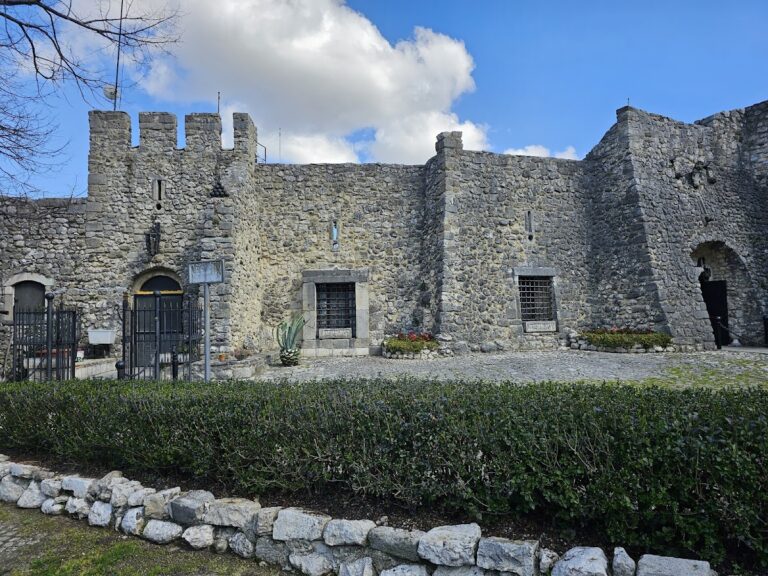
Castello di Popoli occupies the slopes of Monte Morrone above the historic center and overlooks the Tiburtina state road. It is a castello-recinto, an enclosed fortress whose defensive walls surround an area that could shelter a local population. The surviving enclosure has a triangular plan and is built of rough stone. At its highest point stands the original pentagonal watchtower, while a later square tower and a large cylindrical bastion occupy lower ground. The castle survives as ruins that have undergone recent restoration, including work on the towers.
Principal towers and bastion
Pentagonal upper keep
The pentagonal tower, also called the upper keep, occupies the highest point within the enclosure. It developed from an earlier irregular-pentagonal form and represents the oldest elevated defensive element of the surviving fortress.
Square tower and southern bastion
A square tower and the large cylindrical southern bastion were added lower down during later phases of the castle’s development. The southern bastion belongs to the Renaissance restructuring commissioned by Count Restaino IV Cantelmo. Together with the enclosure and upper keep, these towers express the fortress’s transformation from an early refuge and strongpoint into a more heavily rebuilt late medieval and Renaissance defensive complex.
Nearby sites