Castell de Vila-sacra: A Former Monastic Castle in Spain


Site at a Glance
- Rating
- 3.7
- Popularity
- Very Low
- Country
- Spain
- Primary era
- Medieval
- External website
- Open
- Eras represented
- Medieval, Early Modern
- Civilizations
- Crown of Aragon, Spanish
- Site type
- Military
- Remains
- Castle
On this page9 sections
History
Castell de Vila-sacra, also known as Castell Palau de l’Abat, is a former monastic castle in Vila-sacra, Spain, whose surviving fabric combines Romanesque and Gothic elements. It belonged to the Benedictine monastery of Sant Pere de Rodes and is documented in 1226 as a castle with jurisdictional territory, meaning a fortified lordship whose authority extended over local administration and a defined surrounding territory.
From aristocratic possession to monastic lordship
During the first half of the thirteenth century, the castle was held by the Cruïlles-Peratallada family. In 1226, Gilabert de Cruïlles and his wife, Cecília, sold the castle and its dependencies, territory, parish, and jurisdiction to Arnau de Foixà for his lifetime. In 1240, Abbot Ponç of Sant Pere de Rodes bought the castle from Gilabert de Cruïlles. This purchase began the monastery’s gradual extension of authority over Vila-sacra and its territory, a dominion that continued from the thirteenth through the eighteenth century.
Jurisdictional disputes and royal confirmation
The abbey’s growing authority brought it into repeated conflict with the counts of Empúries during the late thirteenth century. In 1303, Ponç V of Empúries accepted a compromise while facing the threat of excommunication, a formal exclusion from the Christian community that could be used as ecclesiastical pressure in political disputes. Although disagreements continued, Sant Pere de Rodes eventually secured full jurisdiction over the castles of Vila-sacra, el Far, and Marzà. In 1402, King Martin the Humane renewed the monastery’s rights after assuming the title of count of Empúries.
Transfer of the monastic community
By the late eighteenth century, the community of Sant Pere de Rodes regarded its ageing monastery as unsafe and decided to move to Vila-sacra. Work on Castell de Vila-sacra began in 1794. French troops sacked the old monastery in 1797 during the War of the Convention, a late-eighteenth-century conflict between revolutionary France and Spain and its allies. The monks were still living at Sant Pere de Rodes when the attack took place, and the community moved into the Vila-sacra castle in 1798.
The community was dispersed in 1809 when religious orders were abolished under King Joseph Bonaparte, Napoleon Bonaparte’s brother and the ruler installed by Napoleon as king of Spain. The monks returned to the castle in 1814 but moved to Figueres in 1818. Later nineteenth-century exclaustration and confiscation measures associated with Mendizábal forced religious communities to leave their monasteries and transferred ecclesiastical property to the state for sale. The Vila-sacra complex, comprising the house, courtyard, and garden, was auctioned and acquired by Ignasi Salleras.
Damage, protection, and civic use
The building suffered severe damage during the Peninsular War and was later rehabilitated. Since 2011, it has housed Vila-sacra’s municipal government. Castell de Vila-sacra was declared a Cultural Asset of National Interest as a historical monument in 1988 and is also registered as a Spanish Asset of Cultural Interest under reference RI-51-0006190.
Remains
The circular tower
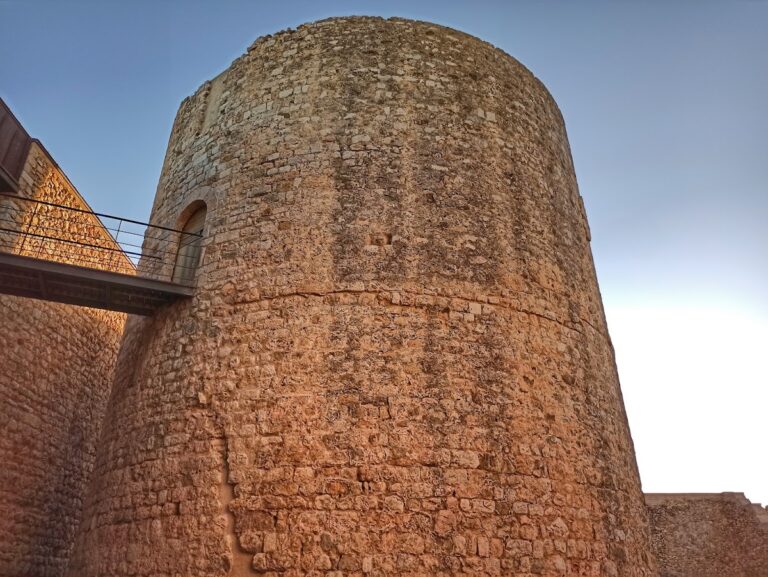
The castle remains stand beside the church, on its western side. The principal surviving feature is a circular tower with a truncated-conical form, approximately 14 metres high. Its external diameter at the base is about 9.70 metres, while the internal diameter is 4.20 metres; the walls are approximately 2.75 metres thick. The lower section rises to roughly 8 metres and is built from small, irregular stones arranged in courses. Above it, a central zone of regular ashlar blocks is followed by a crowning zone of irregular masonry. These three masonry treatments correspond to three building phases. The lower section may date from the eleventh century, the third storey is attributed to around the thirteenth or fourteenth centuries, and the crown appears to belong to the sixteenth century.
The tower has no ancient loopholes or other openings. Within the inhabited part of the palace, however, an older doorway survives at the level of the second floor.
The Gothic palace and attached buildings
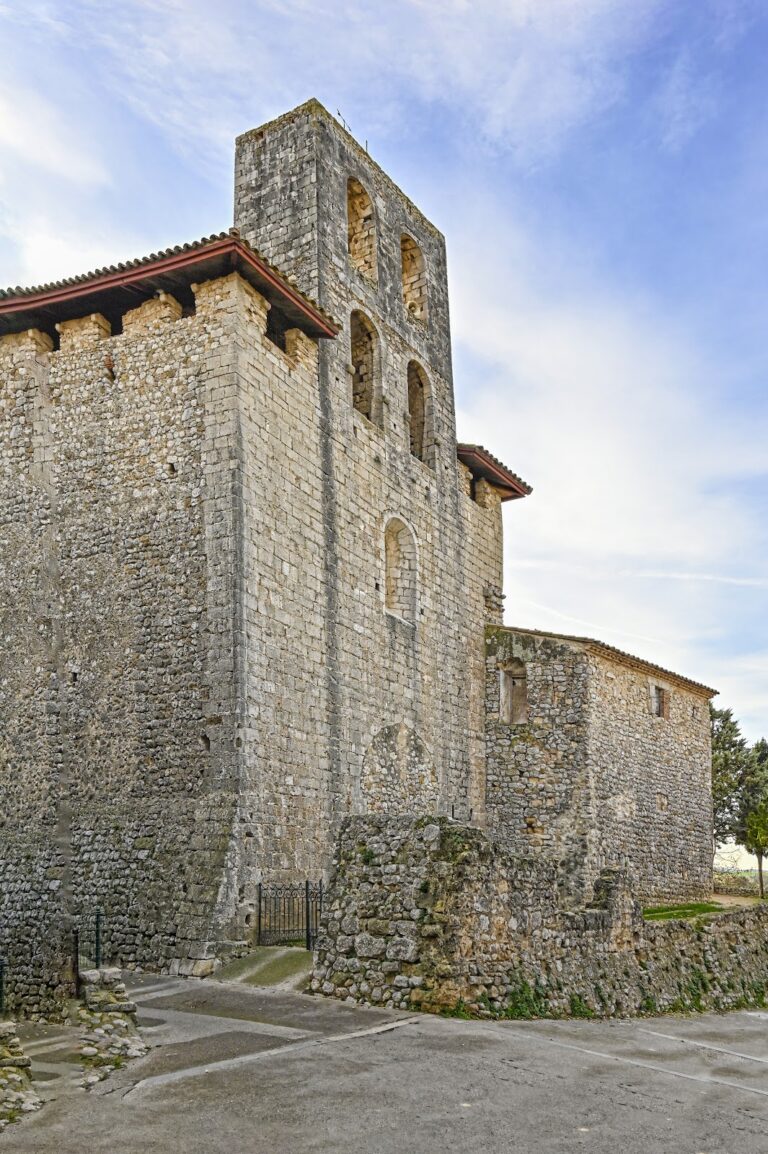
A rectangular building adjoins the southern side of the circular tower. Although it is in very poor condition, it preserves several Gothic features. On its eastern wall is a Gothic twin window with trefoil arches and no intervening column or capital. The northern side contains a large pointed arch, while the lower part retains remnants of loopholes. Other Gothic elements of the palace probably date from the fifteenth or sixteenth centuries.
A rectangular tower stands on the western side of the complex, and additional structures are attached to the circular tower on both its southern and western sides. The house adjoining the western side and the rectangular openings belong to alterations made when the Sant Pere de Rodes community transferred to Vila-sacra in 1798.
Later alterations and surviving masonry
The remaining masonry includes isolated alterations and destruction from later periods. Buildings on the northern side were added much later, while a large structure attached to the eastern end of the Gothic facade stands partly on foundations belonging to older walls whose date has not been determined.