Castell de Saburella: A Medieval Castle in Spain


Site at a Glance
- Rating
- 4.4
- Popularity
- Very Low
- Country
- Spain
- Primary era
- Medieval
- External website
- Open
- Eras represented
- Medieval
- Civilizations
- Crown of Aragon
- Site type
- Military
- Remains
- Castle
On this page6 sections
History
Castell de Saburella is a medieval castle in Spain, near Querol in Tarragona, built after the Christian Reconquest, the medieval Christian expansion into territories governed by Muslim powers in the Iberian Peninsula. Its construction is generally placed in the late twelfth or early thirteenth century, and its surviving fabric combines Romanesque and Gothic features. The limited historical record has prevented a unanimous construction date.
The Cervelló lineage and early records
Saburella, also known as Savorella, was connected with conflicts at nearby Castle of Selmella between the Monastery of Santes Creus, a major Cistercian monastery in Catalonia, and the Cervelló, a medieval Catalan noble lineage that controlled castles and territories. The castle’s first documentary reference appears in the testament of Ramon Alemany de Cervelló in 1229.
Ramon’s testament ordered the construction of a chapel dedicated to Saint Michael and assigned revenues for its upkeep and for the chaplain. It also granted the castle to his brother-in-law, Guillem de Claramunt, for Guillem’s lifetime. The arrangement could not be carried out because Guillem died during the expedition to Mallorca.
Royal intervention and later status
Saburella remained in the hands of the Cervelló lineage. In 1380, Peter III the Ceremonious, king of the Crown of Aragon, asked the general bailiff to return several castles occupied by the Crown to the Cervelló, including Saburella.
In 1481, the castle was recorded as a boundary of the territory of Pont d’Armentera. It is now registered as a Cultural Asset of National Interest and as a Spanish Asset of Cultural Interest with monument status, under reference RI-51-0006692. Its Catalan architectural-heritage inventory identifier is 1516.
Remains
Hilltop setting and layout
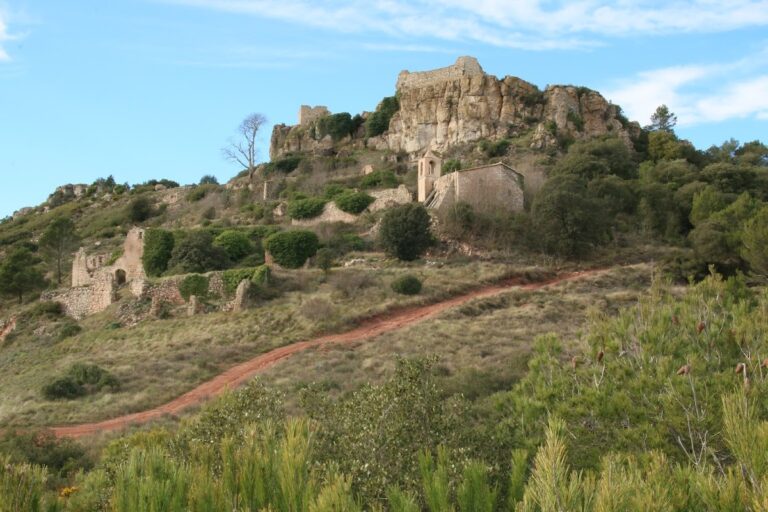
The castle stands on a conical hill on the right bank of the Gaià River, at the northwestern edge of Querol, approximately 683 to 685 metres above sea level. It lies near the Comadevaques stream, which descends from the Vallespinosa area in the Conca de Barberà. The site occupies relatively level ground associated with former cultivated fields and surviving holm-oak woodland, while Aleppo pine woodland predominates in the surrounding area.
From this position, the castle overlooks Sant Miquel de Montclar to the north, Formigosa and the Comadevaques stream to the northeast, Montagut and Castle of Pinyana to the east, and the Camp de Tarragona and the Gaià valley to the south. The town and castle of Querol lie nearby on the opposite side of the river. This setting differs from the nearby rock castle of Selmella, which occupies the edge of a cliff.
Towers and surrounding wall
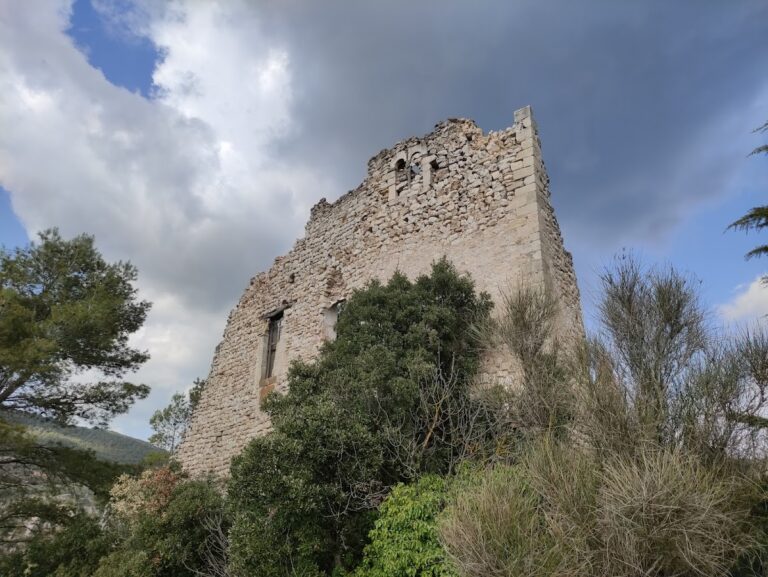
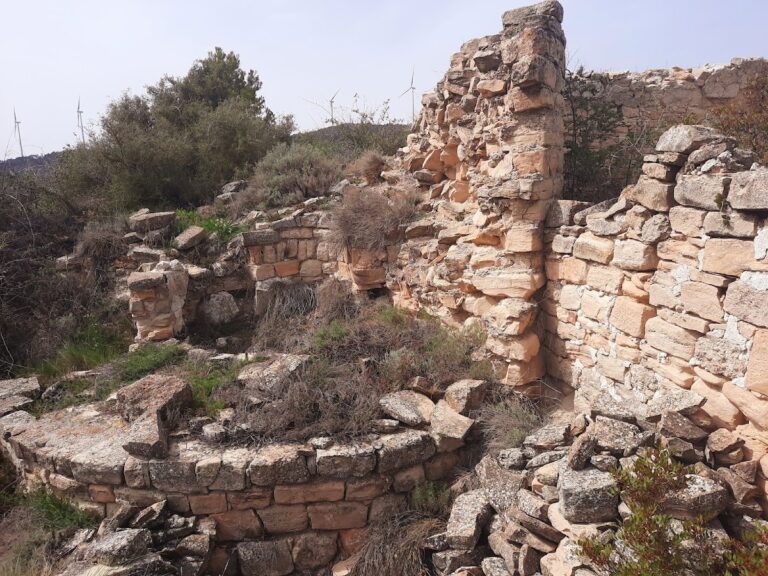
The surviving complex brings together Romanesque and Gothic architectural features. It is relatively well preserved, with one of its three semicircular towers remaining almost complete. Part of the surrounding wall also survives, preserving elements of the castle’s defensive enclosure and its relationship to the hilltop ground.
Nearby sites