Castell de Ribatallada: A Medieval Castle and Farmhouse in Spain


Site at a Glance
- Rating
- 3.9
- Popularity
- Very Low
- Country
- Spain
- Primary era
- Medieval
- External website
- Open
- Eras represented
- Medieval
- Civilizations
- Unclassified
- Site type
- Domestic
- Remains
- House
On this page5 sections
History
Castell de Ribatallada is a former medieval castle in Spain, beside the Ribatallada stream in the municipality of Sabadell, Barcelona Province. Its surviving form belongs to vernacular architecture, the use of local and traditional building practices. The castle first appears in written evidence in 1136, when Ramon Berenguer IV, the twelfth-century Count of Barcelona, granted it and several other castles as a feudal fief to his seneschal Guillermo Ramón.
A feudal fief was a territorial holding granted by a lord to a vassal in return for service and allegiance. The Moncada lineage held Ribatallada until 1310, when ownership passed to the Clasqueri lineage. It later came to the Togores lineage, which became extinct at the end of the fifteenth century. The former castle was declared a monument on 8 November 1988.
Remains
Surviving structures
Ribatallada farmhouse
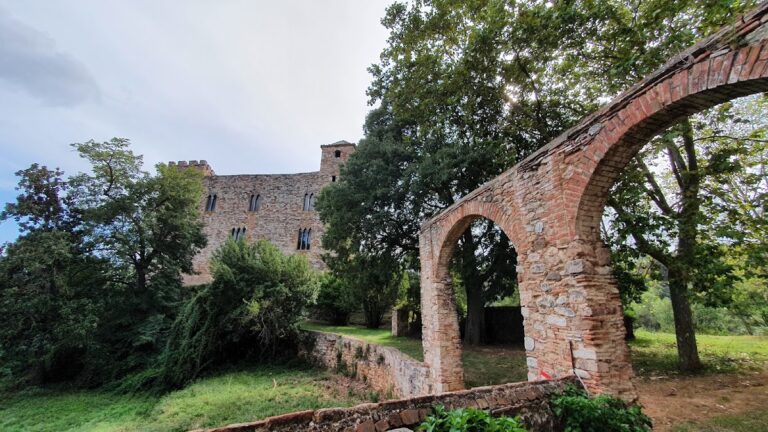
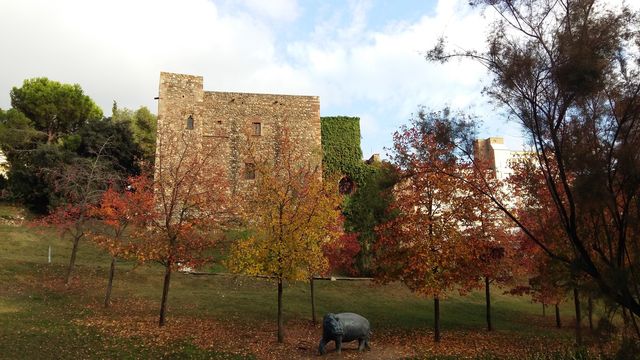
The former castle now survives as the Ribatallada farmhouse, a partially ruined rural building on a hill near San Julià de Altura. Its irregular plan reflects both the uneven ground and successive extensions. The building is a masia, a traditional Catalan farmhouse, and preserves the site’s later rural form.
Northwestern wall
In the northwestern part of the site are the remains of a battered wall that may represent part of the former castle enclosure. The wall is made from medium-sized rounded stones with roughly dressed faces, arranged in regular courses. These surviving masonry remains provide a physical link between the farmhouse and the earlier fortified site.
Nearby sites