Monestir de Sant Llorenç del Munt: A Romanesque Benedictine Monastery in Spain


Site at a Glance
- Rating
- 4.7
- Popularity
- Low
- Country
- Spain
- Primary era
- Medieval
- External website
- Open
- Eras represented
- Medieval
- Civilizations
- Unclassified
- Site type
- Religious
- Remains
- Monastery
On this page6 sections
History
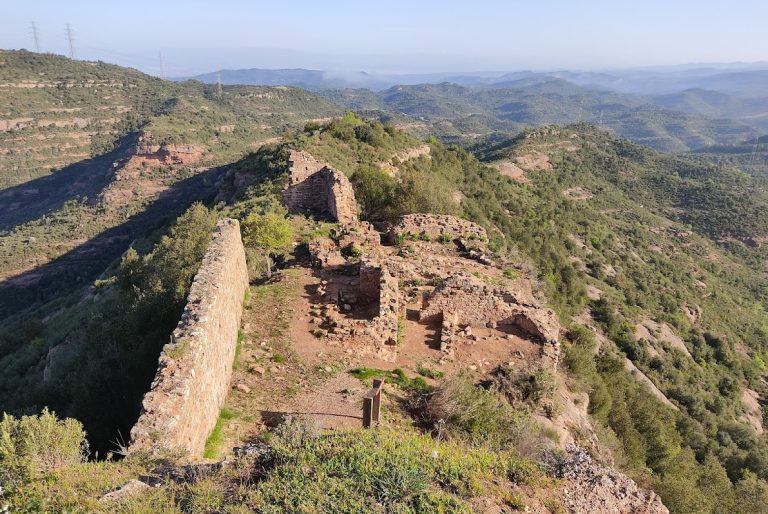
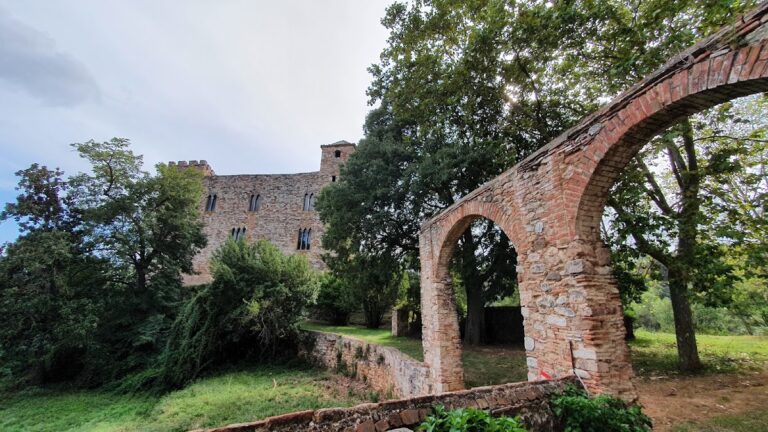
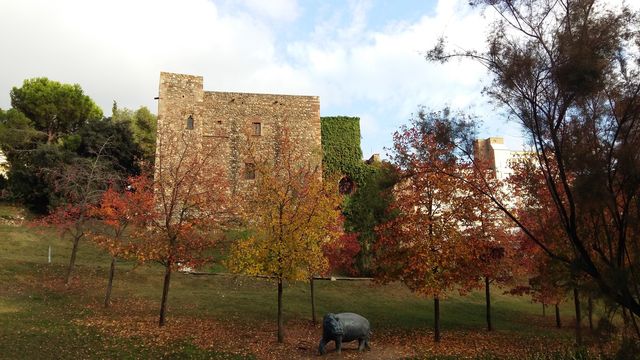
Monestir de Sant Llorenç del Munt is a Roman Catholic Benedictine monastery on La Mola in Spain, within the municipality of Matadepera, Barcelona. Its present form preserves the conception of a mid-eleventh-century Romanesque building, a medieval European style known for thick masonry, rounded arches, and simple geometric forms. The monastery stands within the natural park of Sant Llorenç del Munt i l’Obac, between the Catalan regions of Bages and Vallès Occidental.
Early religious foundation
The earliest evidence of religious buildings on the summit dates from approximately 947 to 957. Records from this period refer to three churches or chapels dedicated to Saint Lawrence, Saint Mary, and Saint Michael. Their precise interpretation remains uncertain, since they may describe earlier buildings or the monastery together with other mountain hermitages.
A religious community governed by the abbot of Sant Cugat, the superior of a Benedictine monastery, appears in 986. The term “monastery” is used in a 1014 document concerning a land exchange between Ramon Borrell, Count of Barcelona, and his wife and the abbey of Sant Llorenç. An abbot of Sant Llorenç is mentioned at the site in 1018. Sant Cugat Abbey, a major Benedictine abbey in Catalonia, promoted the construction of Sant Llorenç del Munt and remained its principal dependency for most of its history. A donation by Borrell II, Count of Barcelona, to the abbot of Sant Cugat included several churches on the Sant Llorenç mountain.
Romanesque construction and monastic decline
The Vallès plain was repeatedly invaded by Muslim forces during this period, leading to the destruction and looting of settlements and churches. No attack on the summit buildings is recorded. The monastery consequently consolidated its position, and construction of the Romanesque building probably began around 1045. The church was consecrated in 1064 by the bishop and the counts of Barcelona.
The monastery began a gradual decline in the early twelfth century, although Benedictine occupation continued until 1608. A priest responsible for the monastery is recorded in 1637, after which the site was abandoned. On 30 March 1809, Napoleonic troops destroyed the remaining monastery and desecrated the abbots’ graves.
Reconstruction and heritage status
The present building was reconstructed between the late nineteenth century and the mid-twentieth century while retaining the structure of the mid-eleventh-century Romanesque monastery. This reconstruction is regarded as an example of Catalan Romanesque religious architecture and as one of the few surviving monasteries of its period. Monestir de Sant Llorenç del Munt was designated a Spanish Cultural Heritage monument on 3 June 1931 under reference RI-51-0000445.
Remains
The monastery occupies the summit of La Mola inside the natural park of Sant Llorenç del Munt i l’Obac. Its surviving church retains the original design without structural changes that alter its conception. The present building is an exact replica, at half the size, of Sant Cugat monastery, whose abbey sponsored its construction.
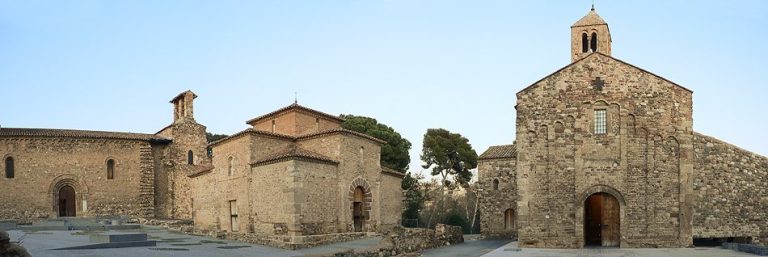
Church structure
The church has three naves and a central transept, the crosswise arm that intersects the main nave. At the crossing, where these parts meet, a tower rises above the crossing arches. The building is constructed from modest-sized local stones, which are reddish and unpolished. Its treatment is notably plain, without artistic ornamentation, and the entrance doorway is small. The bell tower forms part of this compact Romanesque composition.