Castelfondo Castle: Seat of a Medieval Judicial District in Italy


Site at a Glance
- Rating
- 3.4
- Popularity
- Very Low
- Country
- Italy
- Primary era
- Medieval
- External website
- Open
- Eras represented
- Medieval
- Civilizations
- Habsburg
- Site type
- Military
- Remains
- Castle
On this page6 sections
History
Castelfondo Castle is a medieval castle in Italy that served as the seat of a judicial district covering part of the Upper Non Valley. Its jurisdiction included Melango, now Castelfondo, as well as Raìna, Dovéna, Brez, Arsio, Traversara, the Senale Valley, Ruffré, Don, Amblàr, the San Romedio Valley, and Tavón.
Tyrolean control
In the second half of the thirteenth century, the castle became the property of Godescalco of Cagnò. He later sold it to Mainardo II of Tyrol-Gorizia, a medieval count of Tyrol and member of the Gorizia-Tyrol ruling house. Mainardo used Castelfondo as a base for extending his control over the Non Valley.
At the beginning of the fourteenth century, ownership passed to Enrico III of Rottemburg. The castle returned to the Counts of Tyrol in 1412, when several captains were installed there. Around the middle of the fifteenth century it passed to Bernardo Fuchs von Fuchsberg, and in 1471 it became the property of the Thun family, a noble family from the historical Tyrol and neighbouring Alpine regions.
Damage, abandonment, and restoration
Peasants besieged Castelfondo Castle during the 1525 peasant revolt, an uprising that challenged established authority in the German-speaking lands and neighbouring regions. Fires in 1670 and 1738 caused serious damage and destroyed part of the Thun family archive preserved at the castle.
After the resident branch of the Thun family moved to Bohemia, the castle was abandoned and fell into ruin. During the nineteenth century it passed to the Thun branch of Castel Baghér. Guidobaldo Thun and his son Galeazzo Thun then restored the complex.
Remains
Castle complex
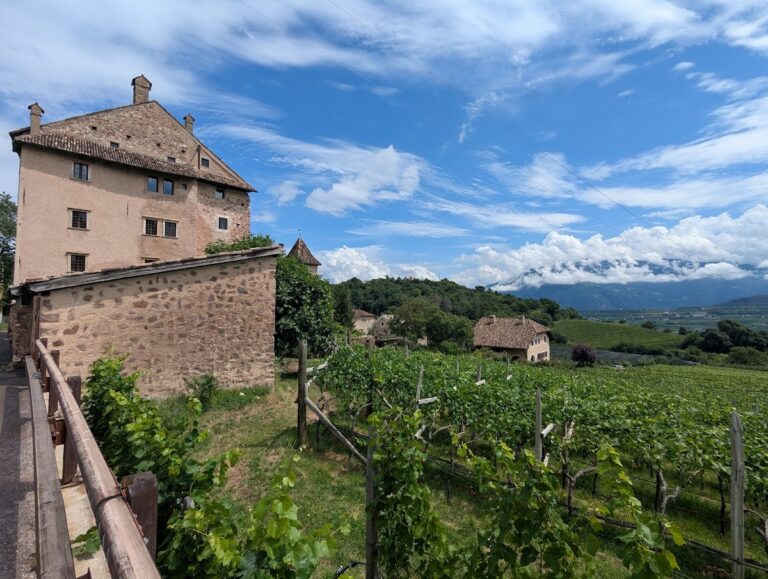
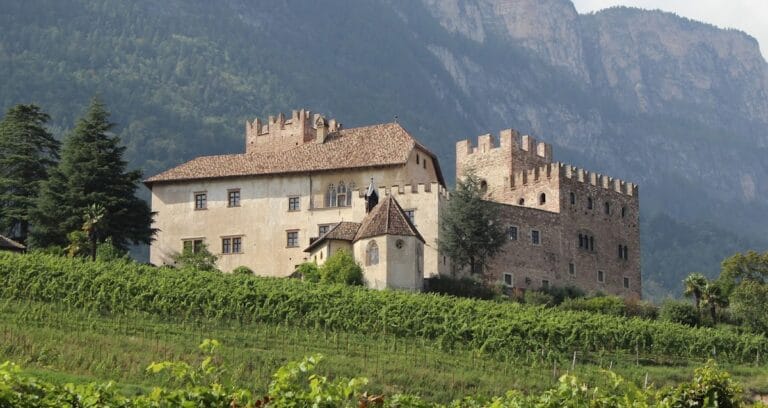
Castelfondo Castle stands on a wooded hill above the confluence of the Robiola stream and the Novella torrent, at the entrance to Castelfondo. The keep, the principal fortified tower and the oldest component of the castle, forms the core around which additional buildings developed over the centuries. An elegant portico, a covered gallery supported by arches, was added around the inner courtyard in 1492. Simone Thun commissioned it, and the master mason Lorenzo of Val d’Intelvi built its four round arches, each with a semicircular profile.
The interior includes an arms collection, a library, and an archive, together with several decorated rooms. These include the Camera del Foro, Fireplace Room, Long Room, Don Quixote Room, Bishops’ Room, and Ancestors’ Hall. Portraits of Thun prelates are preserved in the Bishops’ Room.
Church and tower
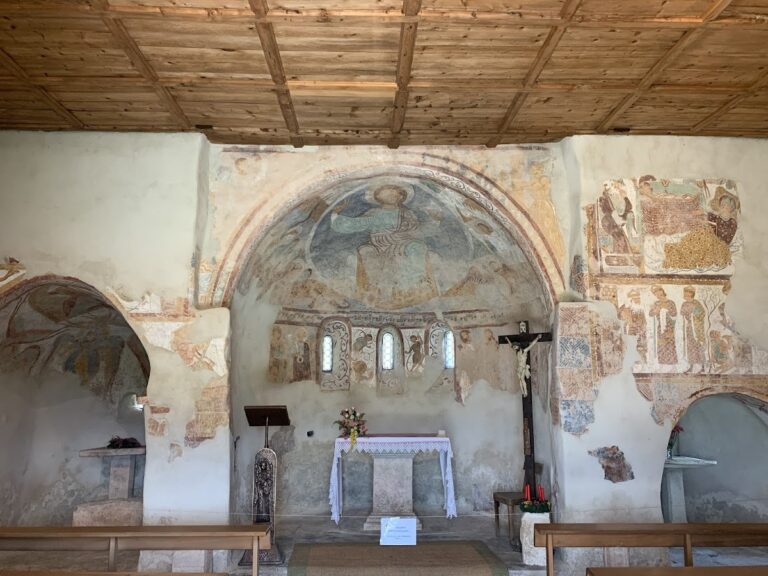
The nearby Church of the Nativity of the Blessed Virgin Mary is documented from 1282 and was restored in 1528. Frescoes, wall paintings made on or over plaster, were discovered in its apse, the usually semicircular or polygonal end behind the main altar, in 1945. They belong to several periods, and some bear the signature of Kaspar Blabmirer, who was active in 1433.
Beside the church stands the Tower of Saint Mary on the Castelfondo hill. Built between 1468 and 1470, the circular, crenellated tower is approximately 25 metres high and has a conical roof. Sigismondo of Habsburg, a fifteenth-century Habsburg ruler of the Austrian lands and Tyrol, ordered its construction. The local population built the tower as forced labour imposed after an attempted revolt.