Château de Versols: A Medieval Fortified Residence in France


Site at a Glance
- Rating
- 5
- Popularity
- Very Low
- Country
- France
- Primary era
- Medieval
- Eras represented
- Medieval, Early Modern
- Civilizations
- French
- Site type
- Military
- Remains
- Castle
On this page9 sections
History
Château de Versols is a medieval fortified residence in France, in the Sorgues valley of southern Aveyron at the meeting of the Sorgues and Versolet rivers. The site was occupied from the early Middle Ages, probably on the location of a Gallo-Roman oppidum, a fortified settlement associated with the Iron Age or Roman periods, and it is documented from the eleventh century. The castle formed the central stronghold of the medieval settlement of Versols.
Early Lordship and Sylvanès Abbey
In 1132, Guillaume Bernard de Versols gave his fief to Sylvanès Abbey, a medieval monastic foundation in southern France, before leaving for Jerusalem. The transfer places the castle and its lordship within the religious and feudal networks of the twelfth century.
The Roquefeuil-Versols Lineage
Between 1256 and 1277, Guilhem, also known as Guillaume, de Roquefeuil acquired the different shares of the lordship of Versols. He was the natural son of Arnaud de Roquefeuil, comtor of Nant, and his testament has been studied for its evidence of feudal connections linking Languedoc and Aragon during the thirteenth century.
In 1275, Guilhem’s son Jean I de Roquefeuil received the homage of the inhabitants of Versols, establishing the Roquefeuil-Versols branch. The family held the lordship until 1716. That year, Élisabeth de Roquefeuil-Versols married Jean-Casimir d’Izarn de Freissinet de Valady under a marriage contract concluded at Versols on 30 June. A clause required their heir to retain the Roquefeuil-Versols name and arms, extending the lineage into the eighteenth century.
Decline and Restoration
During the nineteenth and twentieth centuries, ownership of the castle was divided among several people. The complex was gradually abandoned and partly fell into ruin. From 1964, André de Roquefeuil and his wife reacquired it in stages. Restoration took place during the 1980s with technical assistance from Louis Causse, an architect working for France’s historic-monuments service, the state heritage system responsible for protecting designated historic buildings, and with the support of a study by Jacques Miquel.
The façades, roofs, and great Gothic hall received historic-monument protection under a designation established in 1988. The castle remains privately owned by the Roquefeuil family.
Remains
Fortified Settlement and Courtyard
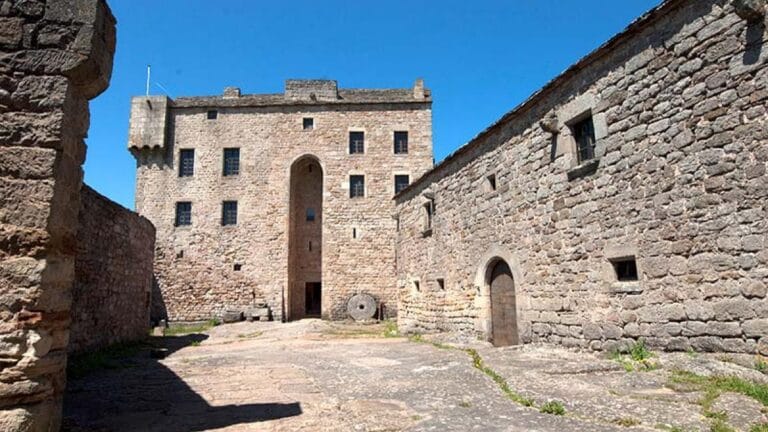
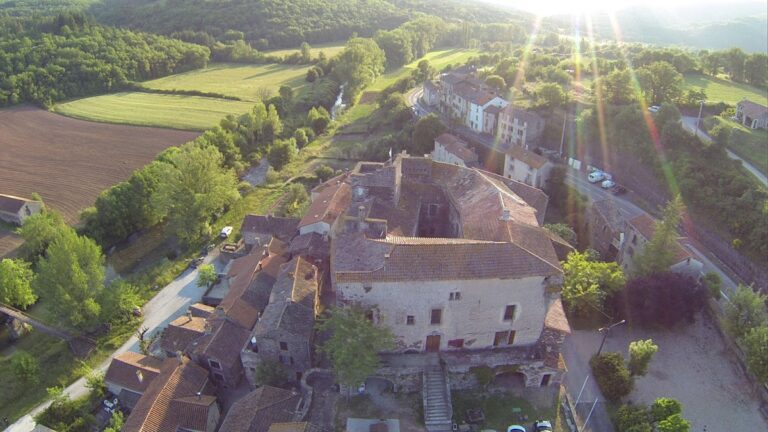
The castle stands on a rocky terrace and forms the central feature of the medieval fortified settlement, or castrum, of Versols. Its buildings are arranged as a fortified cluster around a large inner courtyard, creating a compact defensive and residential complex within the settlement.
Defensive Works
During the Hundred Years’ War, the prolonged series of conflicts between the English and French crowns conventionally dated from 1337 to 1453, the complex was strengthened around 1360 to 1370. The additions included at least one postern, a small gateway through a fortification, three corner towers, and two watch turrets used for observation or defense.
Residential Buildings
The present residential building dates mainly from the fifteenth and sixteenth centuries. It rises above a large substructure of vaulted cellars dating from the tenth to the fourteenth centuries. The building now has two full square stories, with the second story added during the seventeenth century.
Great Gothic Hall
The great Gothic hall, known as a tinel, is a large communal or ceremonial room within a medieval fortified residence. It contains a fireplace and wall paintings, and its surviving fabric forms part of the protected historic architecture of Château de Versols.
Nearby sites