Casa di Annalena: A Neoclassical Palace in Florence
Site at a Glance
- Rating
- 4.1
- Popularity
- Low
- Country
- Italy
- Primary era
- Modern
- External website
- Open
- Eras represented
- Modern
- Civilizations
- French, Grand Duchy of Tuscany
- Site type
- Domestic
- Remains
- Elite Residence
On this page10 sections
History
Annalena and the convent
Casa di Annalena is a palace on Via Romana in Florence, Italy, built around 1810 in the Neoclassical style, which drew on ancient Greek and Roman forms. Its name recalls Annalena, also known as Anna Elena, a fifteenth-century noblewoman whose home and later convent occupied the site.
In 1438, Annalena received a building from Cosimo de’ Medici when she married the military commander Baldaccio d’Anghiari. After Baldaccio was killed in a conspiracy in 1441, she made her home into a convent named San Vincenzo d’Annalena. She died in 1491. In the years after her death, Cosimo I de’ Medici directed that the convent’s lands and buildings be put to military use as a defensive strongpoint. This use continued until the middle of the sixteenth century. The convent closed in 1786.
The garden and reuse of the convent site
In 1791, Marquis Tommaso Corsi acquired a kitchen garden beside the former convent and created the Corsi, or Annalena, Garden. Landscaped to evoke natural scenery rather than a formal geometric plan, it was the first romantic garden in Florence. From 1807, the former convent buildings returned to residential and recreational use. Building entrepreneur and entertainment impresario Luigi Gargani bought almost all of them, using some as homes and others for performances and celebrations. The Goldoni Theatre was established on part of the former convent grounds.
The palace and the Macdonalds
Architect Giuseppe Del Rosso designed the palace around 1810. It later became known as Palazzo Mac Donel or Palazzo Mac Donald, names connected with General Francesco Macdonald, who bought and enlarged the building in 1820. Macdonald had served as a French army general and as Minister of War for the Kingdom of the Two Sicilies, a monarchy in southern Italy, under Joachim Murat, who became ruler of Naples. He lived in the palace with Carolina Bonaparte, Napoleon’s sister and Murat’s widow. They married in 1830. During Macdonald’s ownership, the convent church dedicated to St Vincent Ferrer was demolished and its site used for the palace stables.
Macdonald died in 1837. His son Hugh sold the house’s valuable contents to a French order of the Sisters of the Sacred Heart. In December 1838, the French prince Luigi Carlo Filippo Raffaello d’Orléans, Duke of Nemours, stayed at the house. The property later passed to the Sisters of the Sacred Heart and then to Fondiaria Assicurazioni.
A hotel and its cultural guests
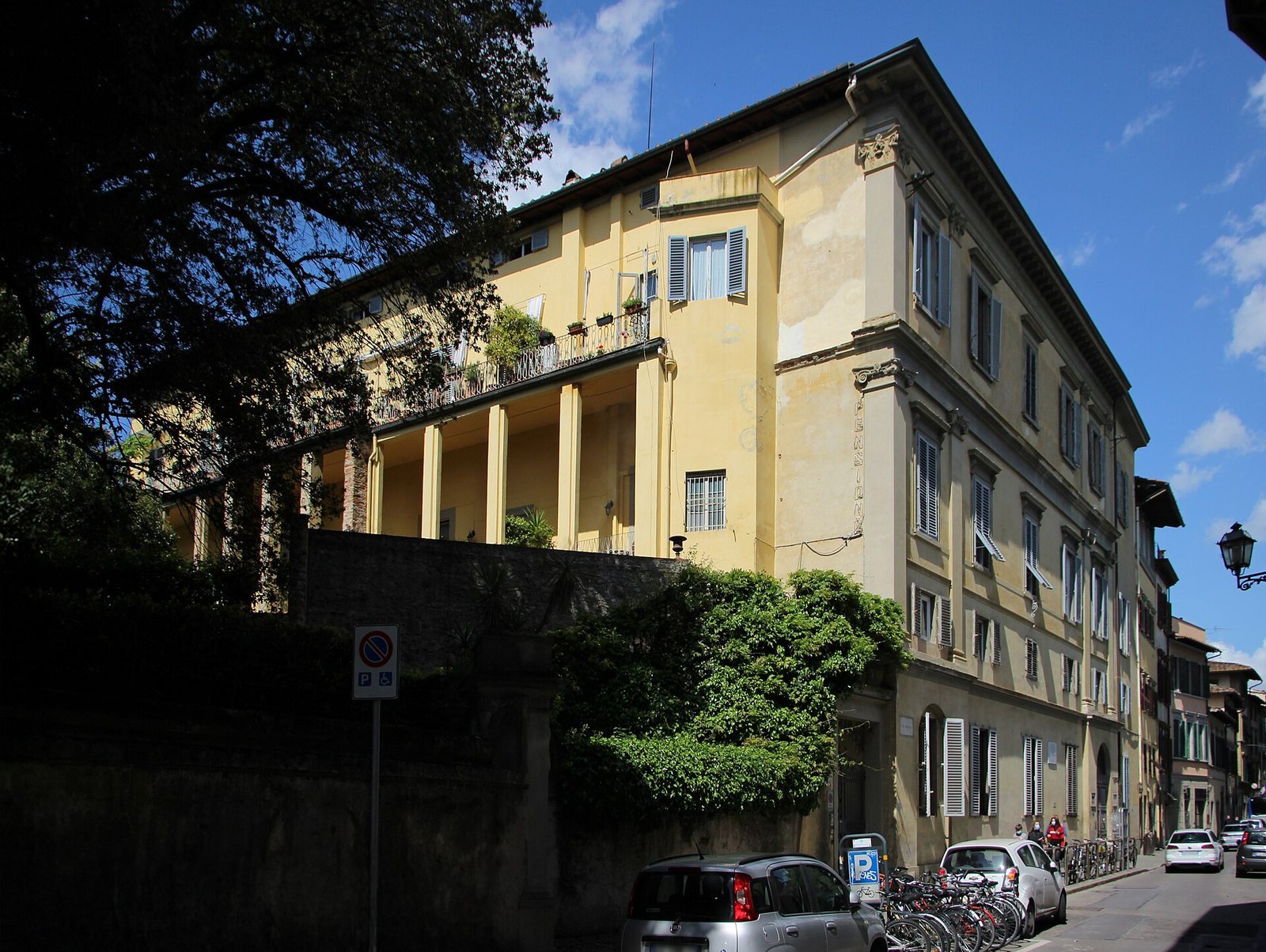
In 1919, the building was divided. The Calastri-Rossoni family converted its second and third floors into Pensione Annalena, which became a lodging place for writers, artists, and other cultural figures. The poet Eugenio Montale stayed there for extended periods during the 1930s and had a relationship with the American scholar Irma Brandeis. His poem Interno-Esterno evokes the two of them reading the English poet John Donne on the pension’s veranda.
In 1944, the writer Carlo Levi worked on pages of Christ Stopped at Eboli beneath the portico outside his room. Composer Luigi Dallapiccola stayed at the pension for more than twenty years, until his death in 1975. Other guests included American museum director Francis Henry Taylor and Italian actors Vittorio Gassman and Ugo Tognazzi.
Remains
Street façade
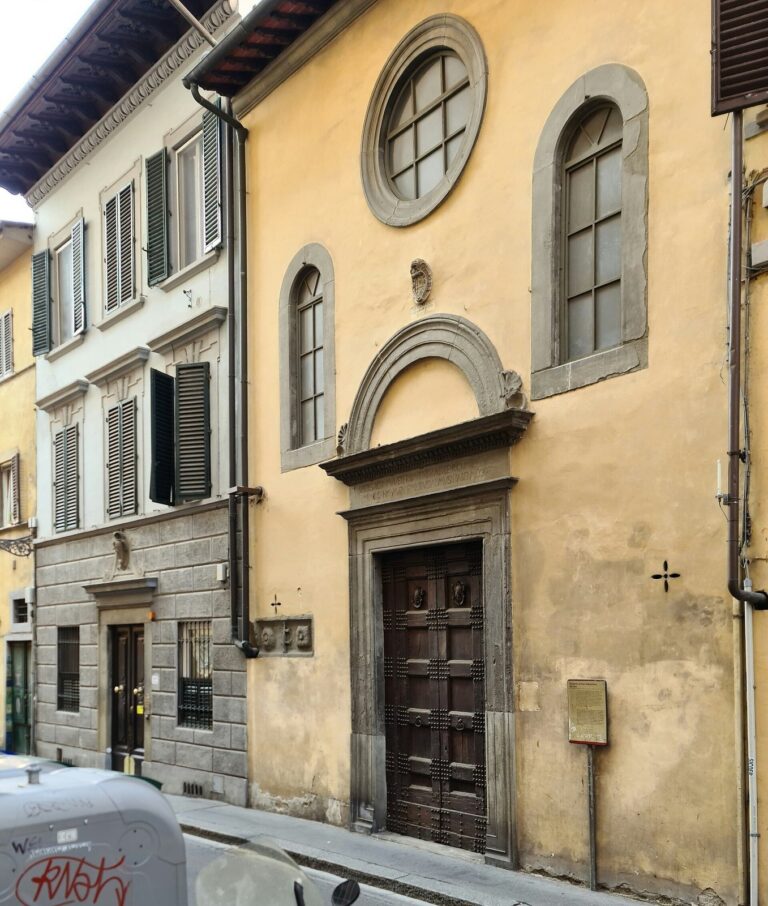
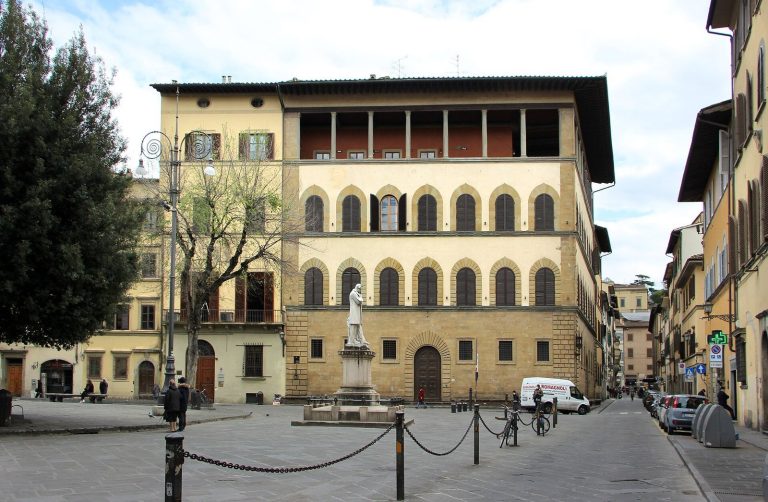
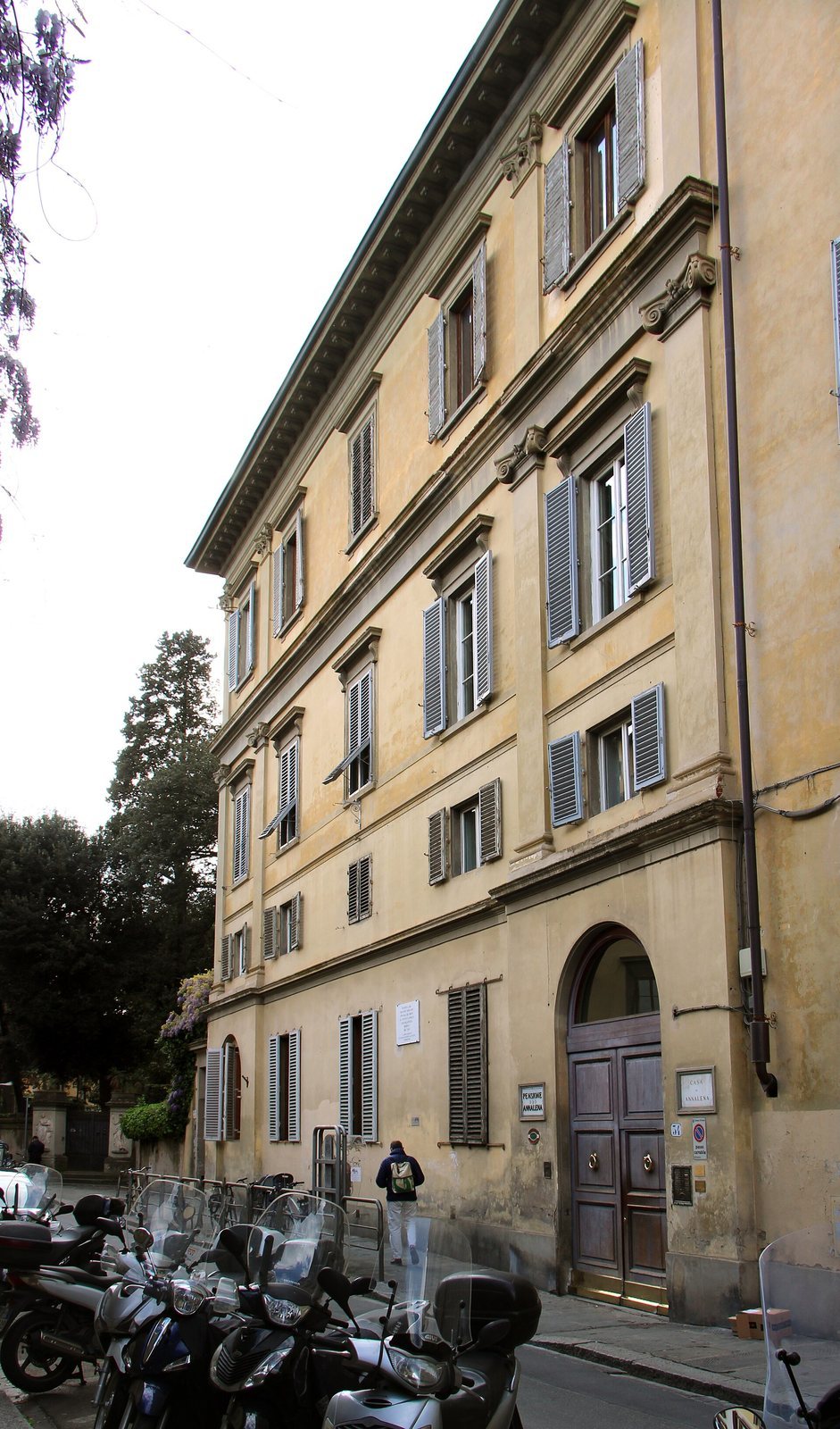
The street-facing façade has five vertical divisions, or bays, across three floors and a mezzanine, an intermediate level. Shallow attached pilasters frame the two outer bays, each topped by an Ionic capital with scroll-like forms. The façade is in fair condition.
Garden-facing side
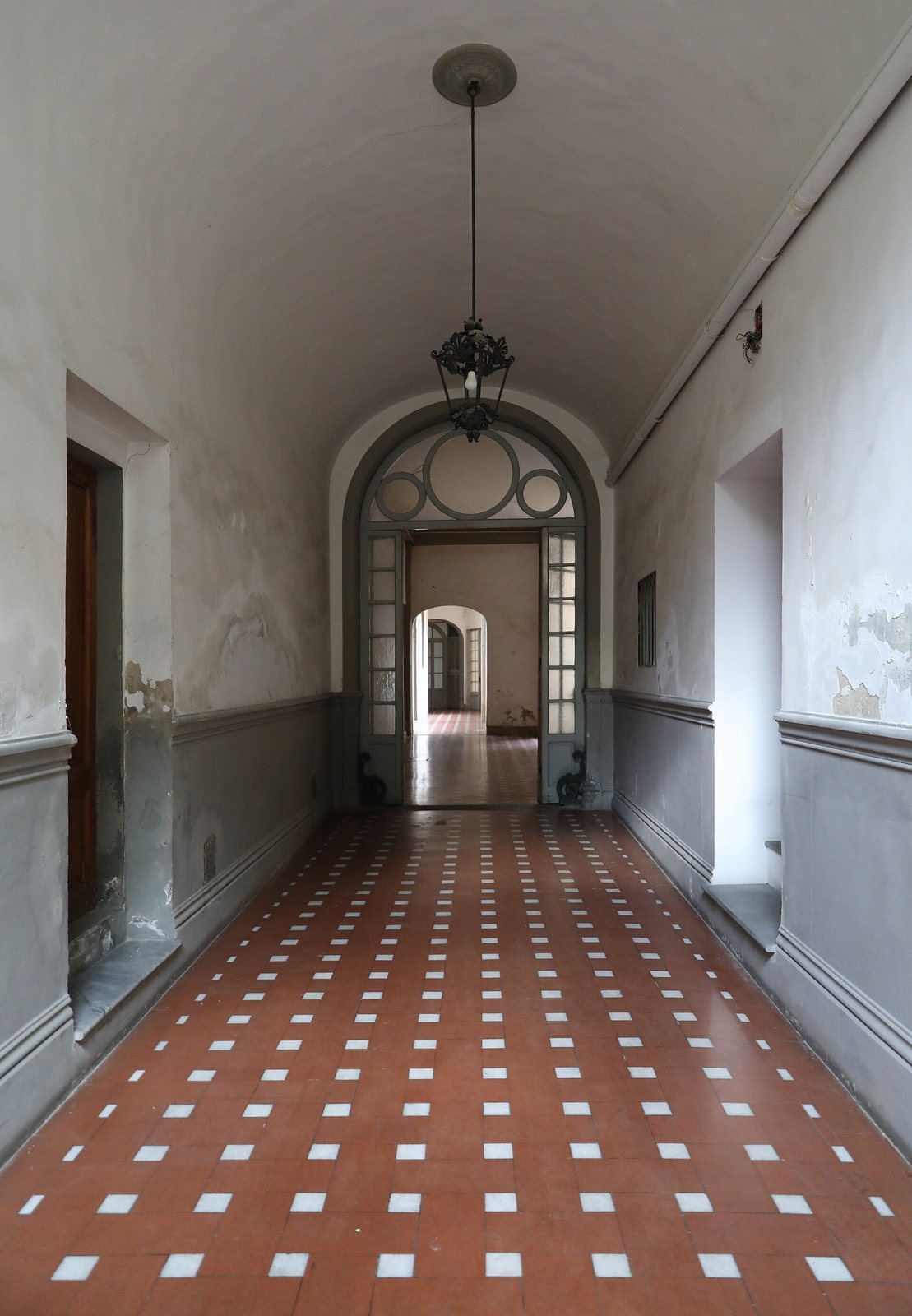
The garden-facing front is more elaborate than the street elevation and includes porticoed spaces at ground level. A veranda associated with this side is recalled in Montale’s poem. The façade is in poor condition, with extensive plaster loss.
Former convent grounds
The Corsi, or Annalena, Garden adjoins the palace. Within the former convent complex, the site of the church of St Vincent Ferrer was reused for the palace stables after the church’s demolition. The Goldoni Theatre was established on another part of the former convent area.
Commemorative plaque
A plaque commemorating Dallapiccola’s long residence at the pension was fixed to the palace façade in 2004.