Casa de los Tiros: Historic Building and Museum in Granada


Site at a Glance
- Rating
- 4.4
- Popularity
- Medium
- Country
- Spain
- Primary era
- Early Modern
- External website
- Open
- Eras represented
- Early Modern
- Civilizations
- Spanish
- Site type
- Domestic
- Remains
- Elite Residence
On this page16 sections
History
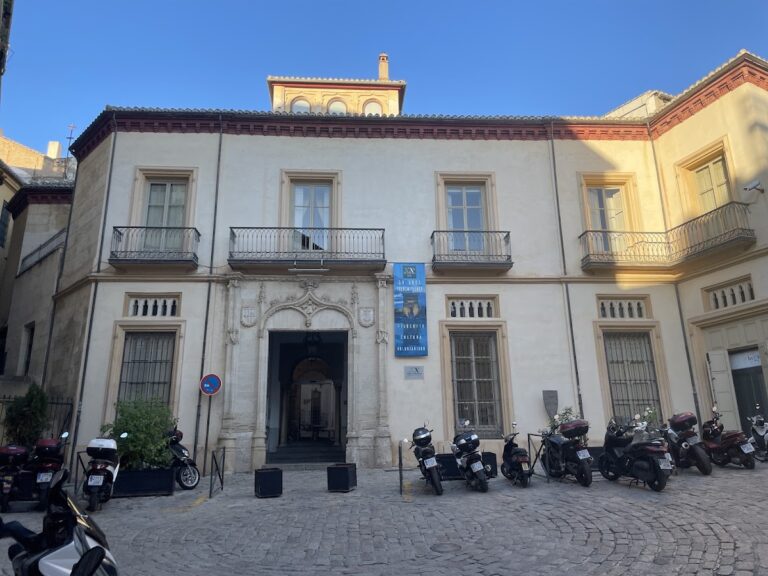
Casa de los Tiros is a historic building and museum in Granada, Spain, constructed in the sixteenth century in imitation of the contemporary palaces of Granada. Its fortress-like form reflects its incorporation into the wall of the city’s former potters’ district. The building now houses the Museo Casa de los Tiros de Granada, which explores the history of the city through art, literature, journalism, crafts, and festival material.
Origins and early owners
The earliest owners belonged to the Granada Venegas lineage. This family began with Pedro de Granada, also known as Cidi Yahya, a noble descendant of Yusuf IV and son of the Infante of Almería and governor of Baza. Pedro converted to Christianity and married his cousin Cetti Meriem, who also converted and took the name María Venegas. Their marriage established the Granada-Venegas family line.
The house was later acquired by Gil Vázquez de Rengifo, commander of Montiel and one of the knights who took part in the conquest of Granada alongside Isabella I of Castile and Ferdinand II of Aragon, the Catholic Monarchs whose joint reign ended Muslim rule in Granada in 1492. The building’s palatial appearance reflects the architectural culture of sixteenth-century Granada, while its defensive character recalls the wall and district into which it was integrated.
The Campotéjar period
The property remained with the Marquises of Campotéjar until 1921. The title had been granted to the Granada Venegas family in recognition of services to the Crown. A lengthy legal dispute between the family and the state lasted from the eighteenth century into the twentieth century, after which ownership passed to the state.
Casa de los Tiros was declared a monument on 3 December 1919 and is recorded under heritage code RI-51-0000171. Its institutional history later included several years as the headquarters of the Ateneo de Granada, while its continuing public role became centered on the museum and its study collections.
The museum and its historical scope
The museum’s holdings grew through donations from private individuals. They include drawings, prints, lithographs, photographs, plans, local handicrafts, books and periodicals about Granada, pamphlets, posters, and newspapers. Together, these materials present the city through its landscapes, historical memory, artistic production, social customs, notable people, and public events.
The displays are arranged in twelve thematic areas. The opening sections address graphic and literary images of Granada and then examine Orientalism, the nineteenth-century European interest in Eastern cultures, landscapes, and imagined historical worlds. They also consider travel literature and the development of Orientalist studies. Another room recreates the experience of nineteenth-century travelers drawn to Granada’s Islamic heritage, historic urban form, and the Alhambra.
Remains
Casa de los Tiros is organized around a narrow, three-storey tower faced with ashlar masonry, meaning regularly cut and finely dressed stone blocks. The original tower forms the surviving core of a building that was expanded around it. Its exterior combines defensive references with palace decoration, while the interior includes a courtyard, staircases, a garden, and richly decorated rooms.
Tower and exterior features
Facade and entrance
The tower facade is crowned by battlements that once carried artillery pieces, giving the house its name. Five life-sized sculptures stand on consoles across the facade. They portray Hercules, Theseus, Mercury, Jason, and Hector as heroic figures prepared for battle, with spread feet, upright shoulders, and fixed gazes.
A large seventeenth-century doorway with a flat lintel opens into the building. Above it, a carved sword pierces a heart beside the motto “The heart commands.” Two balconies and three bronze door knockers complete the principal facade features described at the entrance.
Courtyard and garden
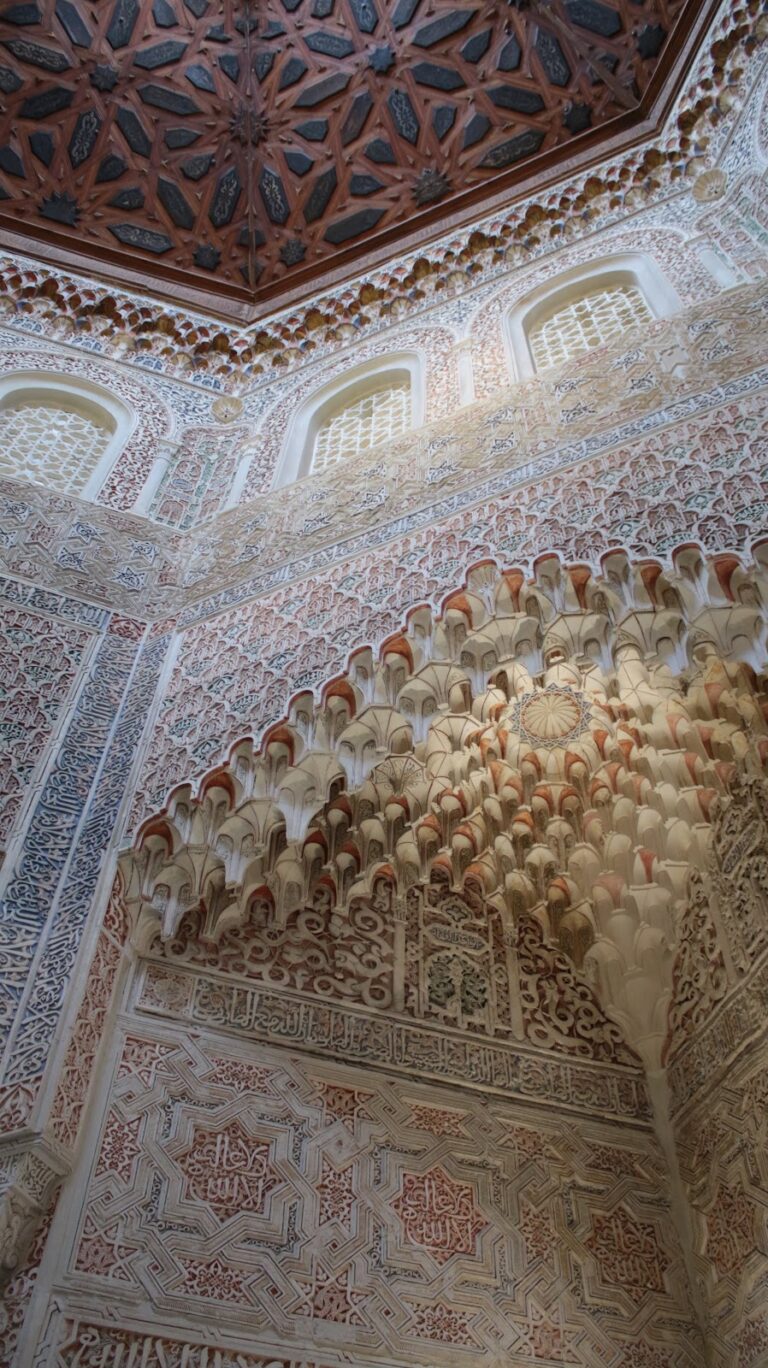
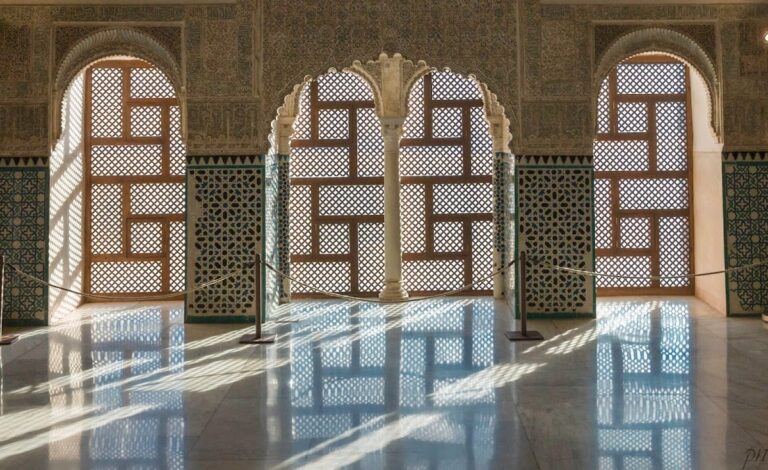
The courtyard has whitewashed walls and follows a Muslim-style arrangement, with a small fountain at the center and Nasrid columns. The Nasrids were the Muslim ruling dynasty of the Emirate of Granada, whose artistic traditions shaped many of the city’s historic buildings.
A small garden occupies the rear of the building. It contains cypresses, boxwood parterres, pomegranate and orange trees, and myrtles, together with a fountain, a pond, busts, and sculptures. Some shrubs carry personal associations because intellectuals of the period planted them, including a laurel planted by Elena Martín Vivaldi.
Interior rooms and circulation
Entrance hall
The tall entrance hall occupies the lower part of the tower. Its flat wooden ceiling rests on large beams supported by Gothic corbels, which are projecting supports that carry structural members. Between the beams are polychrome paintings of mythological animals and fighting beasts.
Staircases
The principal staircase dates from the eighteenth century and is covered by a vault with windows. It displays portraits of Spanish kings from the House of Austria, the Spanish Habsburg dynasty that ruled during the sixteenth and seventeenth centuries. The paintings came from the Generalife, the historic palace and garden estate associated with Granada’s Nasrid rulers, and are copies made during the sixteenth and seventeenth centuries by court portraitists.
A separate sixteenth-century principal staircase has mural paintings of Charity, Hope, and Justice, together with an image of the Immaculate Conception. These painted representations form part of the building’s early decorative program.
Cuadra Dorada
The Cuadra Dorada is the building’s most emblematic room. Its Renaissance wooden ceiling has abundant gilded reflections, a feature that gives the room its name. Renaissance architecture revived classical forms in Europe during the fifteenth and sixteenth centuries, and the room’s ceiling belongs to that decorative tradition.
The ceiling consists of large planks with low-relief decoration and written texts, supported by beams and corbels shaped as historical figures. The arrangement resembles a chessboard. It commemorates figures associated with the struggle to achieve Spanish unity, with an account of each person’s achievements placed below the representation. The figures include Alaric, Hermenegild, Recaredo, Alfonso V, López de Mendoza, the Catholic Monarchs, Charles I, and Isabella of Portugal. Charles I appears as the ruler who raised Spain to imperial status.
Frescoes on the walls depict heroes and warriors. Four roundels, or circular framed reliefs, contain figures of heroines from antiquity.
Museum collections and displays
Landscape, travel, and Granada’s past
The museum’s graphic and literary material presents Granada’s landscape and its changing image. The Orientalism rooms explore nineteenth-century interest in the city’s Islamic past, while the travel section evokes visitors attracted by the Alhambra, historic streets, and Granada’s architectural inheritance.
Ceramics, sculpture, and social customs
Two rooms focus on Fajalauza ceramics made in Granada’s Albaycín district and on small sculptures known as barros, which were produced for travelers and Granada’s bourgeoisie. Another room examines costumbrismo, an artistic and literary approach centered on regional customs and social types. Its subjects include bandits, vendors, and especially the Roma population of Sacromonte.
People, women, and public life
A room devoted to important nineteenth-century figures from Granada is followed by a recreation of the Isabeline period, the reign of Isabella II from 1833 to 1868, through period furniture and furnishings. The section on women combines portraits, literary traditions, biographies, photographs, and Granada’s artistic and literary associations. It includes Woman with a Parrot, painted by Joaquín de la Rosa in 1839, and Woman in the Green Dress, painted by José González in 1851, as well as Mother of the Family, biographies of Eugenia de Montijo and Mariana Pineda, and a photograph of Emilia Llanos.
Another room examines major events and nineteenth-century journalism. Its newspapers address poverty, illiteracy, poor sanitary conditions, and demands for modernization. The final area presents Granada’s major and neighborhood festivals through texts, engravings, posters, hand programs, and reportage photographs. Its materials include bullfighting programs and the Tarasca, a traditional figure used in the city’s Corpus Christi celebrations.
Nearby sites