Château Neercanne: A Terraced Castle and Pleasure Palace in Maastricht


Site at a Glance
- Rating
- 4.7
- Popularity
- Medium
- Country
- Netherlands
- Primary era
- Early Modern
- External website
- Open
- Eras represented
- Medieval, Early Modern
- Civilizations
- Holy Roman Empire
- Site type
- Domestic
- Remains
- Castle
On this page9 sections
History
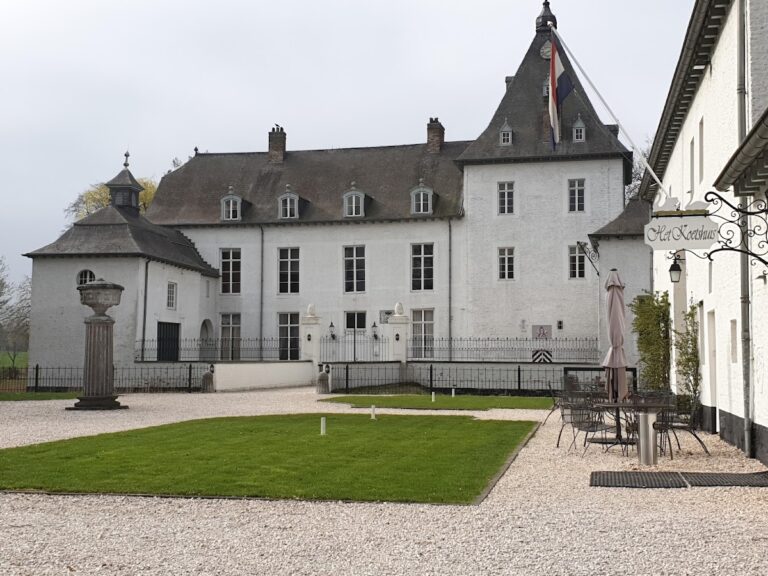
Château Neercanne is a terraced castle and pleasure palace in the Netherlands, just southwest of Maastricht in the Jeker Valley. Its present form chiefly dates from a major rebuilding in 1698 in the Dutch Classicist style, an architectural tradition of ordered proportions, restrained classical forms, and balanced facades. The property developed from the medieval castle of Agimont and later became associated with military events, prominent visitors, the Dutch-Belgian border, and the 1991 European summit that preceded the Maastricht Treaty.
Early castle and medieval conflicts
The site was already connected with human activity and possibly defensive works of Roman origin. The limestone quarries nearby may have supplied or formed part of those earlier fortifications. The earliest known reference to a castle here dates to 1316, when it was called Agimont and may also have been known as Scherpenberg. Bertram van Liers was the earliest known owner and lived at the castle in 1353. Jean Chabot owned it in 1454.
The people of Liège burned the castle in 1465 and plundered it again in 1469. It was subsequently restored, and Gerard Viller acquired the property in 1477. Through inheritance, the castle later passed to a daughter of Jan Pité III. Her husband, Herman van Straten, left her heavily indebted, and Herman’s cousins, the Van Pallandts, bought the castle from the creditor.
Siege warfare and the 1698 rebuilding
The outbuildings and the prominent tower at the southern corner were constructed in 1611. In 1632, during Frederick Henry of Orange-Nassau’s siege of Maastricht, a Spanish relief army tried unsuccessfully to drive the States troops from the castle. Frederick Henry was a Dutch stadholder and military leader whose forces held Maastricht during that campaign.
The property changed fundamentally in 1698, when Daniël Wolff, Baron van Dopff, ordered most of Agimont to be demolished and replaced by a pleasure palace. Van Dopff was a military commander and later governor of Maastricht. The new building was probably based on Johanniter Castle Sonnenburg at Kostrzyn nad Odrą, and Van Dopff may have prepared the drawings himself. He also gave money toward the restoration and embellishment of the Holy Sepulchre Chapel in nearby Kanne.
Visitors, ownership, and the border
Tsar Peter the Great, the ruler of Russia from 1682 to 1725, visited the castle in July 1717. In 1761 it passed to Jan Fredrik Willem, Baron van Cler. In 1791, his wife gave it to her grandson Ignatius van Thier, also known as Ignace Frédéric Nicolas Florentin de Thier. During the autumn of 1794, in the siege of Maastricht, the French Revolutionary general Jean-Baptiste Kléber used the castle as his headquarters for several weeks.
After the Kingdom of the Netherlands was created in 1814, the castle became Dutch territory. When Belgium was formed and the border was established, most of the former lordship of Neerkanne was assigned to Belgian Kanne. Ignatius Baron van Thier successfully secured the castle’s retention within the Netherlands, in the municipality of Oud-Vroenhoven. Maastricht annexed Oud-Vroenhoven in 1920.
Charlotte Adélaïde de Clercx de Waroux, a granddaughter of Baron van Thier, married Oswald Ive Poswick. Poswick was the last castle lord in the early twentieth century. His surviving daughter, Louise Euphrasie Marie Poswick, was the final resident. She sold the property and later died in an adjoining farmstead in Kanne.
Restoration and modern historical associations
The neglected castle became the property of Stichting Het Limburgs Landschap in 1947. Architect Jean Huysmans directed restoration campaigns from 1947 to 1955 and again from 1985 to 1989. Part of the baroque garden was restored during the 1990s under the direction of garden architect Wil Snelders.
A restaurant has operated in the castle since 1955. Stichting Het Limburgs Landschap first leased it to Brand Brewery and, from 1984, to Camille Oostwegel Château Hotels & Restaurants, now called Oostwegel Collection. The restaurant held Michelin stars during 1957–1982, 1986–2018, and again from 2023 onward, with periods of both one and two stars.
During the 1991 European summit, European heads of government had lunch at the restaurant at the invitation of Queen Beatrix. The summit led to the Maastricht Treaty, signed in 1992 and establishing the European Union. A plaque in the quarry bears the signatures of Beatrix and the twelve heads of government then representing the European Union countries. Château Neercanne is a Dutch national monument, registered as monument number 527874.
Remains
Castle buildings and terraces
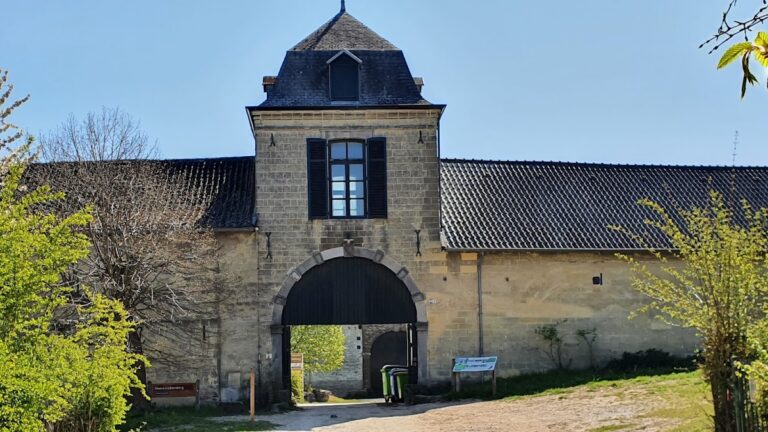
Château Neercanne stands on an artificial terrace against the slope of Cannerberg. The complex includes the main building, a gatehouse and farmstead, outbuildings with a quarry and northern gate, an entrance gate, a defensive wall with a corner tower and garden pavilion, terrace walls with a landing, further terrace walls and fencing, and the tower known as Torentje de Gulden. It is built largely from local Limburg marl, a soft calcareous stone formed from clay and carbonate material. The exterior walls have traditionally been painted ochre.
Some terrace walls may belong partly to the earlier Agimont, while Van Dopff incorporated other elements of the earlier building into the 1698 reconstruction. This produced an irregular plan rather than a fully symmetrical one: the south wing is narrower than the north wing, and the interior walls vary in thickness and alignment. A central staircase divides elongated rooms that connect with the side wings. On the exterior, the staircase is marked by a pediment containing a sculpted relief of grapevines and the date 1698.
The west facade is simpler, with a hard-stone surround only around the entrance door. Its keystone carries Van Dopff’s coat of arms. The castle may have been the first building in Maastricht to use lighter wooden window frames instead of the hard-stone cross windows customary in the region, reflecting contemporary French fashion. The entrance hall retains the original staircase, whose railing is supported by broad balusters. A large portrait of Baron van Dopff hangs there, copied from a posthumous portrait by Johann Valentin Tischbein in Fasanerie Palace at Fulda.
The plastered ceiling contains reliefs of trophies of arms, and several chimney breasts have ornamental stucco decoration. The ground floor is used for the restaurant and kitchen. Little of the original interior furnishing survives, while wall paneling and a collection of tapestries were lost during the Second World War.
Outbuildings and underground quarries
Behind the castle is a group of outbuildings constructed from marl. The former stable is a large room covered by a marl vault carried on pillars nearly one metre in diameter. It now houses the L’Auberge de Neercanne lunch restaurant. A neighboring barn connects directly with the Kasteelgroeve, a section of the extensive underground marl galleries beneath Cannerberg and Muizenberg.
The quarry complex includes the Fallenberg quarry and the artistically decorated Jezuietenberg. Part of the galleries housed the NATO headquarters at Cannerberg during the Cold War. The Kasteelgroeve itself contains rooms and passages used as a wine cellar, wine-tasting area, reception space, and function venue. Names of guests were written or scratched in charcoal on the soft marl walls. The galleries are also associated with the plaque commemorating the 1991 European summit.
Gardens and estate landscape
The terraced garden was gradually restored from 1990 toward its former appearance. The terraces at castle level and street level follow a modern French layout, with box and yew hedges, lawns, gravel paths, garden vases, and benches. A narrow intermediate terrace lies between them. The main garden is at street level and is periodically used for sculpture exhibitions.
Five works by Alexander Taratynov, made in 2000 and 2001, have permanent places in the garden: Flora, Mercury, Daniël van Dopff, Tsar Peter the Great, and Dionysus. Across the road in the Jeker Valley is the partly restored lowest level of the original garden, where the strongly baroque outline of a large pond remains recognizable.
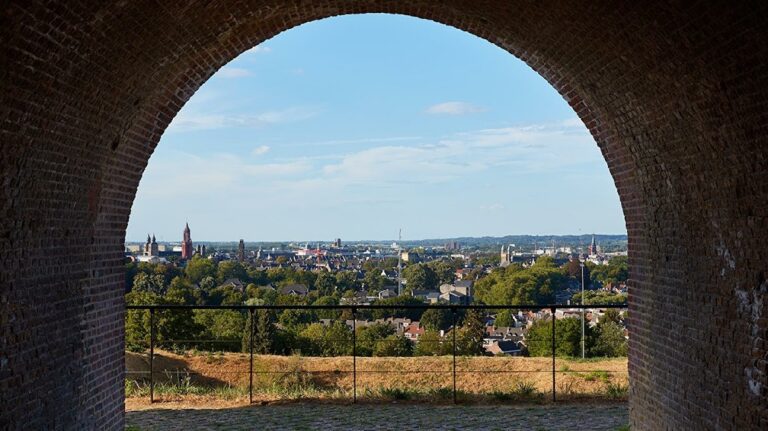
The estate also includes a small vineyard producing red wine and the Cannerbos woodland on the slope behind the castle. The castle and gardens overlook the Jeker Valley and Saint Peter’s Mountain, while the former underground marl quarries continue to serve as wine-cellar and dining spaces connected with the property.