Carmelite Monastery Church of the Annunciation: A Late Gothic Church in Germany
Site at a Glance
- Popularity
- Medium
- Country
- Germany
- Primary era
- Medieval
- Eras represented
- Medieval, Early Modern
- Civilizations
- Holy Roman Empire
- Site type
- Religious
- Remains
- Church
On this page10 sections
History
The Carmelite Monastery Church of the Annunciation is a late Gothic Catholic church in Germany, founded in 1406 by Hans V von Hirschhorn, his second wife, Iland von Dhaun, and his brothers Conrad and Eberhard. The Carmelites, a Catholic religious order, established the monastery with papal approval granted in 1405. Construction had begun around 1400, probably under the direction of Heinrich Isenmenger, a master builder from Wimpfen. The church’s name refers to the Christian feast commemorating the angel Gabriel’s announcement to Mary that she would give birth to Jesus.
Foundation and religious change
Conrad, a canon at the cathedrals of Mainz and Speyer, is believed to have played a leading part in establishing the monastery. The Hirschhorn family provided further gifts, while the transfer of the parishes of Eppingen and Hessloch helped support the community financially.
The Lords of Hirschhorn appear to have adopted Lutheranism in the 16th century. Between 1522 and 1529, they appointed a Protestant pastor to the church and sought to make the Carmelites abandon their religious clothing. In 1530, Holy Roman Emperor Charles V placed the Carmelites under his protection. The local lords initially continued to tolerate the order, but Hans IX von Hirschhorn dissolved the monastery in 1543.
After Hans IX died in 1569, his widow Anna, born Anna von Göler Ravensburg, made the former monastery her residence as a widow. The Carmelites gained favourable decisions from the emperor in 1571 and from the Imperial Chamber Court, a high court of the Holy Roman Empire, in 1596. These rulings did not restore the monastery to them, and it remained in the Hirschhorn family’s hands. Around 1590, the family removed the altar from St Anne’s Chapel and placed a family tomb there, asserting its control over the church.
Return to Catholic use
During the Thirty Years’ War, a European conflict from 1618 to 1648 involving religious and political struggles, Frederick III von Hirschhorn began building a Protestant church in 1628 because he expected a Catholic victory. The appointment of the Catholic Heinrich von Metternich as governor of the Palatinate strengthened that expectation. Frederick returned the monastery and church to the Carmelites in 1629. After his death in 1632, Hirschhorn came under the rule of the Archbishop-Elector of Mainz, who re-established the monastery as a centre for re-Catholicization, the restoration of Catholic institutions and practice in areas where Protestantism had spread.
From 1636 to 1732, the church served as Hirschhorn’s Catholic parish church. A new high altar was installed in 1689. It was later replaced by a Baroque altar made by Heidelberg sculptor Johann Michael Düchert between 1761 and 1765.
Closure and preservation
Gunfire damaged some of the organ pipes in 1799, and they were repaired. The monastery was dissolved in 1803, the church closed, and its movable contents sold. Darmstadt authorities considered demolishing the building in 1810 because of the cost of upkeep. Grand Duke Louis I gave it to the town on 17 March 1812, but the town also contemplated demolition. A further auction in 1840 left only the exterior walls.
The community chose to preserve and renovate the church in 1859, and a temporary roof was put in place around 1860. The town transferred the building to the Catholic community in 1886. A major renovation followed, completed in 1910, and the church was reconsecrated as a parish church on 8 August that year. Work on historic wall paintings took place in 1912; parts of the ceiling were renovated in 1969–1970, and further renovation began in 1998. The church is Roman Catholic, and three Carmelites have lived in the monastery again since 2009.
Remains
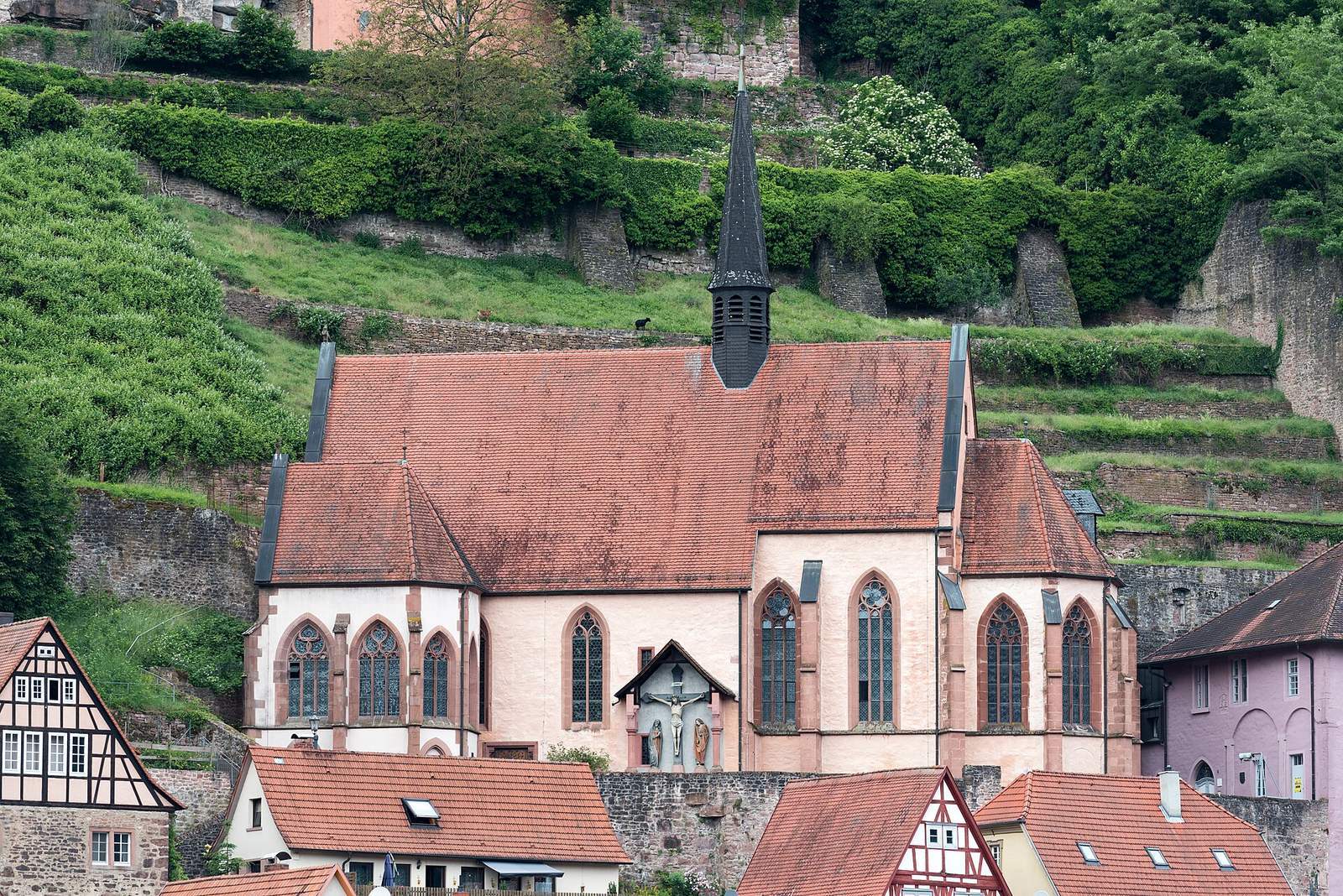
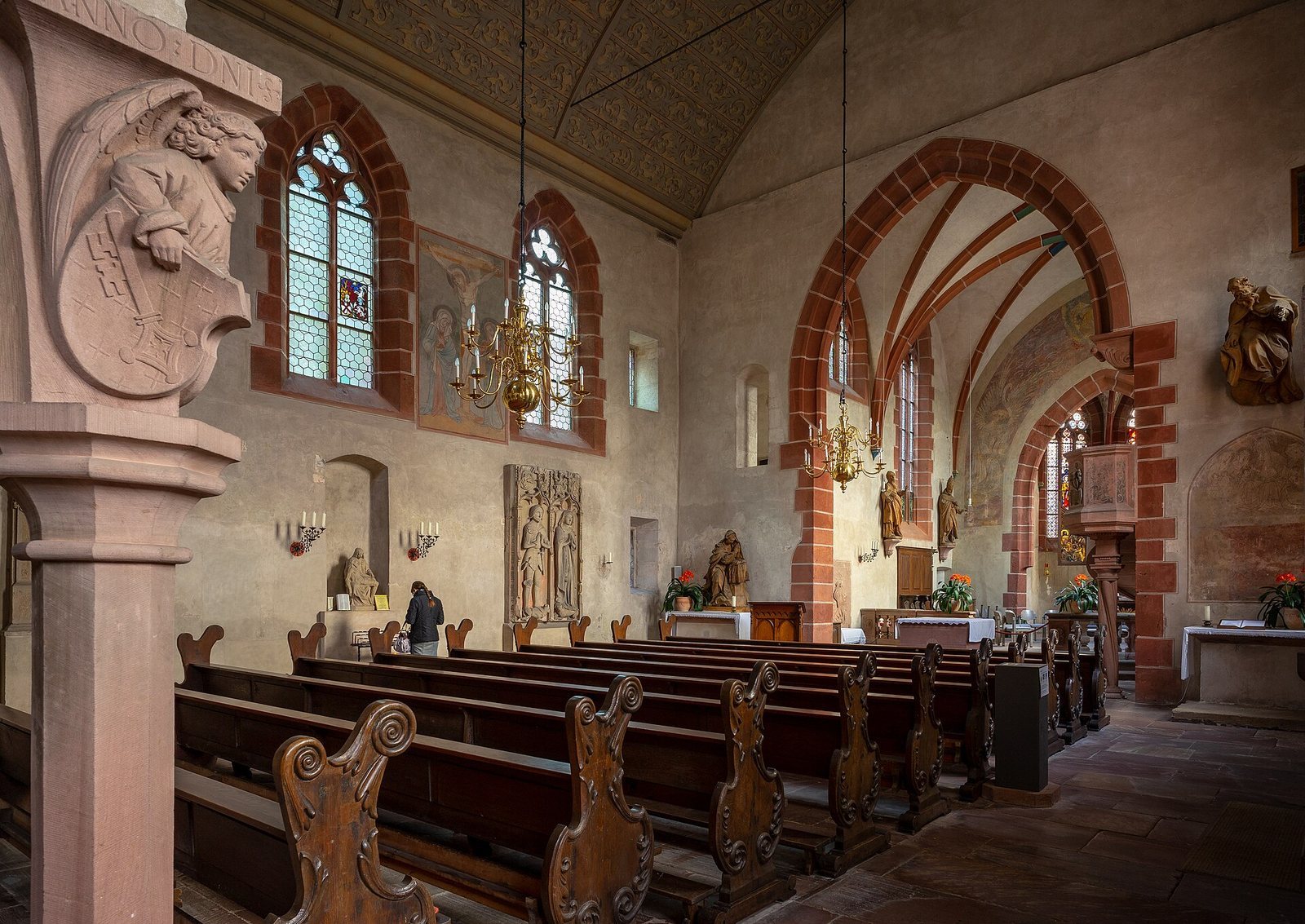
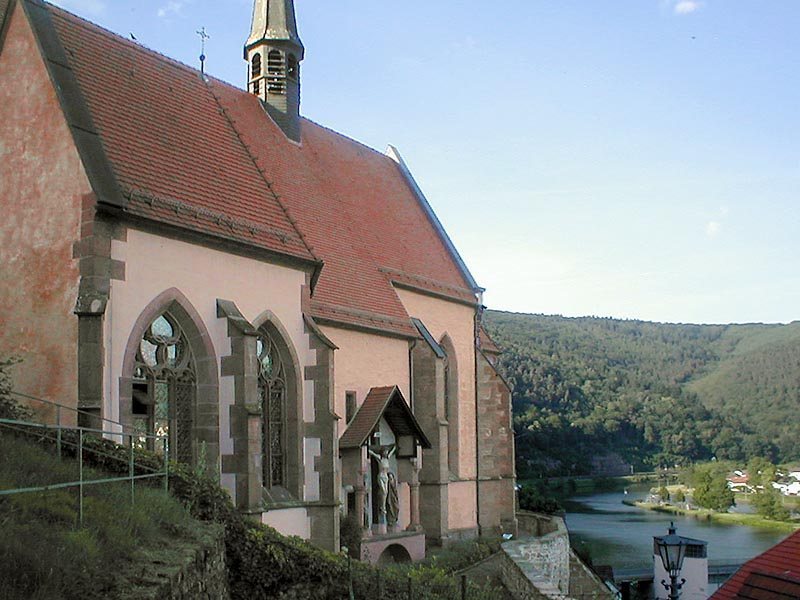
The church is a single-nave hall building, with its chancel at the eastern end and a small tower rising from the middle of the roof. Its surviving features include a vaulted chancel ceiling, a stone screen at the west end, a southern chapel, and a collection of family memorials and tombs.
Church and chancel
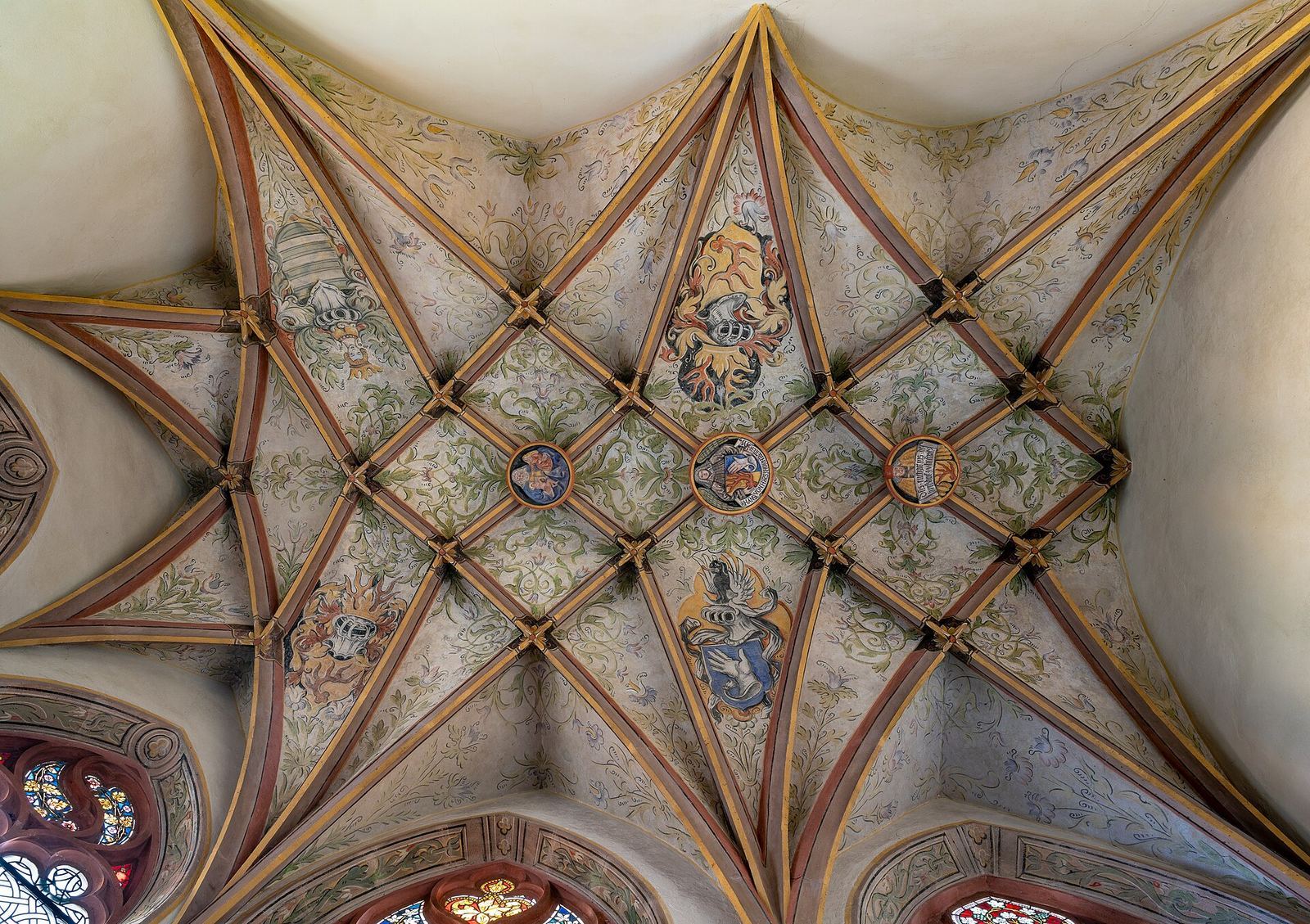
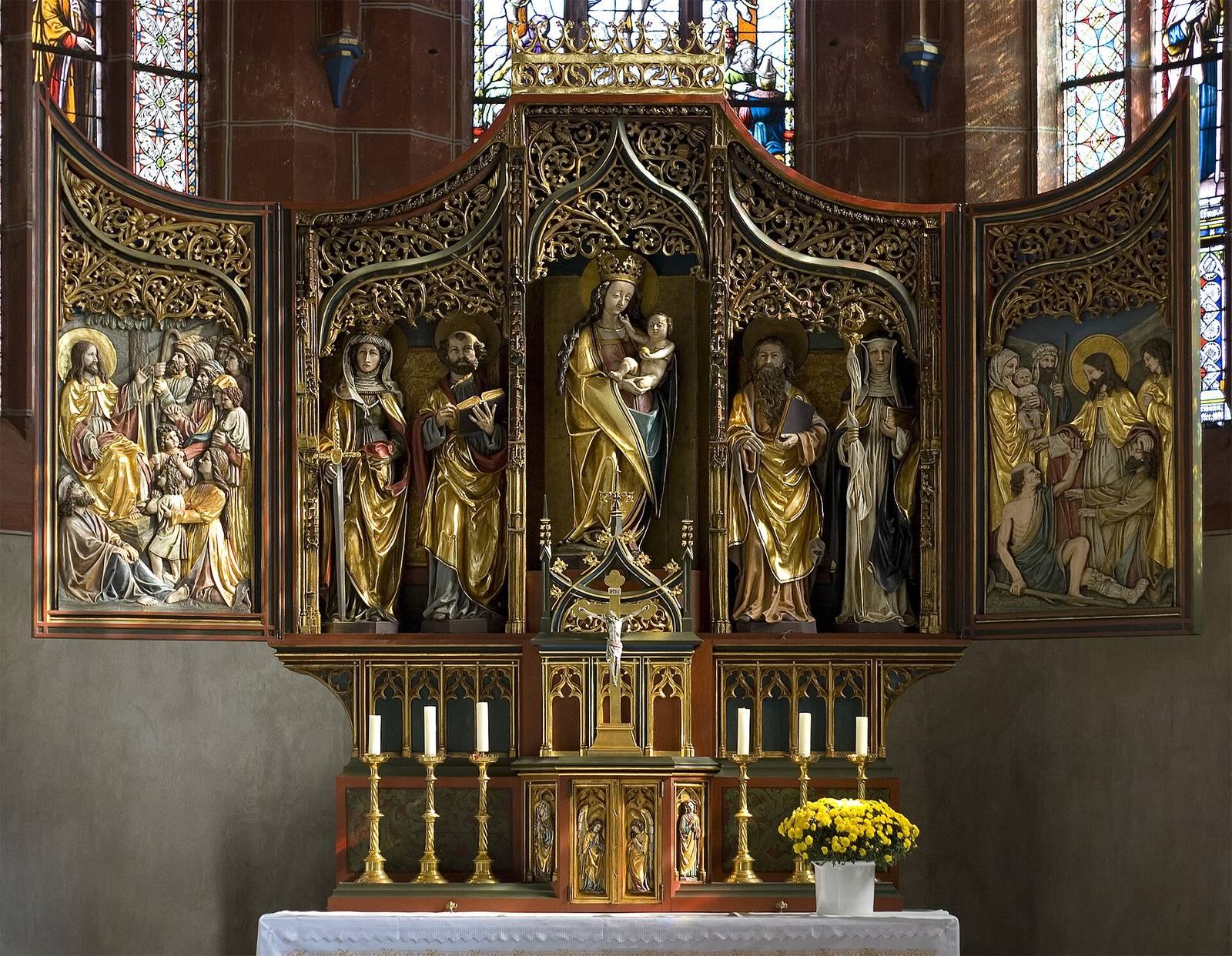
The vaulted ceiling in the chancel bears the coat of arms of the Lords of Hirschhorn on its central stone. A Gothic sandstone rood screen, a partition that once separated the congregation’s nave from the chancel around the altar, now stands against the west wall. It had been moved there by 1618 at the latest. The present high altar is Neo-Gothic. Sculptures from Düchert’s earlier Baroque altar survive separately in the church, including a statue of Mary made by the sculptor.
St Anne’s Chapel
Attached to the church’s south side, St Anne’s Chapel was added in 1511 and fitted out as a chapel dedicated to Saint Anne in 1515. Its distinct gabled roof and two south-facing windows with stone tracery set it apart from the main building. The vaulted ceiling carries the coats of arms of the Hirschhorn and Handschuhsheim families, along with a portrait of Eucharius von Hirschhorn.
Memorials and tombs
Plaque and paired tombs
A memorial plaque on the choir’s south wall commemorates Hans V von Hirschhorn, who died on 18 November 1426, and his son Philipp I, who died on 16 August 1436. Two double tombs show life-size sculpted figures. One commemorates Melchior von Hirschhorn, who died in 1476, and Kunigunde von Oberstein, who died in 1457. The other is for Hans VIII von Hirschhorn, who died in 1513, and Irmgard von Handschuhsheim, who died in 1496.
Tombs beneath the rood screen
Beneath the rood screen are the tombs of three sons of Hans VIII: Philipp II, who died in 1522; Engelhard III, who died in 1529; and Georg, who died in 1543. A separate tomb commemorates Hans IX, Engelhard III’s son, and depicts him as a fully armed knight.