Hinterburg: A Medieval Castle Ruin at Neckarsteinach


Site at a Glance
- Rating
- 4.7
- Popularity
- Very Low
- Country
- Germany
- Primary era
- Medieval
- Eras represented
- Medieval, Early Modern
- Civilizations
- Holy Roman Empire
- Site type
- Military
- Remains
- Castle
On this page13 sections
History
Hinterburg, also known as Alt-Schadeck, is a medieval castle ruin at Neckarsteinach in Germany. Construction probably began around 1100, apparently as a fief of either the Bishopric of Worms or the Bishopric of Speyer. It became the ancestral castle of the free nobles of Steinach and is the oldest of Neckarsteinach’s four castles, alongside Vorderburg, Mittelburg, and Schwalbennest.
The Steinach Lords and the Staufer Period
Bligger von Steinach was the castle’s lord between 1142 and 1165. His son, Bligger II von Steinach, was a minnesinger, a medieval German courtly poet and singer, who expanded Hinterburg into an extensive complex of the Staufer period. The Staufers, also called the Hohenstaufens, were a German ruling dynasty whose power shaped much of the twelfth and thirteenth centuries.
The older Steinach line died out around 1270. In 1272, Bishop Heinrich of Speyer pledged the castle to his creditors. By 1344, Hinterburg was apparently abandoned or in decay. Bishop Gerhard of Speyer then contracted Peter von Mur, provost of Wimpfen, to rebuild it in return for an annual payment of 20 pounds of Heller and two loads of wine.
Feudal Transfers and Rebuilding
In 1366, Emperor Charles IV confirmed the Bishop of Speyer’s ownership. Charles IV was a Luxembourg ruler who was also Holy Roman Emperor and King of Bohemia. In 1375, Contz Münch von Rosenberg received Hinterburg as a fief, meaning that the property was granted by a superior lord in return for obligations.
In 1418, Bishop Raban of Speyer granted the castle and his share of the town to his cousin Wilhelm von Helmstatt for life. After Wilhelm died in 1426, the arrangement passed to his nephew Weiprecht III von Helmstatt, who was required to renovate the apparently decayed castle. A dispute between the Helmstatt and Landschad von Steinach families led to a joint castle peace agreement for Hinterburg and the town of Steinach in 1427. Major alterations to the castle are attributed to Weiprecht von Helmstatt.
After the succession of 1490, the fief was divided between two of Martin von Helmstatt’s daughters. Mia was married to Blicker XIV Landschad von Steinach of Vorderburg, while Gertrud was married to Heinrich VI von Handschuhsheim. In 1497, Heinrich VII von Handschuhsheim acquired the Landschad share, together with a quarter of the town of Steinach and half of the village of Epfenbach.
Sixteenth-Century Disputes and Destruction
Heinrich’s eldest son Philipp undertook further building work in 1529 and died that same year. A dispute over his estate reached the Palatine court, which ruled that the castle belonged to the cathedral chapter of Speyer. In 1541, Bishop Philipp of Speyer enfeoffed the brothers Hans, Hans Pleikard, and Christof Landschad von Steinach with Hinterburg.
A judgment in 1545 ordered the von Handschuhsheim family to leave the castle. They complied after the decision was confirmed in 1549. Hinterburg remained with the Landschad von Steinach family until that line became extinct in 1635. The castle was destroyed during the Thirty Years’ War, around 1630. After the Landschad line ended, the cathedral chapters of Worms and Speyer reclaimed their former fiefs, including Hinterburg, Vorderburg, and half of Mittelburg.
Later Ownership and Return to the State
The reclaimed properties were briefly placed under self-administration before being granted as a fief to Wolf-Heinrich von Metternich zu Burscheid in 1657. In the same year, he acquired the former Landschad hereditary property from Eva Elisabeth, daughter of Dieter VIII Landschad, and the remaining half of Mittelburg from the barons of Venningen. Ownership of the four castles was reunited by the later seventeenth century.
When the Metternich line died out in 1753, the chapters of Speyer and Worms reclaimed both the former fiefs and the hereditary property. During German mediatisation in 1803, a process in which many autonomous ecclesiastical and noble territories were absorbed into larger states, the entire property passed to the state of Hesse. After an agreement with Baron von Dorth, heir to the hereditary property, Hesse transferred Mittelburg, which served as an administrative residence, as well as the ruin of Hinterburg to him. The von Dorth family relinquished Hinterburg in 1910 because its maintenance was too expensive, and the ruin returned to the Hessian state.
Remains
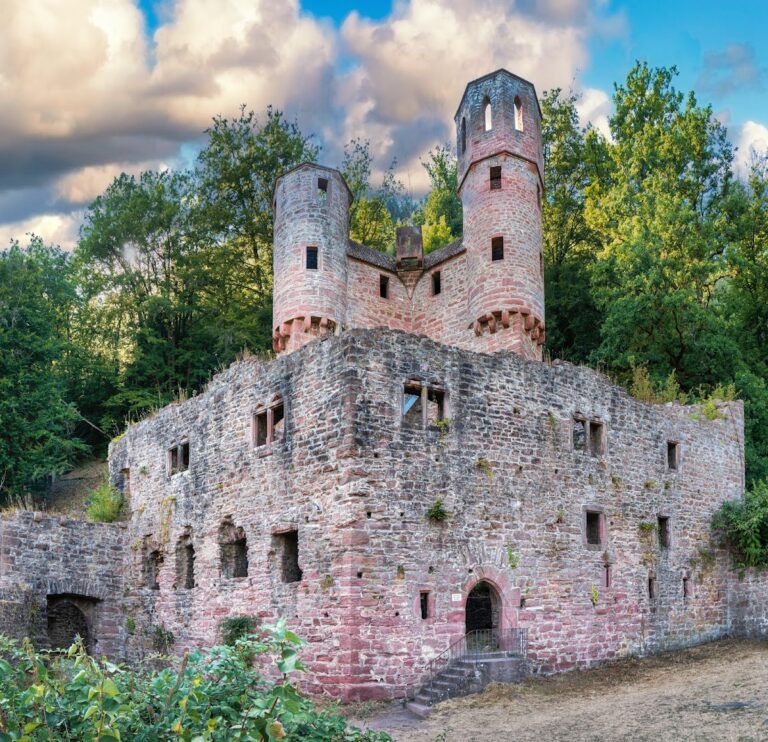
Hinterburg is a ruined spur castle on a rocky promontory about 165 metres above sea level near Neckarsteinach. The ground falls steeply on three sides. A five-sided enclosure occupies the promontory, with the landward side protected by an angled shield wall. A keep stood at the angle of this wall, while a ring wall extended from both ends to enclose the castle.
Walls and Residential Buildings
Shield Wall and Ring Wall
The shield wall formed the strongest defence on the landward side of the castle. The ring wall, which enclosed the site from both ends of the angled defence, is about 3 metres thick. It was built from bossed ashlar, cut stone blocks with projecting outer faces.
Palas Buildings
The principal palas, the main residential and representative building of a medieval castle, has elaborate Gothic windows. Remains of a second, later palas also survive. This building was probably erected in the mid-fourteenth century and, according to written evidence, had a vault added in the fifteenth century.
Keep and Access Structures
Keep
The keep is the most prominent surviving part of Hinterburg. Built from sandstone blocks, it measures 8 by 8 metres and rises approximately 25 metres. Its high entrance is about 10 metres above ground level.
Staircases and Viewing Platform
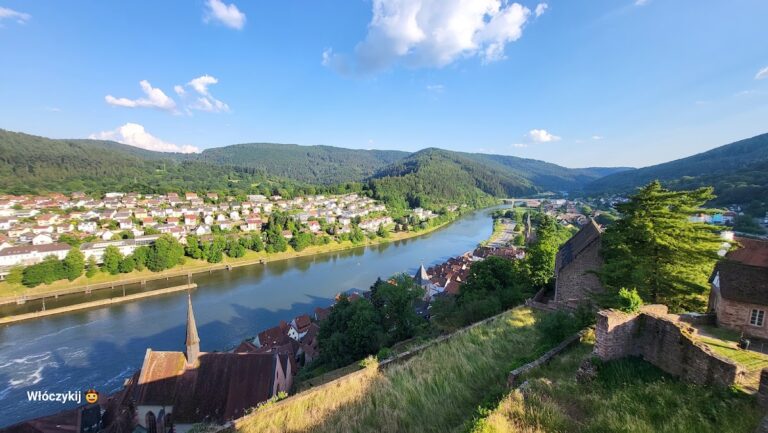
A staircase of 49 steps runs along the angled shield wall of the former palas and leads to the keep’s high entrance. Inside the tower, a left-turning concrete staircase of 63 steps reaches a covered viewing platform about 22 metres above the ground. The platform provides views across the Neckar valley toward Neckarsteinach and Dilsberg.
Courtyard Well and Subterranean Connection
The courtyard contains a fully masonry-lined well at least 23 metres deep. At a depth of 18 metres, a walkable branch leads toward Mittelburg. The Neckar Valley Railway passes beneath the castle through a tunnel measuring 139 metres in length.