Schönau Abbey: A Cistercian Monastery in the Odenwald
Site at a Glance
- Popularity
- Medium
- Country
- Germany
- Primary era
- Medieval
- Eras represented
- Medieval, Early Modern
- Civilizations
- Electoral Palatinate, Holy Roman Empire
- Site type
- Religious
- Remains
- Monastery
On this page16 sections
History
Foundation and protection
Schönau Abbey was a Cistercian monastery in Schönau, Germany, in the Steinach valley of the Odenwald. Burchard II, Bishop of Worms, founded it in 1142 with monks from Eberbach Abbey. The Cistercians, a Catholic monastic order rooted in the Benedictine tradition, arrived on 21 March 1145, when construction began. The foundation also asserted Worms’s claims to southern Odenwald lands that had partly been granted to local nobles and reverted to the bishopric in 1142.
Burchard gave the community land in the Steinach valley and nearby forest, and Bishop Conrad II enlarged the grant in 1172. In 1156, Emperor Frederick Barbarossa gave his half-brother Conrad the role of lay advocate, a secular protector who could also carry out administrative duties for the monastery. Schönau came under imperial protection by 1169. In 1204, Pope Innocent III confirmed its foundation charters and exemptions from tithes on land, fishing, and livestock. The abbey was also exempt from several forms of diocesan control, including episcopal oversight, attendance at church councils, and the monks’ choice of abbot.
Palatine patronage and regional reach
During the 12th century, the Counts Palatine of the Rhine, rulers of the Electoral Palatinate within the Holy Roman Empire, took over the abbey’s protection. They made Schönau their house monastery, favored retreat, and burial place. Around 1182, Conrad of Hohenstaufen moved his residence from Stahleck Castle to Heidelberg, where he served as the abbey’s lay advocate. Heidelberg thereby became a residence of the Electoral Palatinate. Palatine support later helped Schönau through financial difficulties in the 14th century.
At its height in the 13th century, Schönau had about 300 monks and a similar number of lay brothers. Lay brothers were members of the monastery distinct from choir monks and commonly did manual work. Schönau was regarded as the Palatinate’s most important monastery after Maulbronn. Its monks cultivated the Steinach valley and nearby valleys of the Neckar and Rhine, while lay brothers managed agricultural estates. Gifts in the 12th and 13th centuries built up holdings from west of Hirschhorn, across the Rhine, and north toward Frankfurt. The abbey also maintained urban properties to sell farm produce, including at least 40 buildings in Heidelberg and properties in Worms, Speyer, and Frankfurt.
Schönau founded Bebenhausen Abbey in 1189 or 1190 on the site of an abandoned Premonstratensian monastery, belonging to a Catholic order of religious canons. Ramsen, Neuburg, and Lobenfeld were at times subject to Schönau’s abbot. The abbot also supervised Heidelberg’s College of St James from its foundation in 1386; Cistercian students from southern Germany attended it. The abbey relinquished its Frankfurt holdings in the 15th century and acquired the outlying monastic estate at Wiesenbach in 1480. Its wealth helped support Heidelberg University and the military campaigns of some princes.
Burial, devotion, and monastic life
The abbey became a burial place for members of the Palatine and Staufen families. Burchard II was buried there after his death in 1149. Other burials included Conrad of Hohenstaufen, who died in 1195, his namesake son, and his wife Irmgard of Henneberg, who died in 1197. Henry VI the Younger of Brunswick, Adolf, Count Palatine, Rupert II, Elector Palatine, and Rupert’s wife Beatrix of Sicily-Aragon were also buried at Schönau. Dieter of Katzenelnbogen, chancellor to Emperor Henry VI, and Eberhard II of Strahlenberg, Bishop of Worms, were among those interred there. Members of the Erbach family continued to be buried at the abbey until 1503. Conrad II of Riesenberg, Bishop of Hildesheim, died at Schönau in 1249 and was thought to have been buried there.
Hildegund, a woman who entered the monastery disguised as a male novice named Joseph, died during her novitiate in 1188. Her sex was discovered while her body was being prepared for burial, and she later came to be venerated as a Catholic saint. Writers of the late 12th and early 13th centuries adapted her story five times, including the Cistercian writer Caesarius of Heisterbach. Abbot Gottfried, who was at Schönau from 1182 to 1191, was regarded as a saint of the order. Abbot Daniel was venerated as a Blessed, with a feast day on 27 June. Eberhard of Kumbd, a servant of Conrad of Hohenstaufen and later a Blessed, unsuccessfully sought admission to the monastery three times.
The lay brothers were also involved in an episode later called the Boot Revolt. The footwear at issue was warm, boot-shaped night slippers rather than outdoor boots. Konrad of Eberbach described the brothers’ action as a conspiracy for which monastic law prescribed severe penalties.
Late medieval fortunes and dissolution
Ramsen closed in 1418 because of financial problems, and Lobenfeld was dissolved in 1560. Schönau’s own financial difficulties increased after 1500, prompting the sale of some properties. In 1558, during the Reformation, Elector Ottheinrich, ruler of the Electoral Palatinate, dissolved the abbey. An estate administration called Pflege Schönau took over its properties and lordship rights, and tenant farmers received agricultural land.
In 1562, Calvinist refugees from Wallonia, a French-speaking region in present-day Belgium, settled in the vacant abbey. Elector Frederick III is also linked to the use of its buildings as their housing. Although the settlers were said to have been instructed to preserve the monastery, substantial changes and demolitions had taken place by 1583. The settlement grew into the town of Schönau by 1600, and the former abbey complex became part of the developing town.
Remains
Monastic layout
The abbey stood at the center of Schönau, and its buildings followed a Cistercian plan in the Gothic style. Temporary wooden structures gave way around 1200 to substantial buildings enclosed by a ring wall; construction continued into the mid-13th century. The 84-metre-long church was aligned east and stood north of the rectangular cloister, a covered walkway surrounding an open courtyard. The lay brothers’ residence occupied the cloister’s west side. Its southern range led to the refectory, or communal dining hall, with a kitchen attached; a fountain hall stood opposite. The chapter house, where the community met for formal business, occupied the east range, with the monks’ dormitory above it. The infirmary lay farther east, and a hospital was established from 1275.
Surviving buildings and features
Abbey church
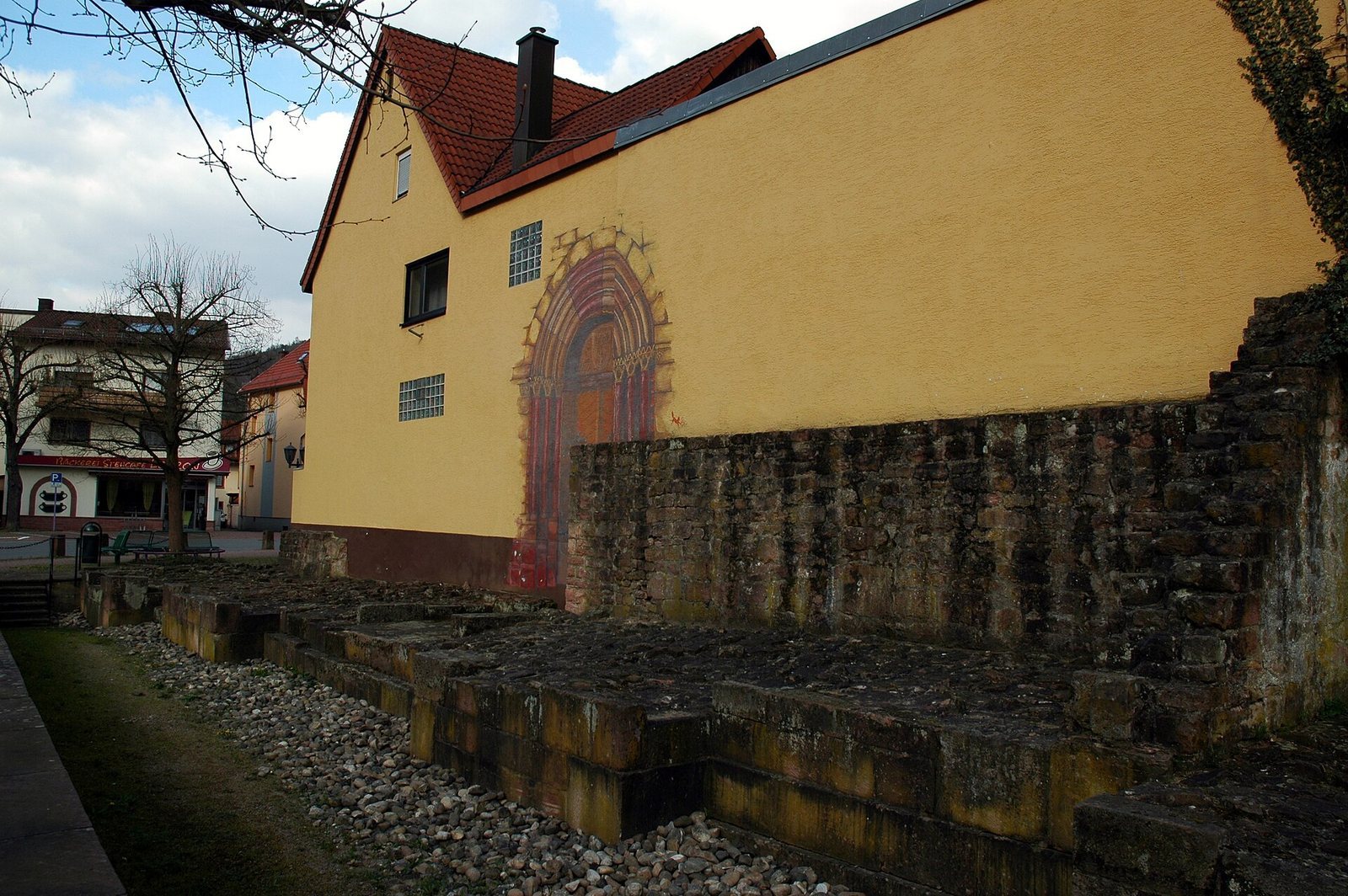
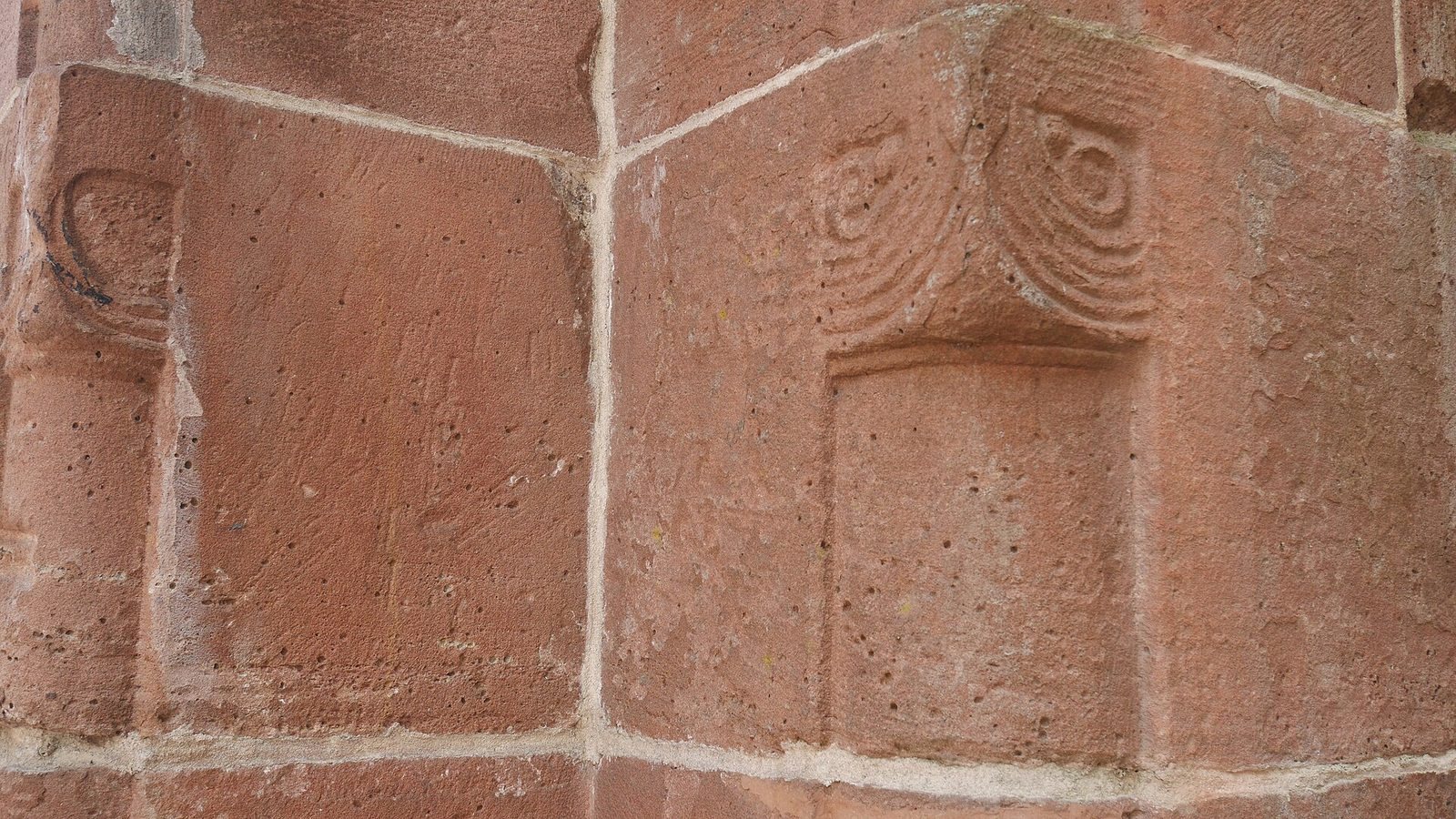
At the excavated church site, semicircular niches for side chapels remain visible in the north arm of the church’s cross-shaped plan. The exposed foundations of the western entrance also survive.
Abbey gate
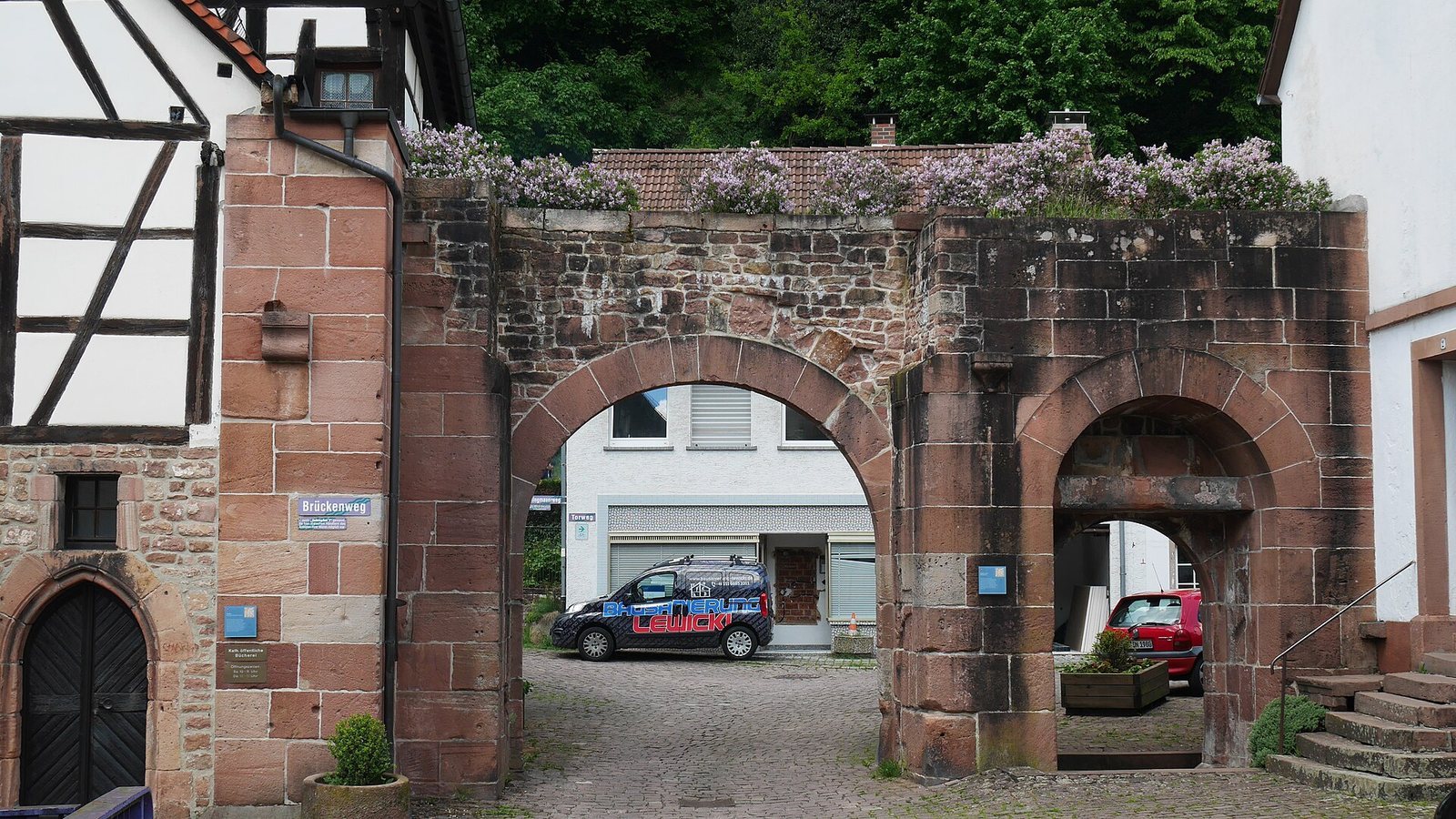
The abbey gate, dating to around 1200, survives as a remnant of the complex’s enclosed precinct.
Former refectory
The former refectory is a two-aisled building, with two parallel interior divisions. It now serves as Schönau’s Protestant town church.
Hühnerfautei
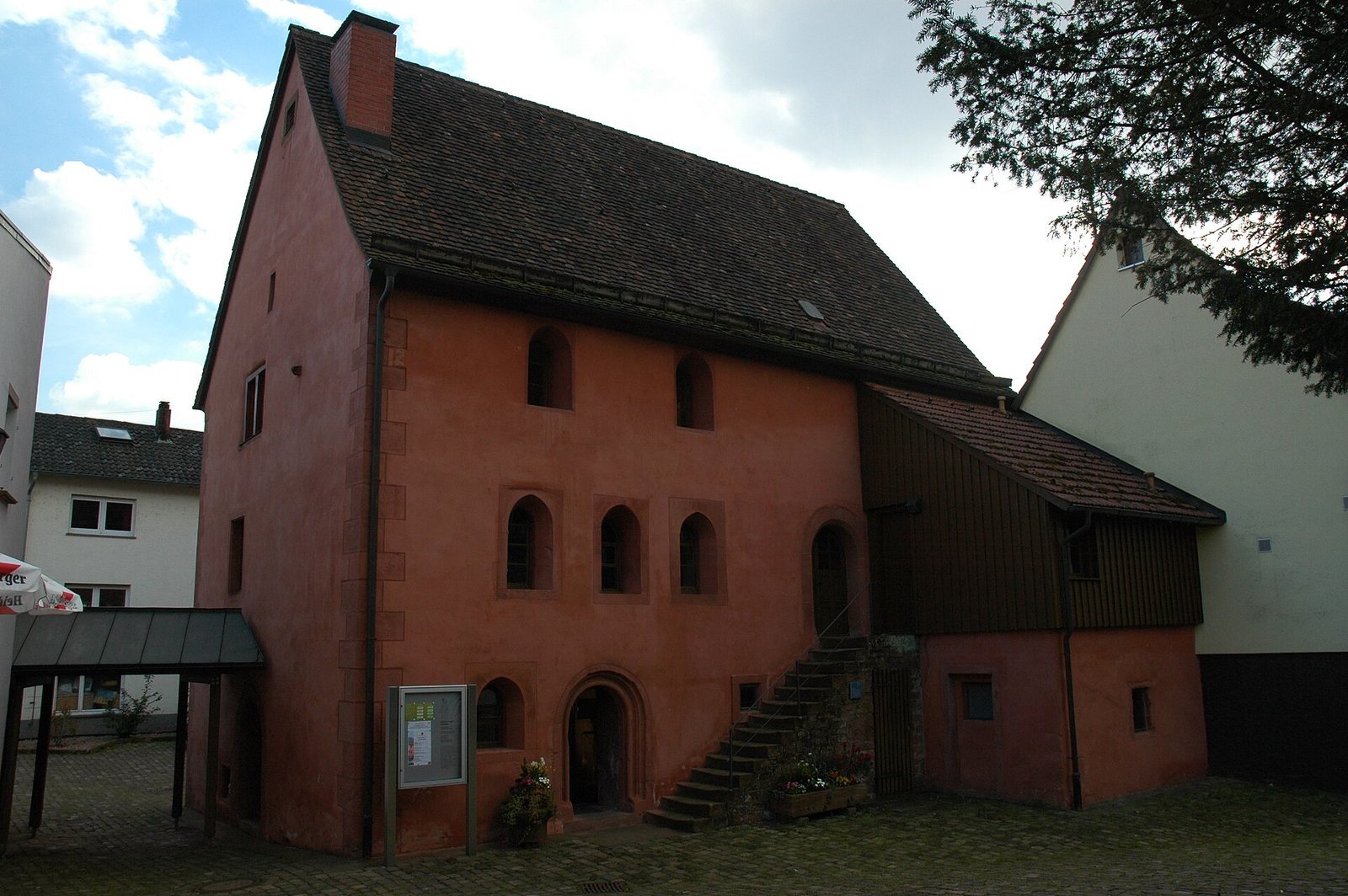
The Hühnerfautei, a former residence of the abbey’s lay advocate dating to around 1250, now houses a history museum. The museum presents the abbey’s past through archaeological finds.
Wallonenhaus
The Wallonenhaus is the former abbey forge, built up by Walloon settlers in the late 1550s.
Abbot’s residence and grounds
The abbot’s residence lies eastward toward the Greiner valley. It later served as a forestry house for more than 200 years. A fragment of the old ring wall remains around part of its forestry garden, and the grounds include the Cistercians’ former fishpond.
Fountain basin
The basin at the marketplace fountain came from the abbey’s fountain house, where it served as a washing basin.
Drawings and archaeological evidence
Ten pen-and-ink drawings of the abbey’s early history, copied between 1576 and 1600 from models made during the monastery’s years of operation, are held at the Germanisches Nationalmuseum in Nuremberg. Each measures 49 by 39 centimetres and depicts the abbey’s buildings in detail. They may have been intended as designs for stained-glass windows. Excavations on the former abbey grounds have also recovered inscriptions.