Whitland Abbey: A Cistercian Monastery in Wales
Site at a Glance
- Rating
- 4.2
- Popularity
- Very Low
- Country
- United Kingdom
- Primary era
- Medieval
- External website
- Open
- Eras represented
- Medieval
- Civilizations
- Welsh
- Site type
- Religious
- Remains
- Monastery
On this page12 sections
History
Whitland Abbey is a former Cistercian monastery in the United Kingdom, founded in 1140 during the medieval period by Bernard, Bishop of St Davids. The Cistercians were a monastic order that emphasized communal observance, manual work, and an austere form of Benedictine life. Whitland was associated with Clairvaux, one of the order’s principal medieval houses, although a possible direct connection with Vaucelles has also been proposed. The abbey became an important Welsh religious foundation, a burial place for members of the ruling dynasty of Deheubarth, and the parent house of monasteries in Wales and Ireland.
Foundation and Welsh development
The foundation was established at Little Trefgarn, near Haverfordwest, and the community was still there in 1144. It moved to Whitland around 1151 to 1155, probably onto land granted by John of Torrington. The chronology of the relocation was once debated, but the move to the later site is now generally accepted.
Before the monastery was founded, the place was associated with Ty Gwyn ar Daf, an occasional residence of Hywel Dda, a tenth-century ruler of much of Wales. A council held there around 940 was traditionally linked with the compilation and enactment of the Laws of Hywel Dda, a medieval Welsh legal tradition associated with his reign. The laws were later deposited at Dinefwr Castle.
Whitland began as a Cambro-Norman foundation but soon came under the control and patronage of Rhys ap Gruffudd, Prince of Deheubarth. Many Welsh monks joined its community, giving the monastery a strongly Welsh character. It was the first Clairvaux-associated Cistercian foundation in Wales and became connected with Welsh resistance to English and Norman domination.
The abbey established five named daughter houses. Strata Florida was founded in 1164 and Strata Marcella in 1170. Cwmhir began with an unsuccessful foundation in 1143 and was re-established in 1176. The later foundations of Comber in 1200 and Tracton in 1224 to 1225 extended Whitland’s influence to Ireland. During the medieval period, the monastery was dedicated to Saint Mary.
Burials, warfare, and royal connections
Whitland served as a burial place for members of the Deheubarth dynasty. Cadwaladr ap Gruffydd, son of Rhys ap Gruffudd, was buried there in 1186. Maredudd ap Rhys died and was buried at Whitland in 1271. He had become a monk at the abbey after Henry II of England ordered him blinded while he was being held as a hostage in England.
The monastery was drawn into the violence of the Welsh conflicts of the thirteenth century. After the Battle of Cadfan, Stephen Bauzan, Nicholas of Cemais, and Patrick de Chaworth invaded and plundered the abbey. Servants were killed, lay brothers were stripped, and monks were assaulted. Following the Battle of Orewin Bridge and the conquest of Wales, Edward I promised compensation of £260, but the payment was never made. The king visited Whitland on 5 June 1295.
Whitland was also connected with the defence of Cynvael Castle during a conflict involving Cadwaladr, the brother of Owain Gwynedd. The abbot of Ty Gwyn ar Taf was entrusted with the castle’s custody and defended it until its walls were destroyed. He then escaped and returned to the monastery.
Decline and dissolution
Medieval descriptions present Whitland variously as a modest establishment or as a monastery with as many as 100 monks and seventeen granges. A grange was a farm or agricultural estate operated by a monastery. By 1440, only eight monks were recorded, reflecting the abbey’s decline.
The monastery was dissolved in February 1539 under Henry VIII’s dissolution of the monasteries, the programme through which the king’s government suppressed monasteries in England and Wales and transferred their property to the Crown or private owners. The community was expelled. A substantial payment may have delayed the dissolution temporarily in 1536, but the site was later granted to Henry Audley and John Cordel during the thirty-sixth year of Henry VIII’s reign.
Extensive destruction followed. Many stones were removed and taken to Carmarthen for the construction of a Catholic church. A forge was later established on the former monastic site. John Morgan owned the property from 1779, and William Henry Yelverton acquired it through his marriage to Morgan’s daughter. Yelverton built a house near the abbey and laid out a landscaped park across part of the former monastery. The estate later passed by marriage to the Blake family, was sold after Major Anthony Blake died in Korea in 1951, and was subsequently divided among local farmers.
Rediscovery and later religious use
Significant ruins remained visible in the early nineteenth century and were recorded by Edward Donovan and other observers. Archaeological excavations took place in 1836, around 1920, and from 1990 onward. The surviving monastic remains and surrounding parkland were designated Grade II listed monuments on 30 November 1966.
A Trappistine community from Stapehill re-established a monastery dedicated to the Holy Cross in 1991. Holy Cross Abbey was founded at Trevaughan, about 3 kilometres southwest of the medieval monastery, and later became associated with Mount Saint Bernard. Because of its proximity to the former medieval foundation, it is sometimes also called Whitland Abbey.
Remains
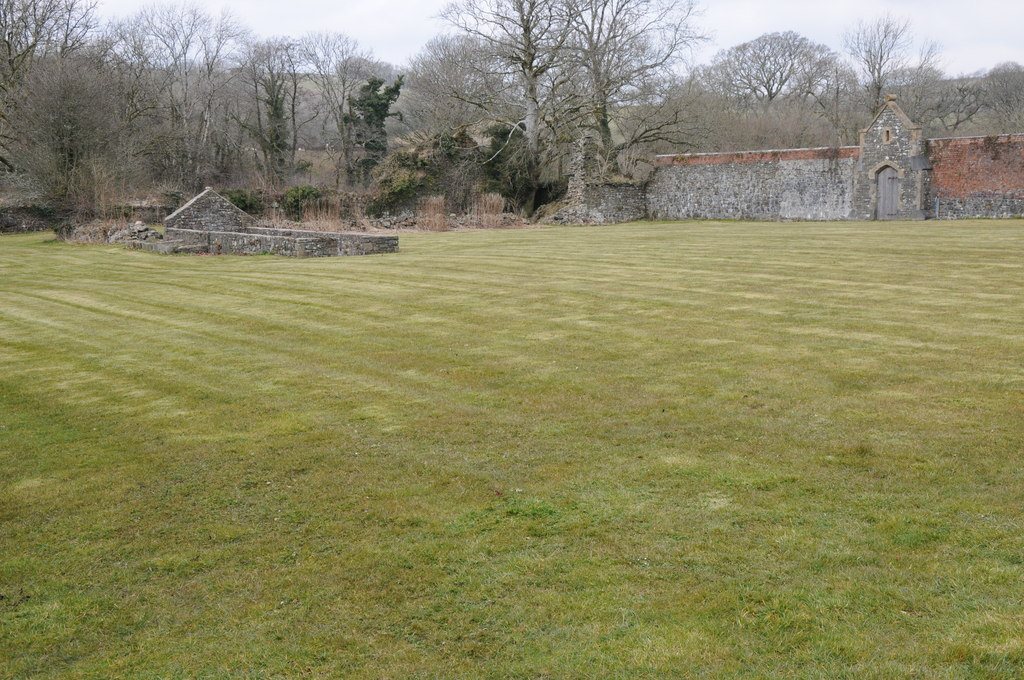
The medieval monastery occupied the northwestern bank of the Afon Gronw, opposite Coed Ysgubor-Fawr. Its name derives from the Latin terms Alba Domus or Alba Landa, meaning “Whitland”; the medieval monks also used the Old French form Blanchland. The former complex measured approximately 226 by 216 feet, or about 68 by 66 metres, and its ground plan remains comparatively well defined through surviving foundations and archaeological evidence.
Monastic buildings
Abbey church
The cruciform abbey church stood on the northern side of the complex. It had a rectangular-ended plan, and its nave contained eight bays. The surviving evidence establishes the church’s position within the wider monastic layout and helps define the northern edge of the former complex.
Cloister and monastic ranges
The cloister lay south of the church. On its western side was the lay-brothers’ range, separated from the cloister by a monastic lane. A lay brother was a non-choir religious brother who generally carried out agricultural, craft, or other practical work rather than following the full liturgical routine of the choir monks. The arrangement of the western range and lane is also found at some Clairvaux daughter houses.
Earlier residence and later estate
Ty Gwyn ar Daf
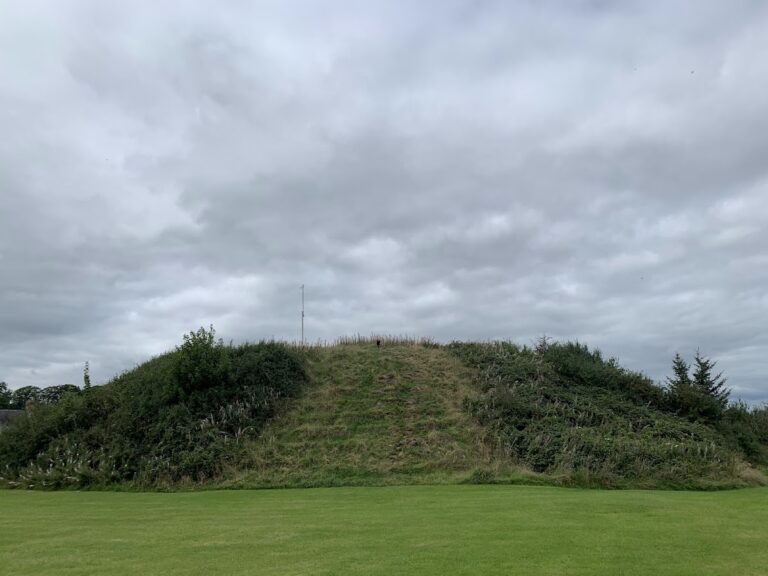
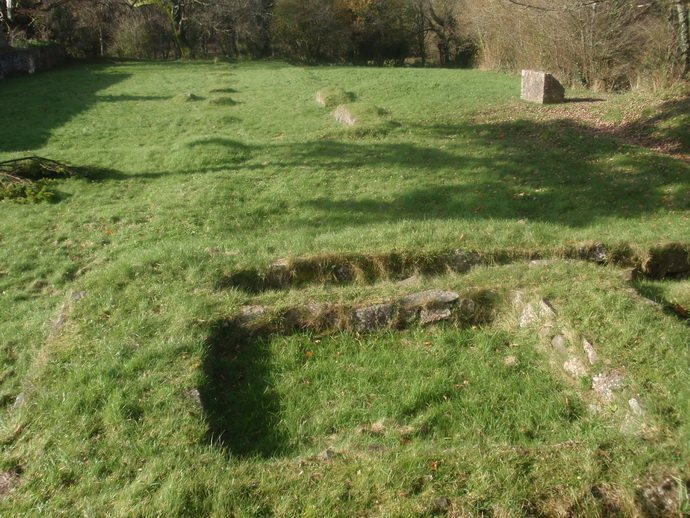
Grass-covered foundations of the earlier Ty Gwyn royal residence can be discerned at the site. The palace was comparatively small and was designed mainly as a hunting residence. Its remains provide physical evidence of the royal use of the location before the foundation of the monastery.
Forge, house, and parkland
The later forge, the Victorian house, and the landscaped park occupy or surround parts of the former monastic estate. These later features form part of the physical history of the site, whose surviving medieval remains were noted by Edward Donovan and other early observers.