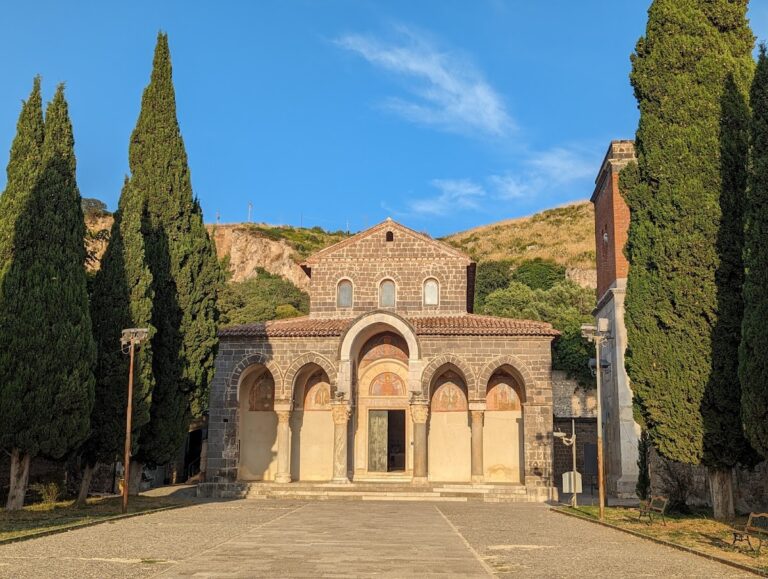
Capua Cathedral: The Episcopal Church of Capua, Italy


Site at a Glance
- Rating
- 4.6
- Popularity
- Low
- Country
- Italy
- Primary era
- Medieval
- External website
- Open
- Eras represented
- Medieval, Early Modern
- Civilizations
- Kingdom of Naples, Lombard, Norman
- Site type
- Religious
- Remains
- Cathedral
On this page8 sections
History
Capua Cathedral, formally the Cathedral Basilica of Saint Mary of the Assumption, is the principal Roman Catholic church of Capua, Italy, and the seat of the Archdiocese of Capua. Its origins are traditionally dated to 856, placing its foundation in the early medieval period, although the building has been repeatedly reconstructed and reshaped.
Foundation and Early Development
The cathedral was originally dedicated to Saint Stephen and Saint Agatha of Sicily before receiving its present dedication to the Assumption of the Virgin Mary. One tradition attributes its foundation to Bishop Landolf II. Another connects the initiative with his father, Bishop Landolf I, who served as bishop of Capua from 815 to 843.
After Saracen forces destroyed Capua in 841, Landolf I is said to have founded and fortified a new settlement on a hill, identified in one tradition as Rebelopolis. He reportedly financed the cathedral from his own resources and began its construction, but died in 843 before the work was complete. His son Landolf II continued the campaign, which is traditionally associated with the cathedral’s foundation in 856.
The church was reconstructed in the tenth century. In 966, Capua became an archdiocese, an elevated diocese headed by an archbishop, and the cathedral consequently became the seat of the archbishop rather than only the bishop.
Medieval and Early Modern Transformations
Archbishop Erveo, who held office from 1072 to 1086, directed major works in the late eleventh century. His campaign included the addition of an entrance portico and substantial changes to the adjoining episcopal palace.
The entrance forecourt was enlarged in the fifteenth century and served as a burial place for Capuan nobles until 1832. Restoration and decoration during this period were associated with the Caetani archbishops, members of an Italian noble family whose ranks included church officials and archbishops.
The complex underwent a radical restructuring between 1719 and 1724. This work introduced a Baroque entrance gate, raised the walls around the forecourt, and rebuilt the bell tower after its collapse in the fifteenth century. The forecourt was known as the Court of Paradise.
Nineteenth- and Twentieth-Century History
Capua Cathedral received the Catholic Church’s status of minor basilica in 1827. This is an honorific distinction granted to churches regarded as especially important for worship, history, or devotion. The cathedral is also described as an Italian national monument.
Architect Federico Travaglini renovated the church from 1854 to 1857 during the episcopate of Giuseppe Cosenza. Bombing in 1943, during the Second World War, almost completely destroyed the cathedral. Reconstruction ordered by the Italian government began in 1949 and continued until 1957, while retaining the historic Latin-cross plan.
In 1992, the Diocesan Museum of Capua opened in the Chapel of the Body of Christ. It preserves paintings and sculptures that came from several churches in Capua, extending the cathedral complex’s role as a repository of the city’s religious art.
Remains
The surviving cathedral is organized around a Latin-cross plan and a central church of three aisles. Twenty-four granite columns separate the aisles. These columns are postwar replacements, while an earlier account states that the former set had been brought from the Roman theatre of Capua. In front of the facade, a Baroque quadriportico, or forecourt enclosed on four sides by covered colonnades, remains one of the principal elements preserved from the earlier cathedral after the 1943 destruction.
Forecourt and Bell Tower
The quadriportico contains sixteen columns, including reused columns from the Roman period. Its entrance gate and raised enclosing walls belong to the eighteenth-century restructuring. The forecourt’s connection with noble burials lasted until 1832, when it ceased to serve that purpose.
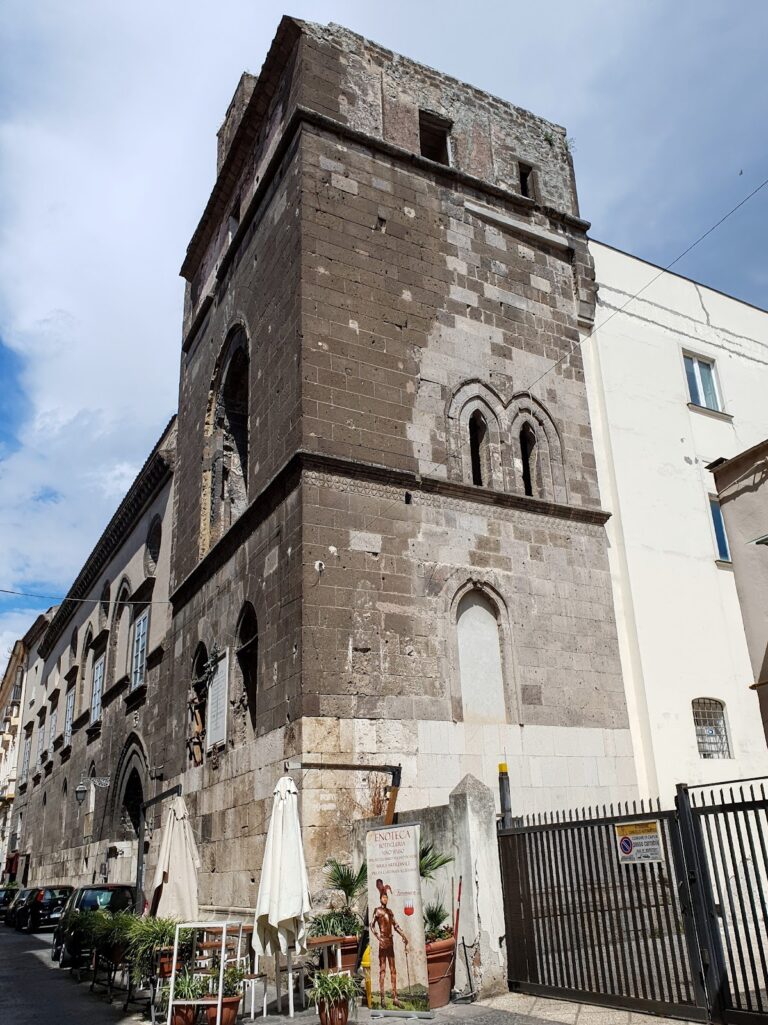
The bell tower was built in the second half of the ninth century under Bishop Landone. Its base incorporates Corinthian columns from ancient Capua, and other parts contain classical Roman remains, including reliefs possibly taken from the amphitheatre at Santa Maria Capua Vetere. After collapsing in the fifteenth century, the tower was rebuilt during the eighteenth-century works.
Crypt and Liturgical Features
The crypt, a chamber below the main level of the church, is supported by several granite columns. Its carved capitals show animals and monstrous figures, with one depicting an archer drawing and shooting an arrow. The crypt also contains a marble statue of the Dying Christ, made by Matteo Bottiglieri in 1724.
The marble base of the baptismal font dates from the tenth century. Its four faces bear the symbols of the Four Evangelists, Matthew, Mark, Luke, and John. The base is regarded as a possible remnant from a phase before the eleventh-century rebuilding. An eleventh-century candelabrum for the paschal candle is carved with marble figures and enriched with polychrome inlay.
Two marble lions survive inside the cathedral and may originally have supported a medieval ambo, a raised structure used for reading or preaching. Funerary monuments from the fourteenth and fifteenth centuries also remain. One reuses a Roman sarcophagus dating from the fourth century, while a fourteenth-century tomb associated with Prince Cesare of Capua is among the monuments retained in the side chapels.
Paintings and Diocesan Museum
The large painting of the Assumption by Francesco Solimena, produced in the 1730s, occupies the center of the rear apse wall. It is framed by a representation of the Holy Trinity, the Christian doctrine of one God in three persons, with choirs of angels and saints painted by Paolo Rivetta in 1961.
Rivetta also painted three twentieth-century scenes from the life of Jesus on the right side of the choir. The Chapel of the Body of Christ houses the Diocesan Museum of Capua, whose collection includes paintings and sculptures originating in churches throughout the city.