Capitoline Temple at Volubilis: A Roman Civic and Religious Monument
Site at a Glance
- Rating
- 4.8
- Popularity
- Very Low
- Country
- Morocco
- Primary era
- Classical
- Eras represented
- Classical
- Civilizations
- Roman
- Site type
- Religious
- Remains
- Temple
On this page8 sections
History
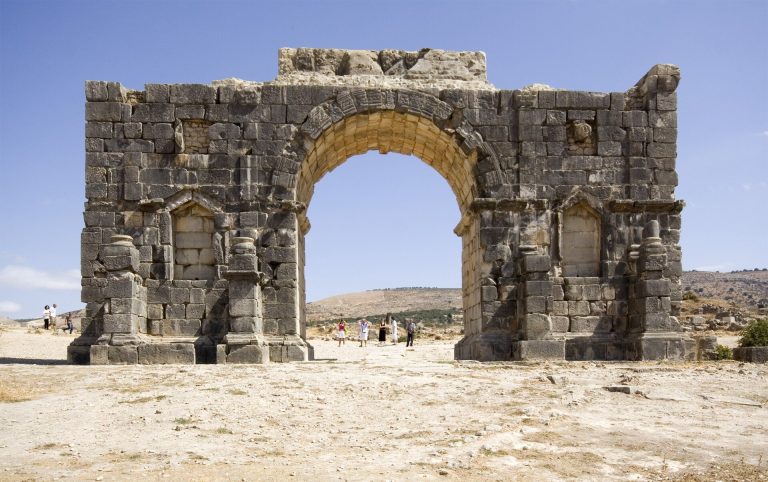
Capitoline Temple is an ancient Roman religious monument at Volubilis, near Fertassa in Morocco. It stood in the Roman province of Mauretania Tingitana, a territory broadly corresponding to northern Morocco, and its latest foundation dates to the beginning of Emperor Macrinus’s reign, around AD 217. Volubilis was a partly excavated Berber-Roman city that may have served as the capital of the Kingdom of Mauretania during the reign of Juba II, a client king who ruled in the late first century BC and early first century AD.
Earlier sanctuary and Roman development
Archaeologist Raymond Thouvenot proposed that the temple may have replaced an earlier Capitoline sanctuary dating from the first century, after Volubilis entered the Roman world. Its unusual position and orientation, including its relationship with the basilica behind it, may also point to construction over an existing place of worship.
Rebuilding under Caracalla and Macrinus
The temple was rebuilt in AD 218, according to an inscription found in 1924. Work had begun during the reign of Caracalla, the emperor who ruled from AD 198 to 217, and continued at the beginning of Macrinus’s brief rule from AD 217 to 218. The rebuilt monument was dedicated both to Macrinus and to Juno, Jupiter, and Minerva, the Capitoline Triad traditionally worshipped in Rome’s principal Capitoline temples. Jupiter was the chief god, Juno was associated with sovereignty and marriage, and Minerva with wisdom, crafts, and strategic warfare.
Capitoline temples had a civic as well as a religious role. Assemblies could meet at or below the Capitoline to declare war, then return with the spoils of a campaign. Such gatherings were also associated with asking the gods for help or offering thanks after success in major public undertakings, including warfare.
Ruin, excavation, and restoration
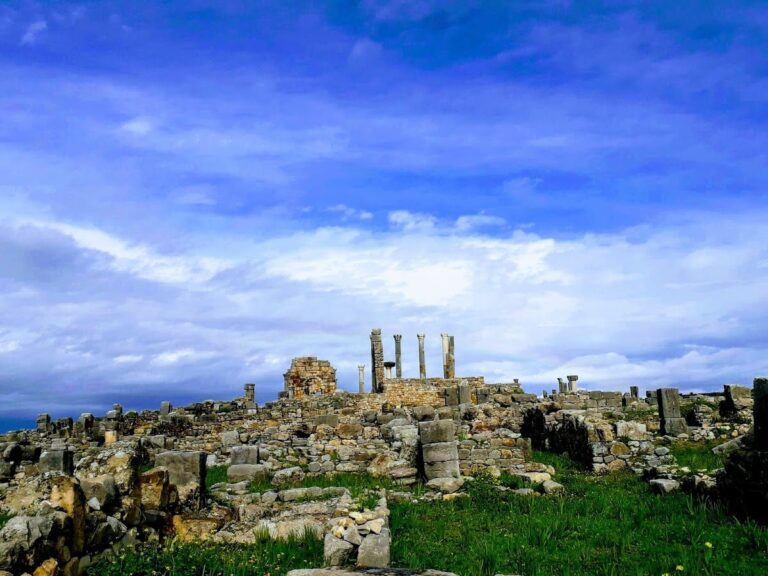
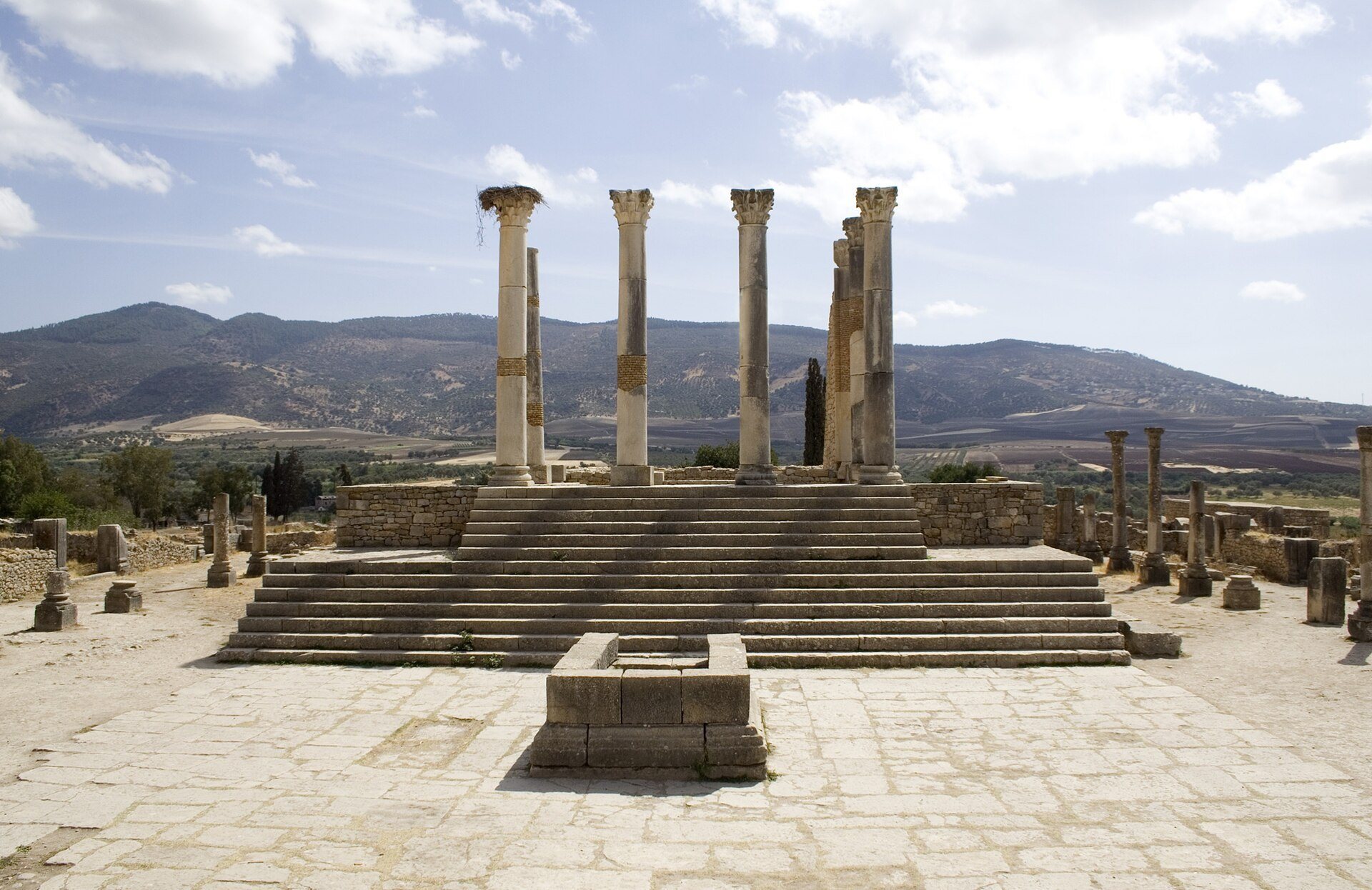
After Volubilis was abandoned, the temple was heavily plundered for valuable materials and reusable building stone. Excavation revealed it in a ruined condition. Partial restoration took place in 1955, followed by more substantial work in 1962. The later intervention reconstructed ten of the thirteen steps, along with the walls of the cella and the columns.
Remains
Temple and courtyard
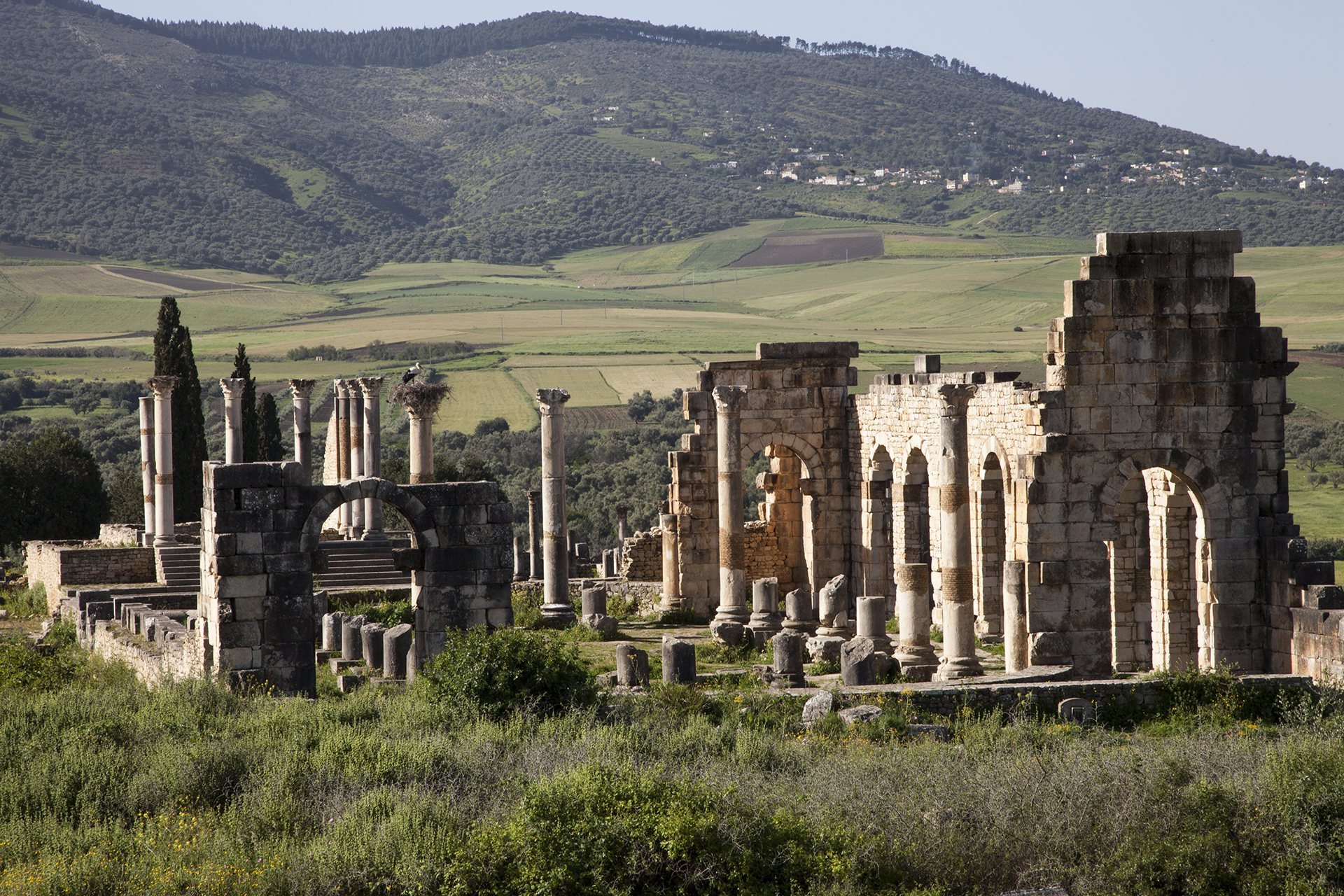
The Capitoline stands south of, or behind, the basilica and is oriented unusually toward the basilica’s rear wall. Its courtyard was originally vaulted, a feature that may reflect the reuse of an earlier sanctuary. In front of the temple was a courtyard with a Corinthian colonnade, whose capitals were decorated with acanthus leaves. An altar stood before the thirteen steps leading up to the building, and traces of the sacrificial altar remain visible.
The temple followed a Roman tetrastyle plan, meaning that its entrance portico had four columns. This form ultimately drew on Etruscan and Greek architectural traditions. Behind the portico was a single cella, the enclosed principal chamber containing the sacred focus of the temple. The later dismantling left the foundations and entrance columns, while the building had once been richly decorated with marble and finely crafted rows of columns. The restored steps and portions of the cella walls and columns help define the surviving structure.
Entrances and adjoining rooms
Four entrances served the Capitoline. The main entrance connected with the forum, the public civic square used for assemblies and communal activities. Two side entrances opened toward streets, while a fourth led directly from the basilica. That entrance was intended for prominent citizens, allowing them to enter without mixing with the general public.
Porticoes beside the temple gave access to several rooms. Some may have accommodated gatherings of the clergy, while others were associated with the worship of Venus and other Roman or Mediterranean deities. Isis, an Egyptian goddess with a large following at Volubilis, apparently did not have rituals performed inside the Capitoline itself. Baths and public toilets stood on the basilica side, while the functions of other adjoining rooms remain uncertain and may have included administrative work.
Additional sanctuaries
Four smaller sanctuaries occupied the temple area, including one dedicated to Venus. Between the Capitoline and the baths stood a small shrine apparently dedicated to the Lares Compitales, Roman household and neighborhood guardian deities associated especially with crossroads and local communal worship. Its placement allowed movement through the area without obstructing the route, while keeping the shrine within the everyday circulation of the city.