Arch of Caracalla: A Roman Commemorative Gateway at Volubilis
Site at a Glance
- Rating
- 4.8
- Popularity
- Very Low
- Country
- Morocco
- Primary era
- Classical
- Eras represented
- Classical
- Civilizations
- Roman
- Site type
- Civic
- Remains
- Arch
On this page8 sections
History
The Arch of Caracalla stands at Volubilis in Morocco. Built by the Roman community of the city, it was dedicated between December 216 and April 217, during the final months of Emperor Caracalla’s reign. The monument commemorated Caracalla and his mother, Julia Domna, and expressed the community’s gratitude for his remission of outstanding taxes.
Dedication under Caracalla
Volubilis paid for the arch from public funds. Marcus Aurellius Sebastenus, an imperial procurator who administered affairs on behalf of the emperor, initiated and dedicated the monument. Its inscription refers to Caracalla’s twentieth tribunician year, meaning the twentieth year in which he held the authority associated with the tribunate of the plebeians. This dating places the dedication before Caracalla’s death on 8 April 217.
The inscription also described the work as commissioned from the ground, together with a six-horse chariot and other ornaments. It named Caracalla through his imperial titles and identified Julia Domna as the emperor’s mother, while recording the community’s thanks for his exceptional generosity. The arch was one of 27 triumphal arches dedicated to Caracalla in Roman Africa, the North African region governed or incorporated by the Roman Empire, although its sculptural treatment was relatively modest and provincial.
Position in the city and later history
The arch stood at the western end of the Decumanus Maximus, the principal east–west street of a Roman city. Its position marked the boundary between Volubilis’s older Punic-Hellenistic quarter, shaped by earlier Phoenician-Punic and Hellenistic traditions, and the Roman-period quarter. It also marked the point from which the Roman city expanded toward the northeast.
The monument remained standing when archaeological excavations at Volubilis began, and its ruins were uncovered during work carried out from 1915 to 1917. The 1755 Lisbon earthquake damaged the structure. French restoration between 1930 and 1934 returned it to a more complete form, but the reconstruction did not accurately reproduce its original appearance. Fragments of the Latin dedication were found scattered on the ground in front of the arch. Windus recorded them in 1722, allowing the inscription to be reconstructed.
Remains
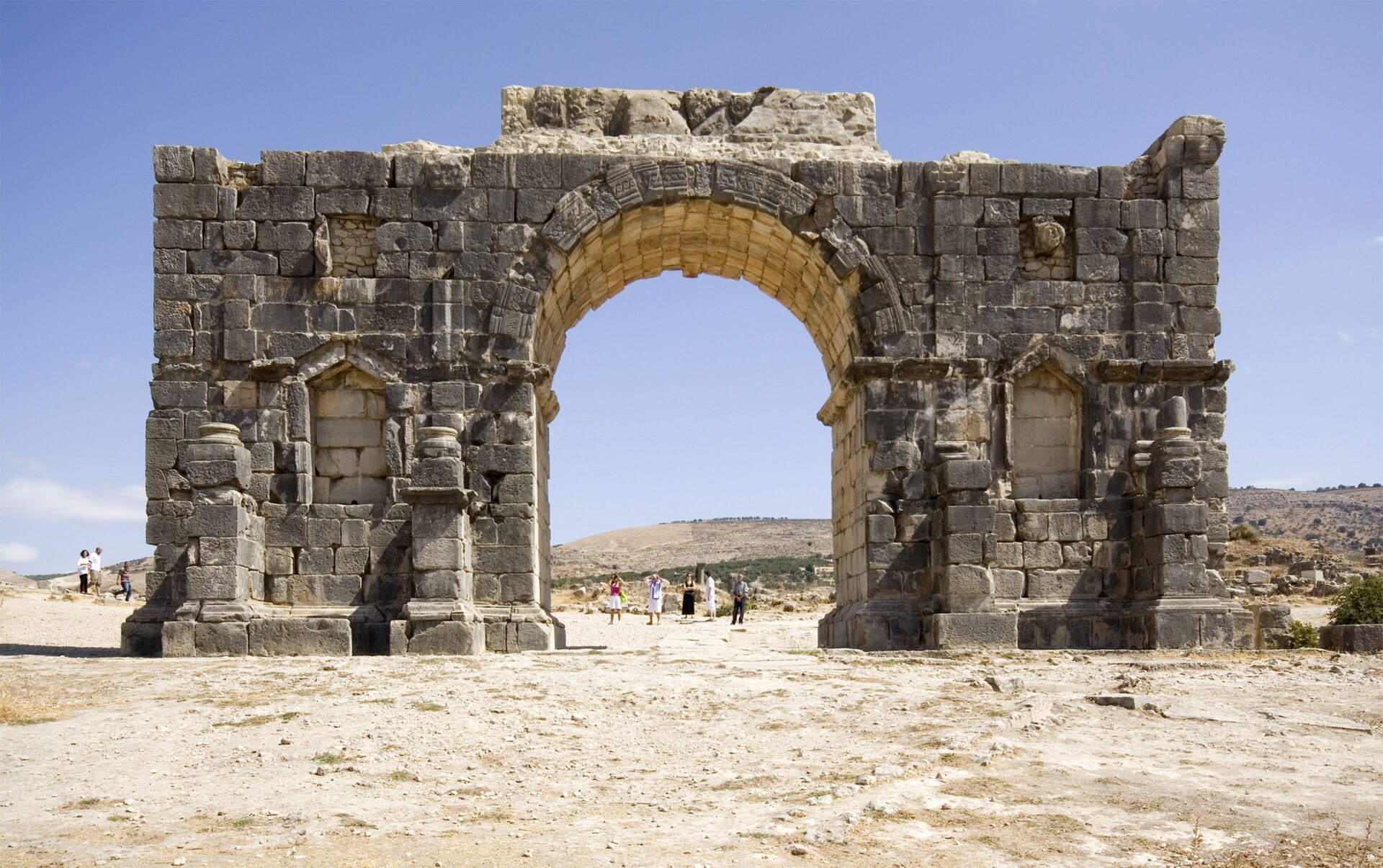
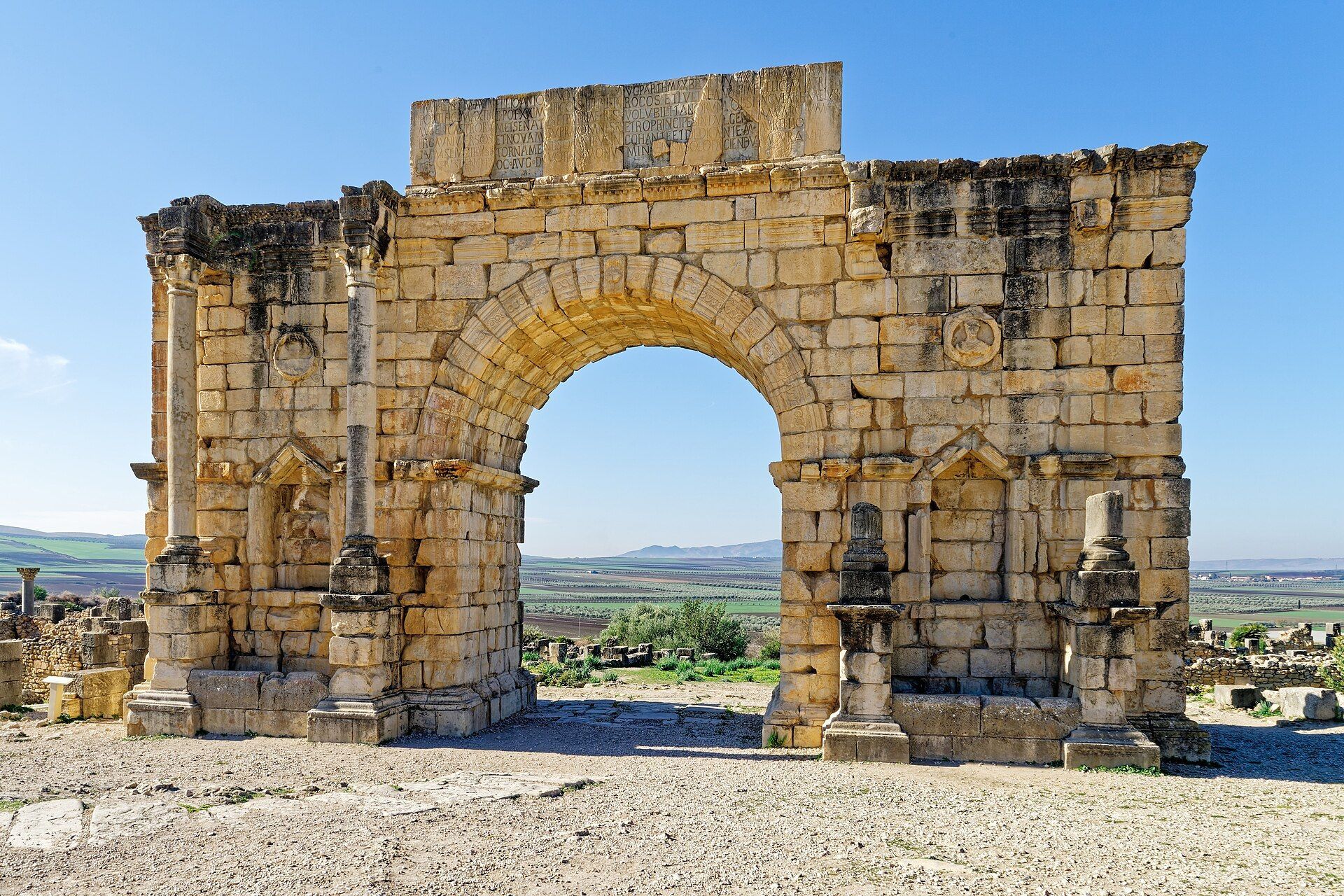
The restored arch is a single vaulted passage carried between two piers, with a horizontal entablature and an attic, the upper storey above the main architectural order. It occupies the western end of the Decumanus Maximus, where the street opens toward a view of the Zerhoun plain, and contrasts in scale with the smaller Tingis Gate at the opposite end.
Structure and passage
Passage and piers
The restored structure is approximately 19.28 metres wide, 4.74 metres thick, and 9.23 metres high including the architrave. Its central passage is about 5.5 metres wide, with an opening approximately 8 metres high. Carefully cut local stone was laid in regular courses. The material is grey Zerhoun limestone from the nearby mountain massif.
The original monument had an additional upper storey and probably reached about 14 metres. It was therefore taller and more slender than the restored arch. The facade carries twisted ornamental motifs, a projecting keystone, and a cornice that runs around the piers. Each pier contains a niche with an open channel in its ceiling.
Water features
The niches probably held water-associated deities, including nymphs or Venus Marina. Water passed through an opening and flowed into carved marble basins at the base of the arch. Statues of nymphs are also described as pouring water into these basins, linking the decorative sculpture with a functioning water display.
Upper sculpture and inscription
The summit originally carried a bronze group of Caracalla driving a chariot drawn by six horses. The chariot is also described as gilded, and statues representing the four seasons added to the monument’s decoration. Portraits or medallions of Caracalla and Julia Domna were incorporated into the design and are damaged.
A Latin dedicatory inscription occupied the upper part of the arch. Its reconstructed fragments preserve the emperor’s titles, Julia Domna’s position as his mother, references to the military camps, the Senate, and the fatherland, and the community’s expression of gratitude for Caracalla’s generosity.