Bolærne Fort: A Coastal Defence Installation in Norway


Site at a Glance
- Rating
- 4.5
- Popularity
- Low
- Country
- Norway
- Primary era
- Modern
- External website
- Open
- Eras represented
- Modern
- Civilizations
- German, Norwegian
- Site type
- Military
- Remains
- Fort
On this page13 sections
History
Bolærne Fort is a coastal military installation in Norway on Østre Bolærne in the outer Oslofjord. It formed part of the Oslofjord Fortress, a system of coastal positions protecting the fjord and important naval facilities, and was established to defend the Norwegian Navy’s principal base at Karljohansvern in Horten.
Early defences and the 1935 battery
The Norwegian Armed Forces began a provisional development on the island in autumn 1916. Its armament consisted of four older 120 mm Bofors guns and two 65 mm guns. Bofors was a Swedish arms manufacturer whose artillery was widely used by coastal and naval forces.
A new battery began construction in January 1935. It received three 150 mm L/50 Bofors guns, whose barrels were fifty calibres long. The installation was still in service when German forces attacked Norway in April 1940.
The German attack of April 1940
At 23:32 on 8 April 1940, the fort’s observer saw three small vessels through the fog. Fort commander Major FW Færden ordered explosive fire, but the battery commander, concerned about neutrality regulations, ordered warning shots instead. The vessels illuminated the fort with searchlights, and the battery opened fire only after they had passed out of its sector.
On 9 April, when the fog lifted, three smaller German vessels attacked. Færden allowed them to advance into the middle of the fjord before ordering the fort to fire. After five shots, the vessels withdrew behind a smoke screen. German aircraft then bombed the position, followed by another attack from two vessels.
During the fighting, one gun was disabled at 12:14 and a second at 12:23, although the German vessels continued to withdraw. Air attacks continued throughout the day. German aircraft and ships also subjected the fort to machine-gun and aerial attacks after the ineffectiveness of the Norwegian air defences had been observed.
By 09:40 on 10 April, two of the three guns were out of action. The remaining gun fired several shots before it too was disabled. At 12:30 the fort raised a white flag, and soldier Hans Christian Furuseth was killed while raising it. German forces removed the crew from Bolærne later that evening.
Occupation and Cold War defence
During the German occupation of Norway in the Second World War, an additional 150 mm Bofors gun was installed on the island. In 1944, four 105 mm guns were placed in the tunnel battery. The former battery was designated MKB 3/501 Bolärne, while the tunnel battery was designated HKB 8./980 Kongshavn (983). MKB referred to a naval coastal battery, and HKB to a coastal battery operated within the German Army’s coastal-defence system.
After the war, Bolærne Fort and Rauøy Fort formed the Bolærne-Rauøy defensive line, intended to prevent an enemy from entering the Oslofjord. In 1950 and 1951, the four guns in the tunnel battery were replaced by four 127 mm guns. The Bofors guns were gradually withdrawn before 1960. Two 75 mm Bofors turret guns were installed in 1972, followed by a third in 1974.
The defensive system also included a controllable minefield at Huikjæla, with its mining station on Vestre Bolærne. During peacetime, the minefield could be controlled from the station. On mobilisation, an uncontrolled minefield was intended to channel shipping through passages between the mainland and Rauøy or Bolærne.
Throughout the Cold War, Bolærne and Rauøy were maintained as standby forts. Their main batteries were required to be ready to fire within 30 minutes, although the required readiness period was extended to four hours in 1981. A mountain storage installation on Vestre Bolærne held supplies for NATO, the North Atlantic Treaty Organization, a Cold War military alliance. The facility was used mainly by the West German Navy during the 1960s.
Decommissioning and later ownership
The tunnel battery and minefield were decommissioned in 1999. The three-turret batteries were placed in mothballed status in 2001. Bolærne was sold to the Brunstad Christian Church in 2004, but after political debate the church relinquished ownership. The property was then sold to Vestfold County Council and opened as an outdoor area.
Before the public opening, safety work filled trenches, sealed bunker openings with masonry, brought defensive positions closer together, and removed barbed wire. In 2013, the mountain installation associated with two turret guns was sealed, while the guns themselves remained in place. The southernmost gun and the radar station were opened for summer visits under the auspices of the Tønsberg Defence Association.
Remains
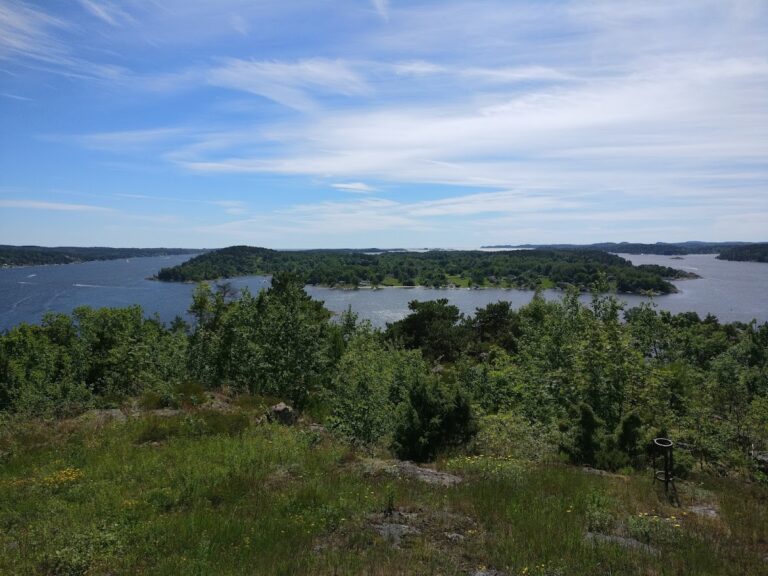
Bolærne Fort occupies Østre Bolærne in the Bolærne archipelago, offshore from Nøtterøy in Færder municipality. Its surviving defensive landscape combines gun positions, a tunnel battery, bunkers, trenches, turret installations, a radar station, and the wider minefield system linked to Vestre Bolærne. The tunnel battery places its guns and operating spaces inside excavated rock, while a casemate is a protected chamber from which a gun can fire.
Gun positions and tunnel battery
Three-gun battery
The 1935 battery was arranged for three 150 mm L/50 Bofors guns. The later Cold War turret installations added two 75 mm Bofors guns in 1972 and a third in 1974. The mountain installation associated with two turret guns was sealed in 2013, but the guns remained in place. The southernmost turret gun is also preserved.
Tunnel battery
The tunnel battery contains the four 127 mm guns installed in 1950 and 1951, replacing the four 105 mm guns placed there during the German occupation in 1944. The guns remain in place but were bricked in, leaving their barrels projecting from the casemates. This arrangement preserves the relationship between the artillery pieces and the excavated rock chambers that housed their operating spaces.
Associated defensive works
Bunkers, trenches, and radar station
Bunkers, trenches, and the radar station formed part of the fort’s supporting defensive works. The trenches were filled and bunker openings were sealed with masonry before the site was opened for public use, while the radar station remains associated with the preserved coastal-defence installation.
Minefield system and mining station
The fort’s defensive layout extended beyond Østre Bolærne. A mining station on Vestre Bolærne controlled the peacetime minefield at Huikjæla. The planned mobilisation field between Rauøy and Bolærne formed part of the system’s arrangement for directing shipping through selected passages in the Oslofjord.
Mountain storage installation
A separate mountain installation on Vestre Bolærne stored NATO supplies, mainly for the West German Navy during the 1960s. Its presence reflects the wider Cold War logistical network connected with the fort’s coastal-defence role.