Burgruine Treffen: A Medieval Castle Ruin in Austria
Visitor Information
Google Rating: 4
Popularity: Very Low
Country: Austria
Civilization: Medieval European
Site type: Military
Remains: Castle
History
Burgruine Treffen is located in the municipality of Treffen am Ossiacher See, Austria. This site traces its origins back to early medieval times and was developed by the Bavarian and later local noble civilizations that ruled this Alpine region.
The earliest known phase of the site began in the year 878, when King Karlmann granted a manor known as “curtis ad Trebinam” to the Bavarian monastery of Ötting. This estate included 19 servants and 70 farms and gradually evolved into the basis for the later castle complex. Around 1065, Count Markwart IV from the Eppenstein dynasty, a powerful noble family in the southeastern Alps, likely constructed the initial castle. Markwart’s family had significant influence across the region, which makes this period the foundational era of Burgruine Treffen.
Ownership of the castle changed hands several times over the following centuries. From approximately 1090, the Swabian Counts of Veringen held it, adopting the name “von Treffen” from their estate, which indicates its growing local importance. In 1163, Ulrich II of Treffen, who was Patriarch of Aquileia—a powerful church leader in northeastern Italy and the Eastern Alps—transferred the castle and its lands to the Patriarchate of Aquileia. This move sparked conflicts, notably with Duke Herman II of Spanheim, ruler of Carinthia, who besieged the castle in 1177. The siege ended when Emperor Frederick I Barbarossa compelled the duke to return control to the Patriarchate.
During the following decades, the castle remained under the Patriarchate’s jurisdiction but faced frequent disputes involving the Salzburg archbishops and various local counts, reflecting the turbulent political landscape in the area. From 1277 onwards, control shifted through a series of noble families: it was enfeoffed—granted as a fief—to the Counts of Ortenburg and then pledged to the Carinthian dukes Otto and Heinrich in 1306. Later, it transferred to figures such as Konrad von Aufenstein and Engelmar von Villanders.
In 1361, the castle returned to the Patriarchate and was granted to Duke Rudolf IV of Habsburg, signifying its continuing strategic relevance. A decade later, in 1371, it was enfeoffed to Rudolf von Liechtenstein, marking the beginning of an association with the influential Liechtenstein family. This period, however, ended abruptly in the late 15th century when the castle sustained damage from Turkish raids between 1473 and 1483. Emperor Frederick III ordered its destruction in 1489 as punishment for the Liechtensteins’ support of Hungarian King Matthias Corvinus.
Following the castle’s destruction, the lordship was granted in 1490 to Lasla Prager, who undertook repairs and strengthened the fortifications. The Liechtenstein family retained ownership until the mid-1500s, after which they constructed a new residence in the valley below. This led to the gradual abandonment and decline of the original castle on the hillside. Over the next centuries, the estate passed through several noble families including the Grotta von Grottenegg, Christallnigg, and Goess families. In the 20th century, Karoline Kramer became the leaseholder of the ruins.
A strong earthquake in 1690 completely destroyed what remained of the castle structure. Despite this natural disaster and centuries of neglect, the ruins have remained remarkably preserved for more than 480 years.
Remains
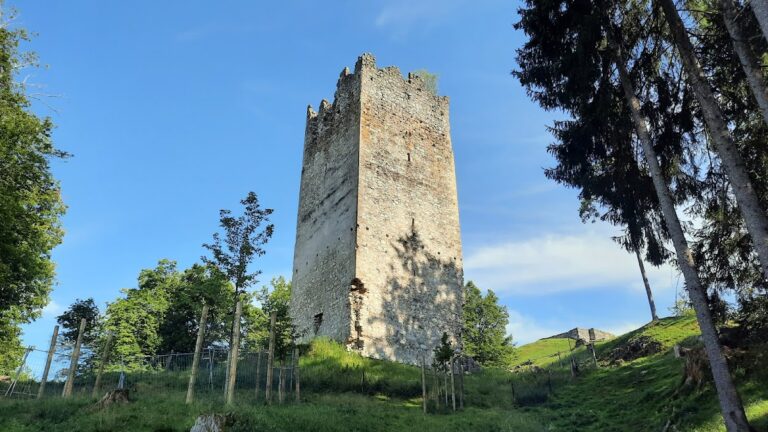
The ruins of Burgruine Treffen occupy a commanding position on the rocky ridge of Steinwender Höhe hill, about 220 meters above the valley floor and roughly 750 meters above sea level. The castle stood on the western foothills of the Gerlitzen massif, near the Ossiacher See. Covering around 5,400 square meters, the site’s location offered extensive views and control over communication routes through the Krastal valley, extending towards the Drau River and the area near Faaker See.
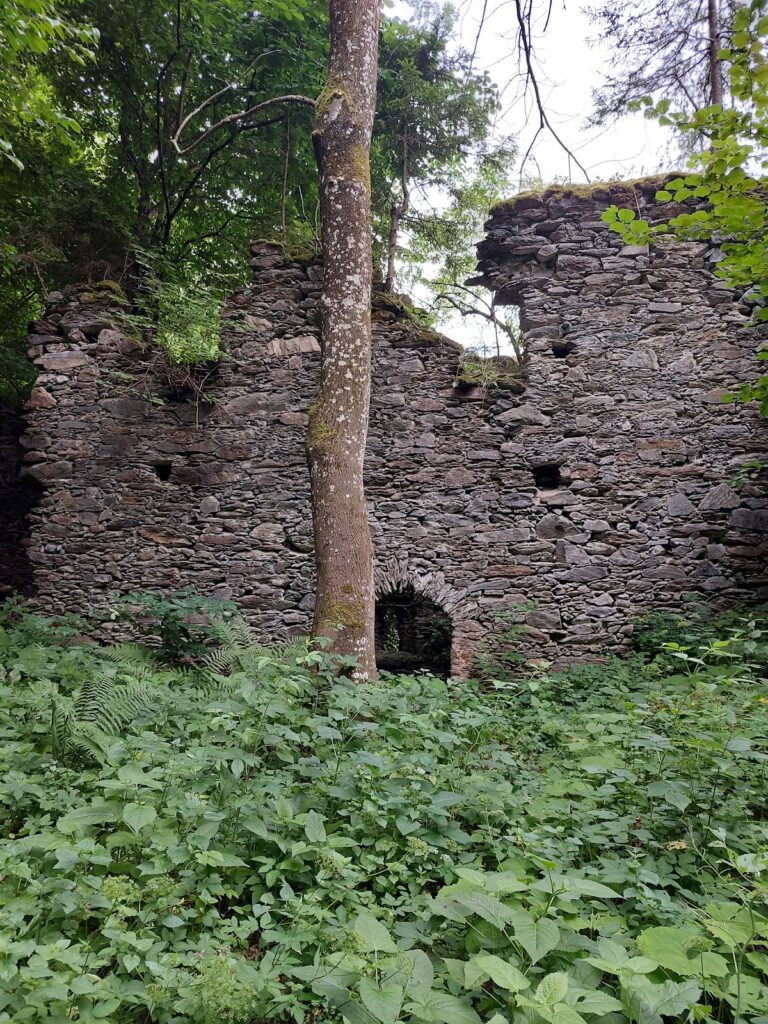
Present day remains include the foundation and partial walls of several structures clustered around an entrance tower. This tower formerly served as the main gateway, guiding visitors into the economic courtyard—an open area enclosed by service buildings used for everyday activities such as storage and craftwork. Historical sketches and photographs taken from different angles (southwest, southeast, northeast, and north) illustrate a castle complex that was substantial in size and well-fortified.
The construction employs typical medieval techniques, with stone masonry carefully integrated into the natural rocky outcrop. These ruins have endured despite long periods of exposure and destruction, providing a clear outline of the castle’s medieval layout. Visual documentation by artists like Markus Pernhart and photographer Hermann Truschnig highlights perspectives primarily from the east and southwest, underscoring the site’s rugged setting and defensive advantages.
Although the castle has not been restored, the extensive stonework—especially the remains of the entrance tower and adjoining walls—remain stable enough to convey the structure’s former scale and function. These ruins stand as a physical record of Burgruine Treffen’s medieval prominence and its evolution from an early manor estate to a strategic stronghold in the region.
Nearby sites