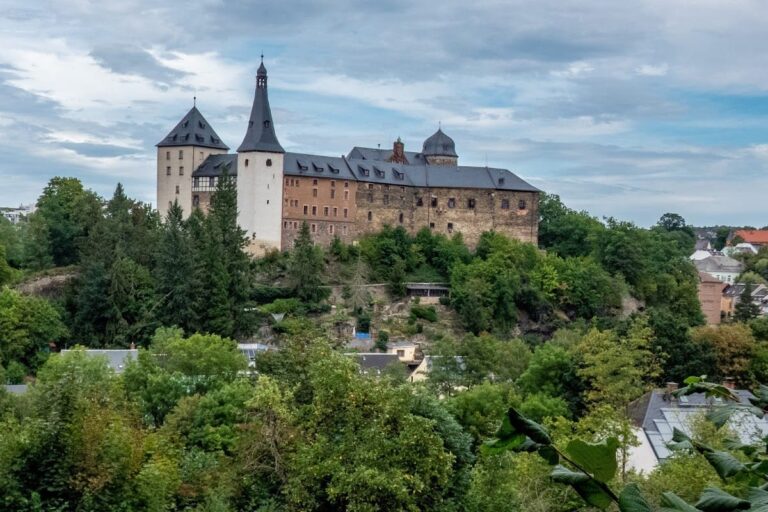
Reichenfels Castle Ruins: A Medieval Hilltop Castle in Thuringia


Site at a Glance
- Rating
- 4.4
- Popularity
- Low
- Country
- Germany
- Primary era
- Medieval
- Eras represented
- Medieval, Modern
- Civilizations
- Holy Roman Empire
- Site type
- Military
- Remains
- Castle
On this page13 sections
History
Reichenfels Castle Ruins are the remains of a medieval hilltop castle near Hohenleuben in Germany, probably built around 1200 by the Vogts of Weida. The castle became the administrative centre of the lordship known as Pflege Reichenfels, a territory that by around 1793 included Reichenfels Castle and the settlements of Hohenleuben, Triebes, and Langenwetzendorf.
Medieval lordship
The Vogts of Weida and Gera were territorial governors whose offices developed into regional lordships in eastern Thuringia and the Vogtland. Reichenfels passed to the Vogts of Gera in 1356. In 1550, the Burgraves of Meissen from the Plauen line acquired the castle and placed members of the old Vogtland nobility there as its garrison.
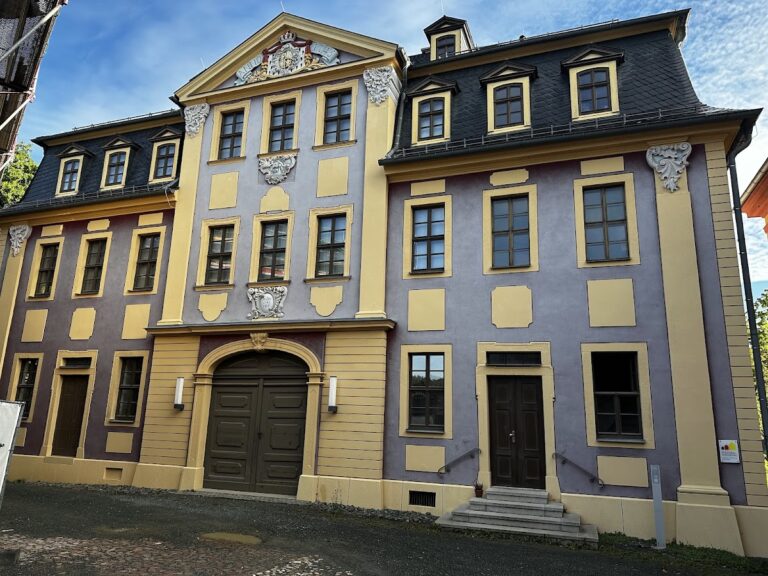
In 1703, Georg Wilhelm von Müffling sold Reichenfels Castle and the lordship to Count Heinrich XXIV of Reuss-Köstritz. The Müffling family had held both Reichenfels and Hohenleuben until that sale. Heinrich XXIV moved the administrative seat to Hohenleuben, where Hohenleuben Castle was either newly constructed for this purpose or already in existence.
Decline and nineteenth-century transformation
From the eighteenth century, the medieval castle deteriorated. The Pflege Reichenfels became part of the Principality of Reuss Junior Line and, within that political structure, belonged to the Reuss-Köstritz branch of the Schleiz line. The Reuss dynasty was a ruling house whose territories were divided among several branches.
In 1804, Prince Heinrich XLIII of Reuss-Köstritz began building a neo-Romanesque palace among the ruins and reshaping the surrounding grounds as a park. The undertaking was abandoned in 1811 without substantial success. The Köstritz princes dissolved the estate economy in 1846. The palace tower collapsed in 1872, and between 1900 and 1903 the castle and palace remains were dismantled down to their foundations.
Protection, research, and regional memory
Reichenfels was placed under monument protection in 1944 and again in 1955. Repair and restoration began in 1955, helping prepare the complex for cultural use and the presentation of its history. The ruins remain a protected cultural monument.
The forecourt museum grew from the work of the Vogtland Antiquarian Research Association of Hohenleuben, founded in 1825. Museum Reichenfels presents the history of the castle through archaeological finds, preserves objects rescued from Hohenleuben Castle, and houses the Kresse Archive, which includes literature on the Vogtland and the former Reuss principalities.
A permanent exhibition devoted to Georg Kresse was established around 1999. Kresse was a seventeenth-century Vogtland figure remembered in regional tradition as a peasant general and folk hero during the Thirty Years’ War, the European conflict fought mainly from 1618 to 1648 amid religious, dynastic, and territorial struggles in the Holy Roman Empire. His connection with Reichenfels belongs to local tradition rather than a demonstrated direct association with the castle. Tradition places him in the Kresse Cave in the Triebe Valley, where he is said to have hidden from the authorities.
From 1984, Reichenfels hosted an annual castle festival together with a Georg Kresse memorial run. The runs ended after the political changes of 1989 and 1990, while the castle grounds and museum forecourt continued to serve as event spaces. The site’s historical identity also appears in the name of a 1921 emergency banknote issued in Triebes and symbolically in Hohenleuben’s coat of arms.
Remains
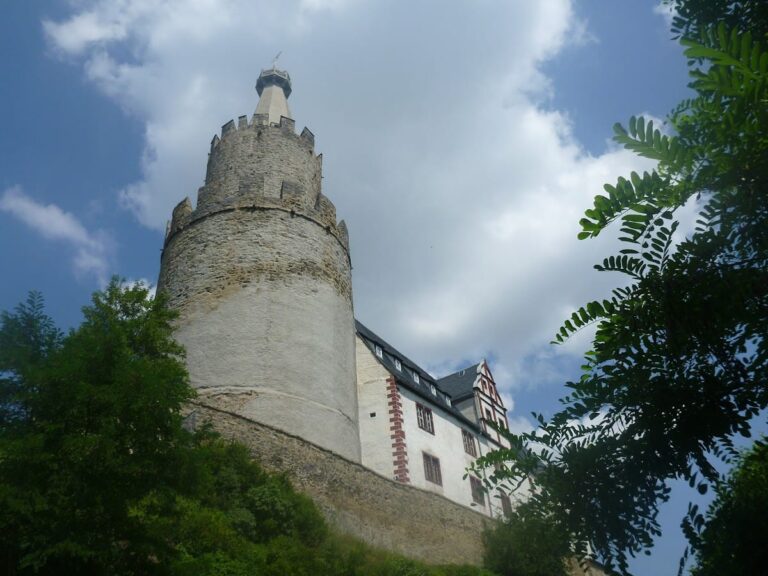
Reichenfels stands on the Schlossberg spur at about 350 metres above sea level, roughly 45 metres above the Triebe Valley and about one kilometre west of Hohenleuben’s town centre. The complex comprises a compact inner castle and a forecourt, with the inner area separated from the forecourt by a broad, deep ring ditch. The surviving masonry, museum, and surrounding public and private buildings together form Hohenleuben’s Reichenfels district.
Castle and defensive works
Inner castle and curtain wall
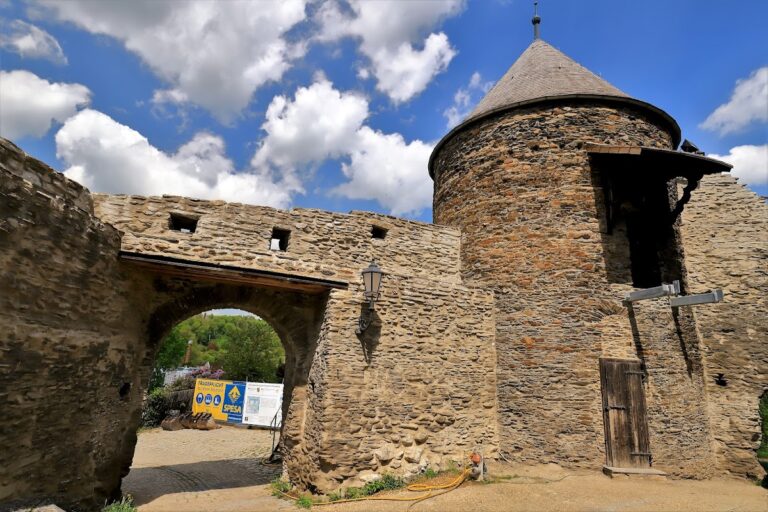
The inner castle was enclosed by a polygonal curtain wall, an enclosing defensive wall, measuring about 30 metres in diameter. On the western side, sections of sandstone wall survive between approximately 4 and 8 metres high. A keep, the principal fortified tower of a medieval castle, secured the complex, and remains of additional buildings can still be seen within the enclosure.
Gate, bridge, and ditch
A continuous stone bridge now crosses the ring ditch, whose broad channel separated the inner castle from the forecourt. The gate retains evidence of the former drawbridge mechanism, including a preserved roller. Its threshold bears a druden foot, a protective symbol associated with supernatural safeguarding in German-speaking regions. A supporting vault survives on the inner side of the curtain wall.
Forecourt and later landscape
Museum and former farm building
The forecourt contains Museum Reichenfels and a former farm building. The farm building now serves as a castle tavern and hotel. Areas without buildings are enclosed by a historic wall, while part of the courtyard has a modern tent-like stage roof that provides weather protection for outdoor events.
Park features and labyrinth
The unfinished nineteenth-century park scheme left several physical traces. A Classicist sandstone gate survives, and a stone cross known as the Holy Cross was moved from the former palace park. Outside the forecourt lies the Reichenfels labyrinth, formed from grass and stone and measuring about 10 metres across. Its path extends for roughly 200 metres.
A chestnut avenue leading from Hohenleuben toward Reichenfels was laid out in 1770 along the route now associated with the Reuss Princes’ Road. This approach belongs to the later landscape history of the estate rather than to the medieval defensive complex.
Mining galleries in the Triebe Valley
Kresse Caves
The Triebe Valley contains former mining galleries known as the Kresse Cave or Kresse Caves. They were historically associated with the Reichenfels estate and later became linked by tradition with Georg Kresse. Two former galleries carried the name. One, also called the Kresse Camp, was destroyed by quarrying around 1936; it had previously been clearly visible from the castle and viewpoint.
Nearby sites