Burg Elsterberg: Medieval Castle Ruins in Germany


Site at a Glance
- Rating
- 4.6
- Popularity
- Low
- Country
- Germany
- Primary era
- Medieval
- Eras represented
- Medieval
- Civilizations
- Holy Roman Empire
- Site type
- Military
- Remains
- Castle
On this page7 sections
History
Burg Elsterberg is a medieval castle ruin in Germany, built by the Lords of Lobdeburg between 1200 and 1225 in the Vogtland region of Saxony. It is the largest castle ruin in the Vogtland and, with a built-up area of about 1.5 hectares, was among the largest fortresses in Saxony.
Foundation and Lobdeburg rule
The castle replaced an earlier stronghold known as the Old House, situated about 400 metres away above the meeting point of the Tremnitz stream and the White Elster. Local tradition says that the two castles were linked by underground passages and a leather bridge. The Lords of Lobdeburg were a medieval noble and comital family whose members held territories in eastern Thuringia and western Saxony.
A feudal register from 1349–1350, compiled under Frederick the Strict, a Wettin margrave of Meissen, names two nobles called Hermannus de Elstirberg among the nobility of the Osterland. The Osterland was a medieval region broadly associated with areas between present-day Thuringia and Saxony, and the two men belonged to the Lobdeburg comital family.
Destruction and changing ownership
Burg Elsterberg was destroyed in 1354 during the Vogtland War and had been rebuilt by 1366. After the rebuilding, it became the centre of the Lordship of Elsterberg. A depiction from around 1580 shows the Gothic castle in its reconstructed form.
In 1395, the Margraves of Meissen acquired the castle. A margrave was a high-ranking territorial ruler, and the Meissen margraves governed the territory around Meissen while acquiring possessions across Saxony. They pledged Burg Elsterberg to the von Wolframsdorf family in 1402. The von Bünau family took possession in 1437 and sold the castle and town in 1636 to their relative Carol Bose.
The castle’s military and political history continued during the Schmalkaldic War, the 1546–1547 conflict between Emperor Charles V and the Protestant Schmalkaldic League. After the league’s decisive defeat at the Battle of Mühlberg in 1547, the castle owner Heinrich von Bünau was taken into Spanish captivity. His release required a ransom of 565 guilders, valued at approximately 50,000 Deutsche Marks.
Decline and preservation
Burg Elsterberg was no longer inhabited after 1698 and gradually deteriorated under its later owners. A depiction from around 1725 connects the decline with the Thirty Years’ War, the major European conflict of 1618–1648 that caused extensive destruction across central Europe, while still showing substantial buildings standing at the castle.
The municipality of Elsterberg purchased the ruins on 25 May 1909 for 13,000 marks and then continued their preservation. The vaulted cellars have been restored and are used for annual local celebrations, including the local heritage festivals held since 1883.
Remains
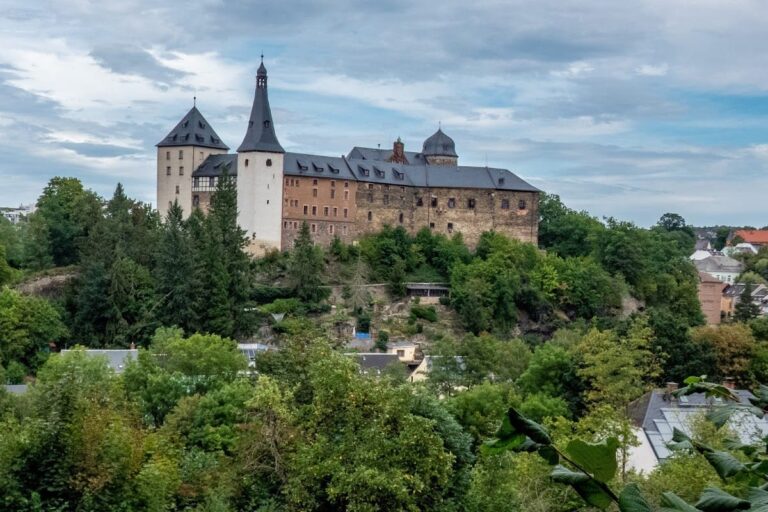
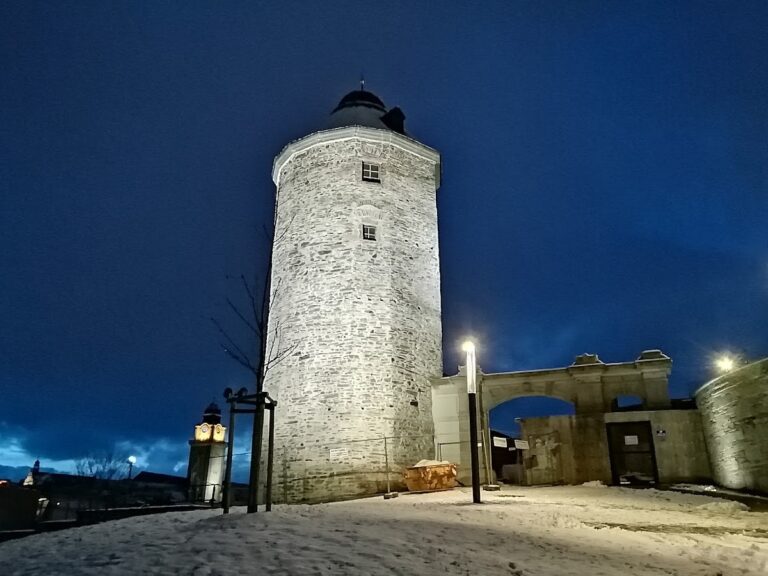
Burg Elsterberg occupies a bend of the White Elster at the northern edge of the old town. The fortified area covered about 1.5 hectares and was enclosed by two substantial ring walls, meaning surrounding defensive walls that formed the site’s perimeter. Five watchtowers strengthened the fortification, and three remain in good condition. Surviving elements include round towers, wall sections, vaulted cellars, and the castle well.
Walls and towers
The two ring walls defined the castle’s defensive enclosure. Round towers survive along with sections of the enclosing walls, while three of the five former watchtowers remain in good condition. One of the two preserved round towers now contains the Elsterberg local-history room.
Main building and water supply
The former main building contained a large vaulted knights’ hall, reached by an outside staircase. The castle well, cleared in 1932, is traditionally said to have been about 26 metres deep and supplied water to the inhabitants. The restored vaulted cellars remain part of the surviving castle fabric and are used for local celebrations.