Lichtenhag Castle Ruins: A Medieval Hilltop Castle in Austria

Site at a Glance
- Rating
- 4.4
- Popularity
- Very Low
- Country
- Austria
- Primary era
- Medieval
- External website
- Open
- Eras represented
- Medieval
- Civilizations
- Habsburg, Holy Roman Empire
- Site type
- Military
- Remains
- Castle
On this page8 sections
History
Lichtenhag Castle Ruins, historically also known as Burg Liechtenhaag, are the remains of a medieval castle in Gramastetten, Austria. The castle stands in the Mühlviertel region of Upper Austria and first appears in written records in 1455, during the reign of Ladislaus Postumus, the fifteenth-century king of Hungary and Bohemia and duke of Austria. Its position above the Große Rodl valley probably allowed the Lords of Haag to oversee movement connected with the salt trade between Aschach an der Donau and Bohemia.
The Lords of Haag and Lichtenhaag
The castle is traditionally associated with the Lords of Haag, although the family’s precise origins remain uncertain. They may have descended from the Bavarian knights of Haag or may have been related to the owners of the former Haag Castle near Stadt Haag in Lower Austria. The name Lichtenhaag appears in the titles of Martin Aspan von Haag zu Liechtenhaag and his brother Wolfhard Aspan von Haag zum Liechtenhag, who died in 1409.
At that time, Lichtenhag referred to an open tract of land south of the later castle, below the farm now called Maier in Aspanhof. The name suggests an unforested, enclosed estate. The land was cultivated from the freehold Alhartinghof, which later became known as Maier in Aspanhof. The family’s wider history included Espinius von Haag’s acquisition of Hartheim Castle in 1323 and the construction of the church at Annaberg by his nephew Ulrich in 1313, where members of the Haag family were buried.
Espinius’s son, Wolfhard Espin von Haag, adopted his father’s given name as a family name. The family subsequently used the forms Espin von Haag, Espan, and later Aspan von Haag. During the fifteenth century, the Aspans also acquired Wimsbach Castle.
Construction and Lordship
A 1504 land register made for Jörg Aspan von Haag, who died in 1515, states that his parents, Sigismund Aspan von Haag and Agnes, built the castle from the ground up on land belonging to Alhartinghof. An Urbar, or land and property register, recorded estates, rights, obligations, and revenues. After the castle was built, the former freehold farm served as an agricultural estate and became known as Maier zu Aspanhof.
Lichtenhag and its associated properties were held by the Aspans as a sovereign fief, meaning land granted by a ruling prince in return for obligations such as service or loyalty. The lordship included woodland, hunting grounds, fishing waters, the Maier in Aspanhof farm, and numerous freehold and enfeoffed subjects. Members of the Aspan family served as land judges, burgraves, and administrators at Wallsee, Scharnstein, Schaunberg, and Neuhaus. A burgrave administered a castle or fortified district, while a land judge exercised judicial authority over a defined territory.
The valley below the castle was not a principal route, but salt carriers repeatedly used secluded paths there in attempts to avoid customs duties. Lichtenhag’s elevated position probably gave the Lords of Haag a role in controlling this movement, linking the castle’s local lordship with wider commercial traffic between the Danube and Bohemia.
Decline and Later Ownership
By 1615, when Hans Joachim von Aspan sold Lichtenhag to Wolf von Gera, the castle was described as a poor, old building no longer suitable as a lordly residence. Gera lived at Waxenberg Castle and had no practical use for Lichtenhag, allowing the property to decay. Around 1598, before the sale, Jacob Aspan von Haag auf Liechtenhaag, lord of Hartheim and Wimsbach, had been raised to the rank of baron while serving as a councillor and provincial councillor of the emperor in the Duchy of Austria above the Enns.
In 1654, Konrad Balthasar von Starhemberg acquired the lordships of Waxenberg, Lichtenhag, and Eschelberg. The Starhembergs were an Austrian noble family, and Lichtenhag was assigned to the Lordship of Eschelberg, from which its subjects were administered. A regional view by Georg Matthäus Vischer shows Lichtenhag already in ruins around 1670. Vischer was a seventeenth-century cartographer and engraver whose views provide visual evidence for castles and settlements in Austria.
Preservation and Private Ownership
Preservation work in 1954 and 1955 concentrated on stabilizing the residential tower and limiting further deterioration. Kurt Wöss purchased the ruin in 1964 and converted the front building into a weekend residence. Since 2012, the property has been owned by Harald and Renate Kogler and remains privately owned.
Remains
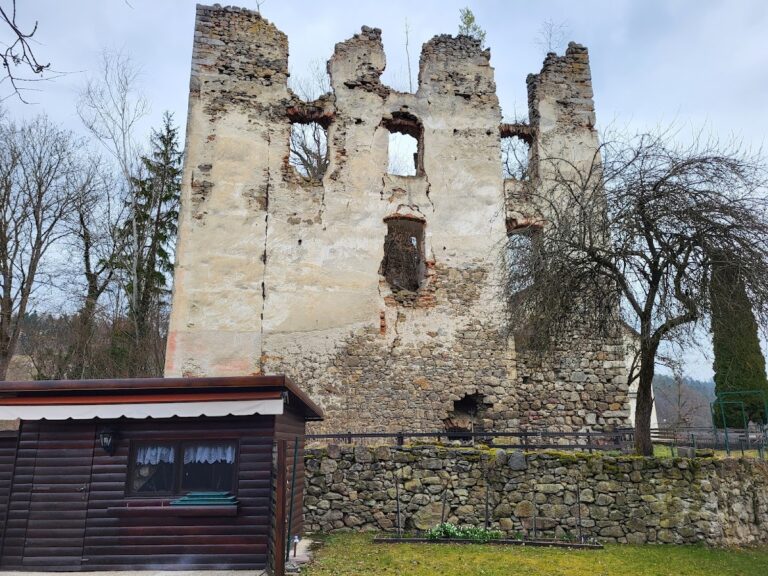
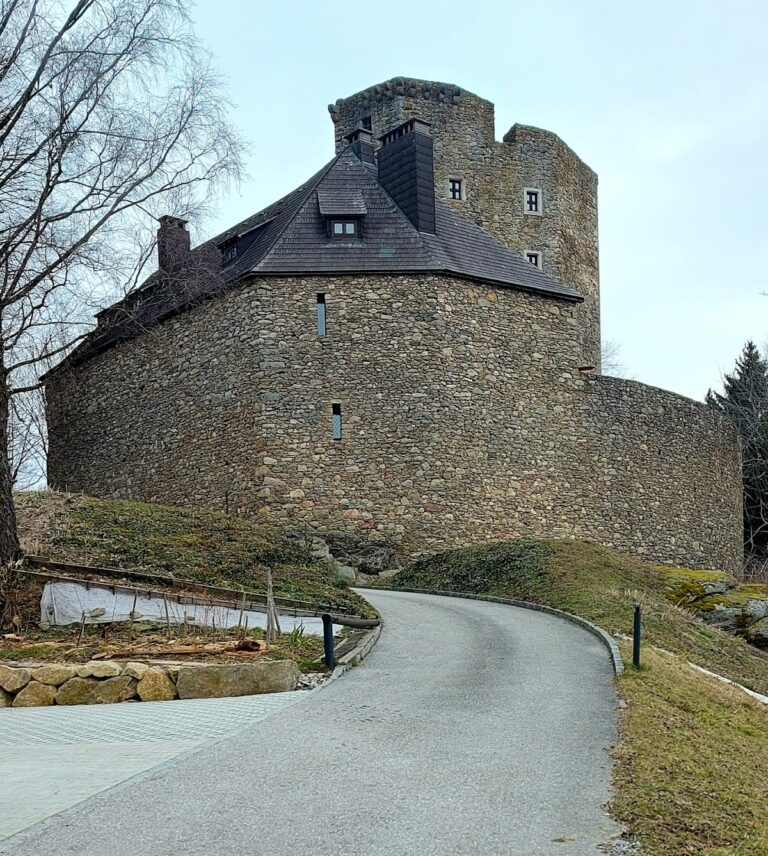
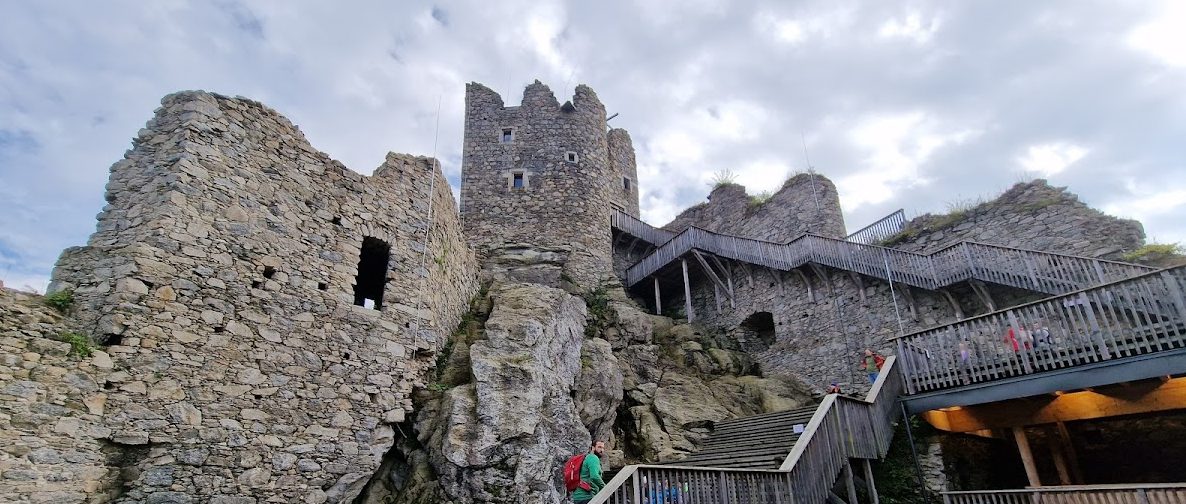
Lichtenhag is a small hilltop castle on a ridge that descends steeply toward the Große Rodl valley. The site lies at an elevation of 470 metres above sea level, about one kilometre west of Gramastetten’s town centre as the crow flies. Its irregular triangular ground plan is enclosed by a ring wall covering approximately 1,100 square metres. The complex consisted of servants’ houses and a substantial pentagonal residential and defensive tower.
Residential and Defensive Tower
The tower originally rose through five storeys and had Gothic door and window frames. It formed the principal massive structure of the small castle complex, combining residential use with a defensive function. The tower now survives as a ruin, and the stabilization work of 1954 and 1955 focused on protecting it from further deterioration.
Servants’ Houses and Front Building
The servants’ houses also survive only as ruins within the former castle complex. A residential building in front of the ruin, once part of the castle property, remains inhabited. It was converted into a weekend residence in 1964. A coat-of-arms stone is associated with the ruin, adding a surviving heraldic element to the remains of the former lordly estate.