Castle Sponheim: Ancestral Seat of the Counts of Sponheim in Germany


Site at a Glance
- Rating
- 4.2
- Popularity
- Very Low
- Country
- Germany
- Primary era
- Medieval
- Eras represented
- Medieval
- Civilizations
- Holy Roman Empire
- Site type
- Military
- Remains
- Castle
On this page7 sections
History
Castle Sponheim is a medieval castle ruin in Burgsponheim, Germany, probably established around the eleventh or early twelfth century. Originally called Spanheim, it first appears in two records from 1127, when it belonged to Meginhard of Sponheim, the first member of the family to use the title Count of Sponheim. Through hereditary succession, the castle became the ancestral seat of his descendants.
Seat of the Counts of Sponheim
The castle was enlarged during the twelfth century and served as the residence of the Counts of Sponheim. After the county was divided in the early thirteenth century, Castle Sponheim no longer held the same position as the family seat. It instead became the residence of comital ministeriales, dependent officials or military retainers who served a count in administrative, judicial, or military roles.
A castle chapel is known from an indulgence letter issued in 1300. An indulgence was a remission of temporal punishment associated with sin in Catholic theology, so the letter provides evidence that a chapel existed at the site by that date.
Inheritance and Destruction
When the male line of the Rhenish branch of the House of Sponheim ended in 1437, ownership passed jointly to the Margraves of Baden and the Counts of Veldenz. The Veldenz territories were inherited by Count Palatine Frederick I of Simmern in 1444 and later passed to the House of Palatinate-Zweibrücken.
During the Thirty Years’ War, a European conflict fought from 1618 to 1648, Spanish troops commanded by Ambrogio Spinola besieged the castle in 1620. Spinola was a Genoese-born military commander in Spanish service. The siege may have caused part of the destruction that left Castle Sponheim a ruin.
Tradition holds that the Blessed Jutta of Sponheim, who died in 1136, and her brother Hugo of Sponheim, Archbishop of Cologne, who died in 1137, were born at the castle. This tradition remains unsubstantiated.
Remains
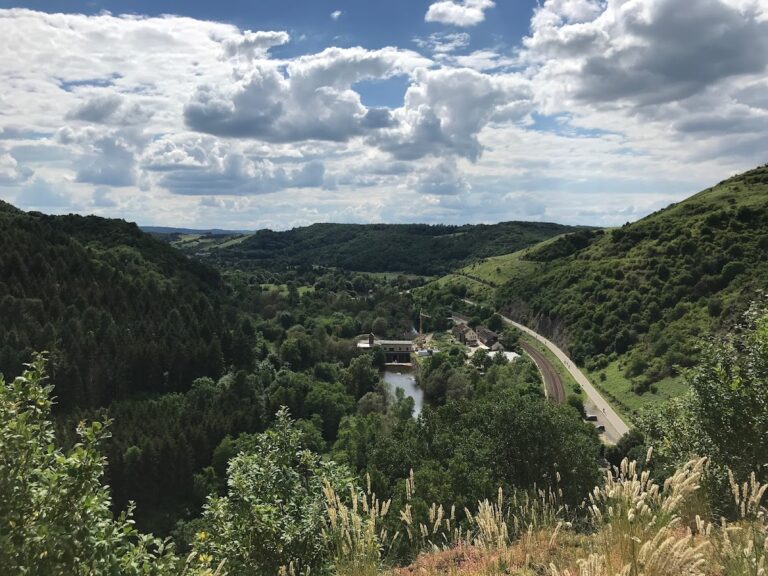
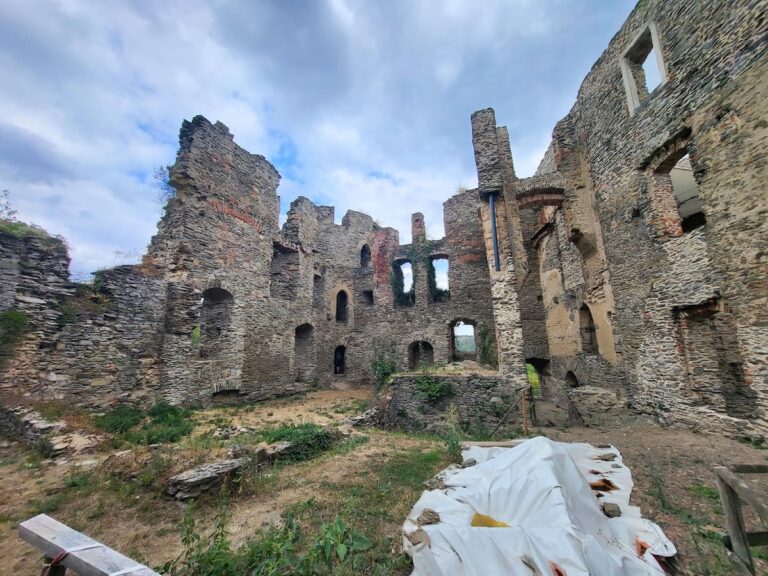
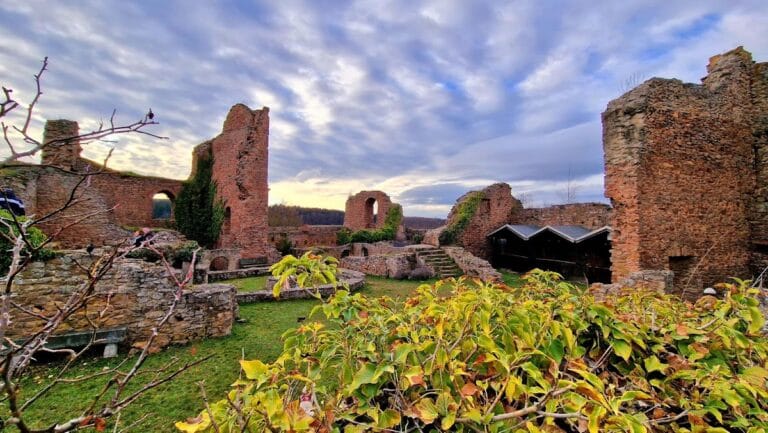
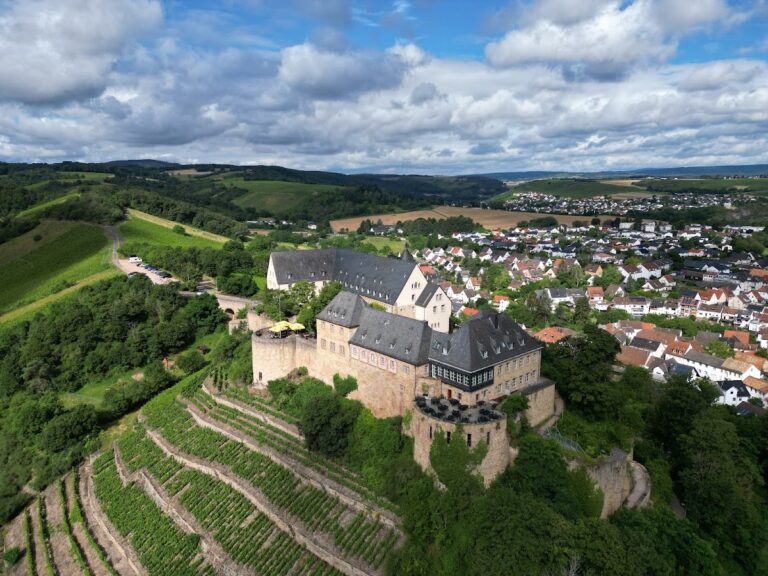
Castle Sponheim is a spur castle, a fortified site built on a projecting ridge or rocky spur, using steep ground for additional defense. The castle stands on a crag about 250 metres long at an elevation of roughly 245 metres. The Ellerbach stream, a tributary of the Nahe, curves around the southern and eastern sides, while the surviving ruins occupy the approximately 130-metre-long tip of the spur.
Fortifications and Principal Buildings
Ring Wall and Residential Buildings
A ring wall enclosed the castle and protected its principal buildings. These included a residential palas, the main living and representational building of a medieval castle, together with a strongly fortified rectangular keep. The surviving structures form the core of the ruined castle at the end of the rocky spur.
Keep and Round Watchtower
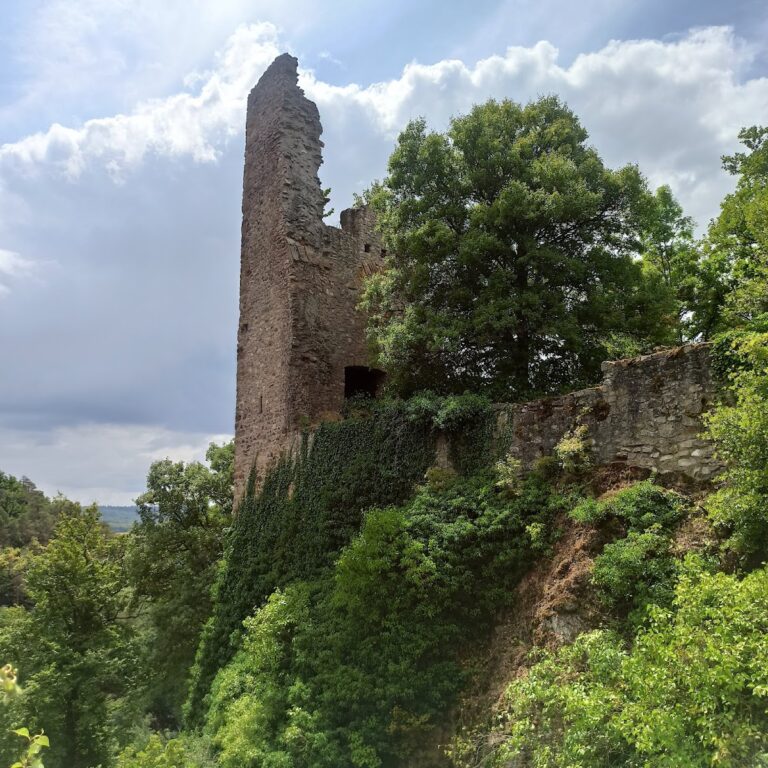
A tower approximately 22 metres high was constructed in the twelfth century from rough-hewn, bossed ashlar masonry. Its residential arrangements included a privy chamber, elaborate windows, and a fireplace. Towers built with comparable bossed ashlar are described as occurring only south of the Nahe.
The round watchtower survives in ruined form. Its platform is accessible as a lookout tower and provides a view of Burgsponheim, while its remaining masonry contributes to the visible defensive outline of the medieval site.
Nearby sites