Burg Ror: A Medieval Hilltop Castle in Bisingen, Germany


Site at a Glance
- Rating
- 3.2
- Popularity
- Very Low
- Country
- Germany
- Primary era
- Medieval
- Eras represented
- Medieval
- Civilizations
- Holy Roman Empire
- Site type
- Military
- Remains
- Castle
On this page8 sections
History
Burg Ror is a ruined hilltop castle in Germany, built around 1100 as a medieval hill-spur fortress by the Lords of Bisingen. The castle stood on a projecting slope south of Bisingen and belonged to a noble family whose Bisingen line divided into three branches. The Walger von Bisingen line held both a castle in Bisingen and Burg Ror, while other branches were associated with Zainingen and the Kerus line.
The Lords of Bisingen
The Lords of Bisingen served several regional powers, including the Counts of Zollern, whose neighboring seat was Hohenzollern, the Lords of Hohenberg, and the Counts of Zollern-Schalksburg. Baldebert I von Bisingen appears in the records in 1228, followed by his son Walger I von Bisingen in 1255. Baldebert also built a castle near Roßwangen on the Burgbühl, but that stronghold had already been destroyed by the time of his death in 1263.
A later member of the family, Walger III, held Bisingen and Burg Ror as a fief from the Counts of Zollern-Schalksburg. A fief was land or property held from a higher-ranking lord in return for service and allegiance. These connections placed Burg Ror within the network of regional noble and comital families that shaped medieval Swabia.
Destruction and transfer
Reutlingen destroyed Burg Ror in 1311 during the war between the Swabian imperial cities and Württemberg. The castle’s palas, the principal residential and representative building of a medieval castle, was rebuilt afterward, although the rebuilding may instead have followed an earlier destruction. The exact sequence remains uncertain.
After Walger IV died in 1342, the knight Konrad, also called Cuon, sold the castle site and the village of Bisingen to the Counts of Zollern for 500 pounds. Konrad was the Urach seneschal, a senior household and administrative official in a medieval lord’s service. In 1343, the farmsteads associated with the castle in the valley below were granted to citizens of Streichen.
Archaeological investigation
Excavation and the securing of exposed masonry took place between 1953 and 1959 through the Bisingen-Steinhofen local heritage association. The work was directed by the State Monument Office with Angelika Reiff. Further archaeological excavations followed in 2004 and 2005 under Erhard Schmidt, working with the heritage-preservation department of the Tübingen Regional Council.
Remains
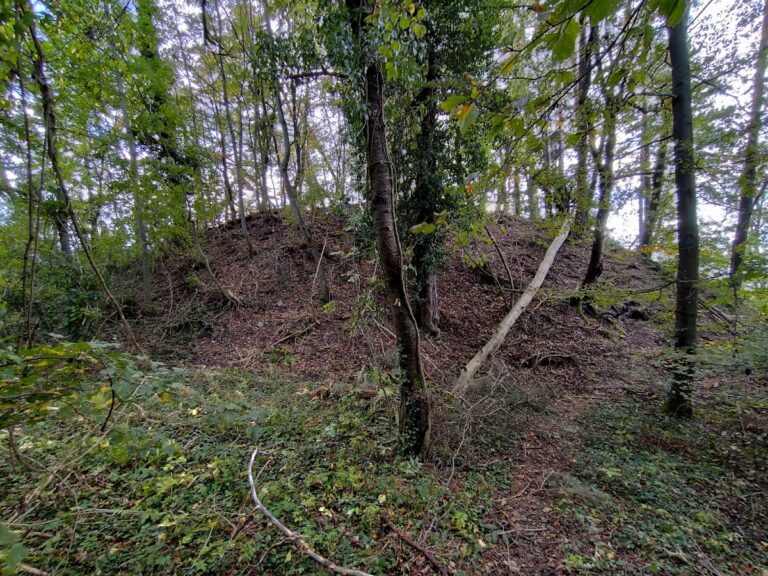
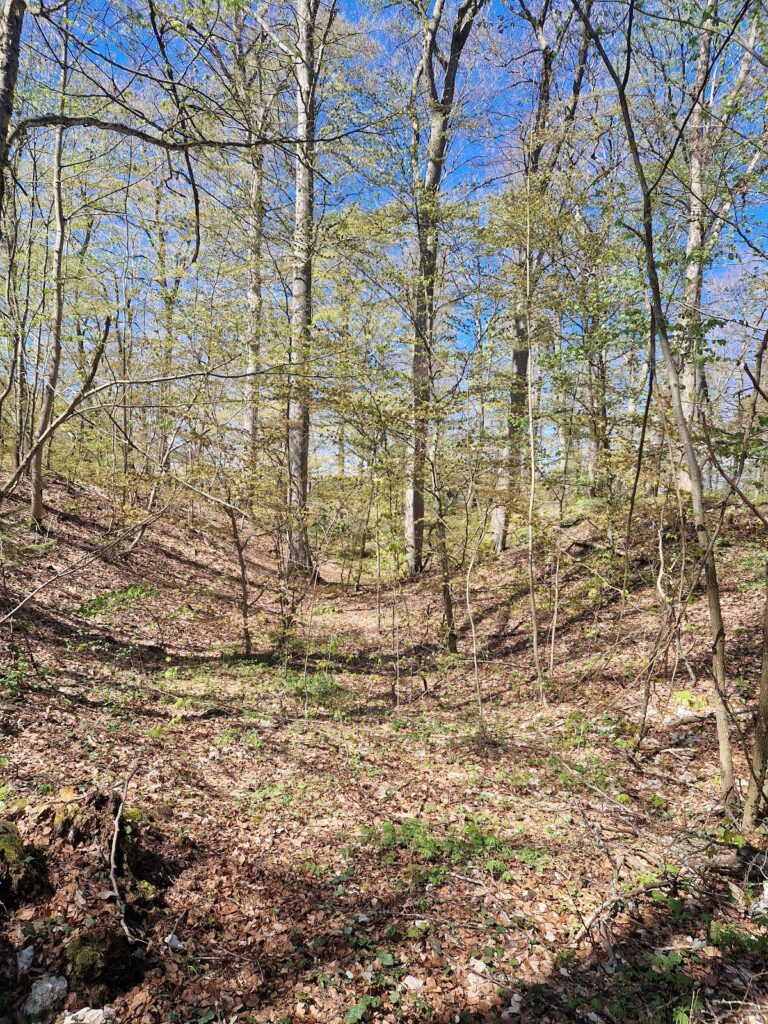
Burg Ror occupies a projecting slope of the Schlössleswald, a spur extending from the Hundsrücken south of Bisingen in Baden-Württemberg. The site lies at approximately 673 metres above sea level. Built in rubble-stone masonry, the castle used the natural hill spur as the basis for its fortified layout. Surviving evidence consists of masonry remains, ditches, earthworks, and a restored shield wall, a particularly strong section of an enclosing wall designed to protect the most vulnerable side of a fortification.
Castle buildings
Palas
The former complex included a palas, the castle’s principal residential and ceremonial building. Its rebuilding belongs to the period after the destruction of 1311, or possibly to a reconstruction following an earlier attack. The surviving castle evidence is understood together with the excavated masonry that was secured during the investigations of the twentieth and early twenty-first centuries.
Fortifications and earthworks
The restored shield wall forms part of the surviving defensive fabric. Ditches and earthworks accompany the masonry remains and preserve the castle’s adaptation to the projecting terrain. Together, these features indicate a hill-spur fortress constructed in rubble stone, with its defenses arranged around the elevated castle site.