Burg Westerhusen: A Historic Frisian Chieftain Castle in Germany
Visitor Information
Google Rating: 4.8
Popularity: Very Low
Country: Germany
Civilization: Early Modern, Medieval European, Modern
Site type: Domestic
Remains: Palace
History
Burg Westerhusen was situated in the village of Westerhusen within the municipality of Hinte, in what is now modern Germany. It was established by the local Frisian chieftains and held an important role as a center of judicial authority and regional leadership from at least the 14th century.
The earliest known period of Burg Westerhusen’s history includes its identification as a fortified stone house, typical for its time and region. The castle appears in written records in 1436, when it featured prominently during a military conflict. Mercenary forces, hired by the Hanseatic city of Hamburg and aligned with the Cirksena family—a powerful noble house—attacked the stronghold to suppress piracy and diminish the influence of chieftains who opposed their control. The chieftain Ewe (or Ewo) Howerda initially succeeded in defending the fortress, but it was eventually overtaken. The castle suffered near-total destruction, and its materials were transported to the nearby city of Emden to strengthen that city’s defenses. Following this defeat, Ewe Howerda lost his chieftain status and was referred to as the former chieftain of Westerhusen until his death in 1457. By around 1445, there is evidence that Ewe transferred his leadership and legal rights to his son Wyloff, who is recorded in a charter as a co-signer.
Despite the castle’s destruction, the site continued to be occupied and transformed. In the 16th century, a Renaissance-style manor house was constructed on the location, owned by another chieftain named Reint in 1529. This manor marked a shift from fortified residence to a more domesticated noble estate, reflecting changing social and political conditions of the time. After the late 1500s, records do not mention any further chieftains holding power in Westerhusen.
The Renaissance manor was likely dismantled during the 17th century and replaced by a new manor house. Around 1780, that manor was destroyed by fire but was quickly rebuilt as a large country house. Ownership changed hands, and in 1785 the estate came under the possession of Conring, who served as a land rent master. During the 19th century, the property was owned by Dirk Janssen Groenewold, a prosperous farmer who undertook substantial remodeling around 1860, adding architectural elements such as a balcony, veranda, and a gable with a shield shape.
In the 20th century, the estate transitioned to institutional use when the Ukena family sold it to the Ostfriesische Beschäftigungs- und Wohnstätten GmbH, an organization providing residential care for people with disabilities. The surrounding lands, including what was once the castle’s garden, were acquired by the municipality of Hinte.
Remains
The original Burg Westerhusen is believed to have been constructed as a stone house, comparable in style to the surviving Steinhaus of Bunderhee, a type of fortified residential building typical for the East Frisian region. While specific details of its layout and size have not been preserved, archaeological remnants indicate that the castle was partially surrounded by moats, referred to locally as Graften, and encircled by earthworks known as Zingel. These earthworks served as defensive embankments enhancing the site’s fortifications.
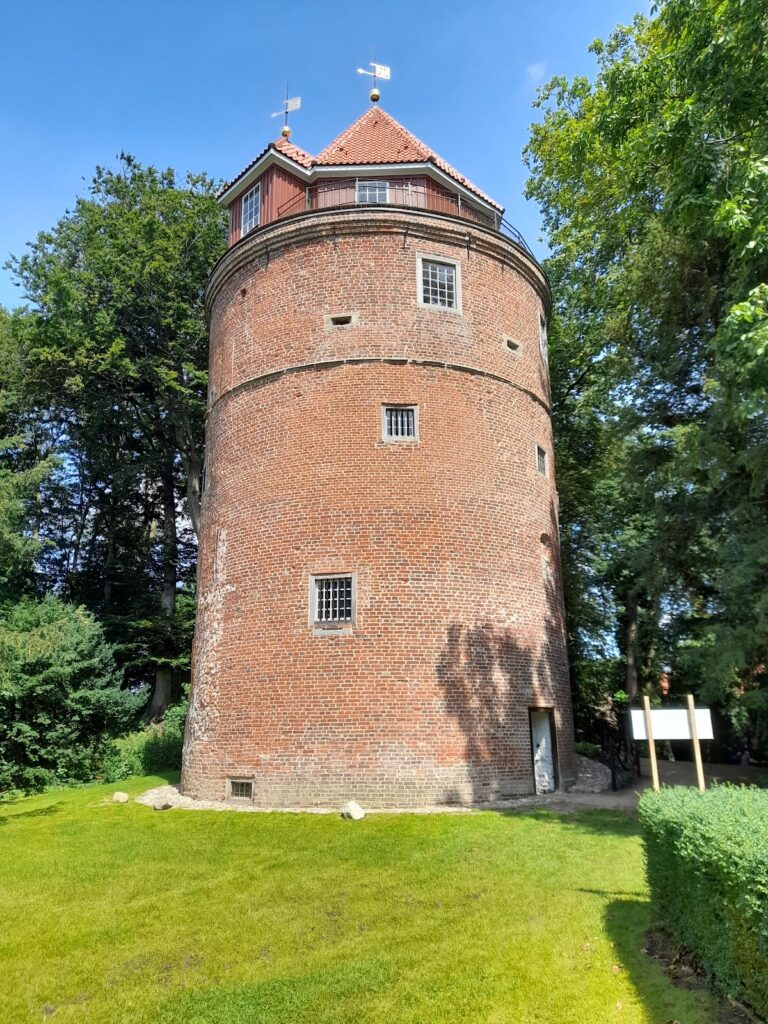
From the complex, the Schatthaus is the only building still standing today. Erected around 1600, this structure shares the site’s heritage and is recognized as part of the protected historic monument. The Schatthaus reflects the evolution from medieval fortress to early modern manor functions that the site underwent in the centuries following the original castle’s dismantling.
After the castle’s destruction in the 15th century, the materials salvaged—including wood, stone, and iron fittings—were transported to the city of Emden, where they were repurposed to reinforce that city’s fortifications. This reuse underscores the practical adaptation of building resources during periods of conflict and reconstruction in the region.
Later architectural phases saw the construction of a Renaissance manor in the 16th century, followed by a 17th-century manor house, which eventually gave way to a larger country house in the late 18th century. The 19th-century renovations introduced features such as balconies, verandas, and a shield-shaped gable that altered the appearance of the estate to suit contemporary tastes.
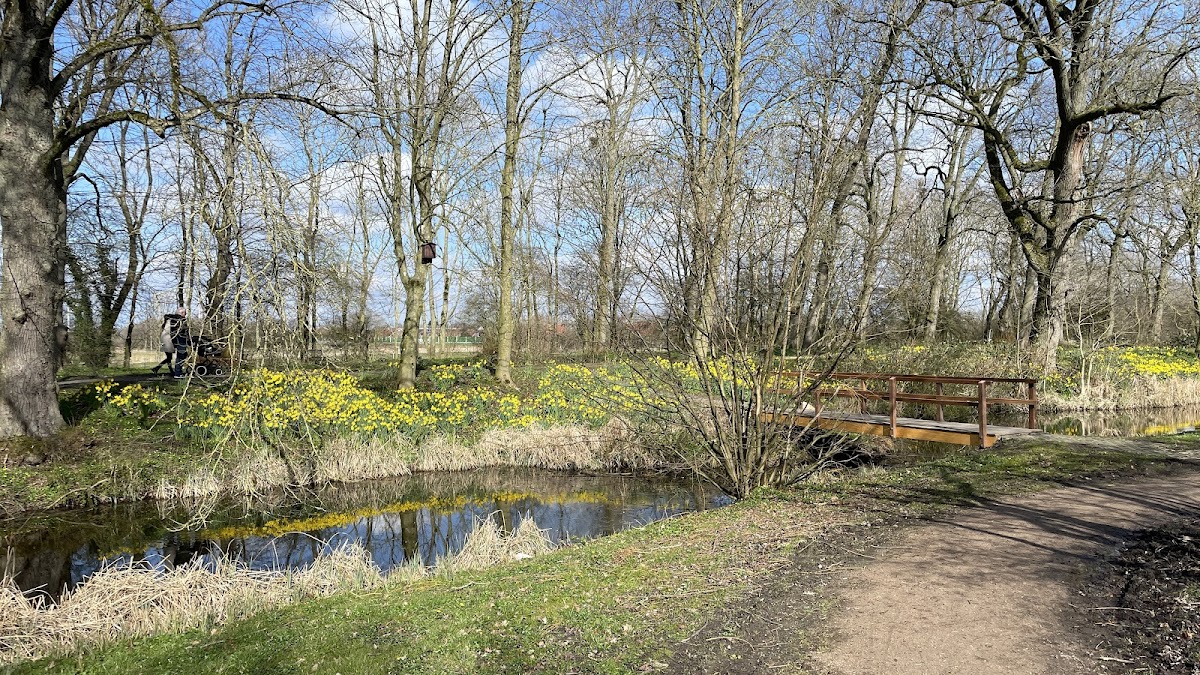
Today, the castle’s moats and earthworks remain visible in the landscape, providing tangible evidence of its medieval fortified character. These surviving features, together with the Schatthaus, serve to connect the present site with its layered history as a center of Frisian chieftain authority and later noble residence.
Nearby sites