Burg Wellberg: A High Medieval Motte Castle in Germany


Site at a Glance
- Rating
- 4.4
- Popularity
- Very Low
- Country
- Germany
- Primary era
- Medieval
- Eras represented
- Medieval
- Civilizations
- Holy Roman Empire
- Site type
- Military
- Remains
- Castle
On this page6 sections
History
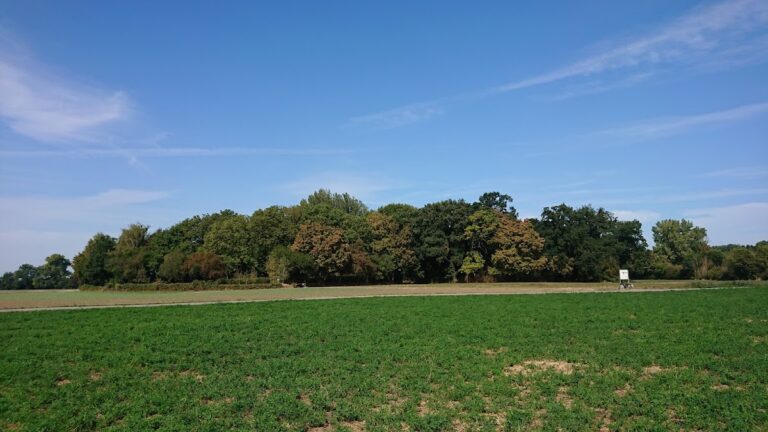
Burg Wellberg is an abandoned high-medieval motte castle in Germany, about 2.5 kilometres southwest of Pfungstadt in Hesse. A motte was a medieval fortification centred on a raised mound, usually supporting a tower and sometimes accompanied by an enclosed bailey. Once dated broadly to the tenth or eleventh century, the site was placed more securely in the twelfth or thirteenth century after excavations and investigations in 2013. Its original name, owners, and exact foundation date remain unknown.
Construction and reinterpretation
Excavations in 1936 identified two construction phases. Aerial photographs taken in 1973 then revealed seven concentric ditches, indicating that the mound belonged to a palisade-fortified castle surrounded by banks and multiple defensive ditches. These findings established a more complex arrangement than the visible earthwork alone suggested.
The 2013 excavation campaign, prompted by the earlier aerial photography, confirmed an outer bailey southeast of the mound. Stone-built architecture, ceramics, metal objects, and bones recovered during the investigation provided a firmer High Medieval date. The discovery overturned the earlier interpretation of Wellberg as a simple motte comparable to Drusenküppel and Gewanneküppel. Its arrangement instead belonged to the more developed type represented by Weilerhügel, Ketzelburg, and Wachenbuchen.
No masonry construction has been identified on the principal mound. The upper structure may therefore have been a timber tower-like building. Its possible early abandonment remains a tentative interpretation, based on the combination of the mound’s form and the lack of identified stone construction.
Remains
Earthworks and castle layout
Burg Wellberg stood at the eastern edge of a former, probably Palaeo-Neckarian river meander, meaning an ancient channel of the Neckar, at the southern margin of the Modau’s alluvial fan. This is a fan-shaped deposit of sediment formed where flowing water spreads out and loses energy. The Wellborngraben passes a few dozen metres south of the site, where a spring may formerly have existed. The former castle area was traditionally known as “Am Wellberg.”
Principal mound
The main earthwork is an irregular mound about 6 metres high and approximately 50 metres in diameter at its base. Its visible bank is formed partly by polygonal sections rather than a precise circle. The surrounding defensive system included banks and several ring ditches. Aerial survey identified seven ditches, each about 2 metres wide and 1 metre deep, with roughly 3 to 4 metres separating their edges. No identified stone building survives on the mound, whose superstructure may have been timber.
Outer bailey
The outer bailey occupied the former field area called “Die alte Nachtweid,” southeast of the mound. Its water-filled ditches were relatively shallow, reaching no more than about 60 centimetres to 1 metre in depth. Several posts, some still well preserved in the ground, indicate waterlogged or marshy conditions and may have formed part of bridge structures. Stone discoveries point to masonry buildings in this area, while ceramics, metal finds, and bones provide material evidence for activity within the castle complex.