Burg Wehlen: A Medieval Hilltop Spur Castle in Germany


Site at a Glance
- Rating
- 4.3
- Popularity
- Low
- Country
- Germany
- Primary era
- Medieval
- External website
- Open
- Eras represented
- Medieval, Modern
- Civilizations
- German, Holy Roman Empire, Margraviate of Meissen
- Site type
- Military
- Remains
- Castle
On this page11 sections
History
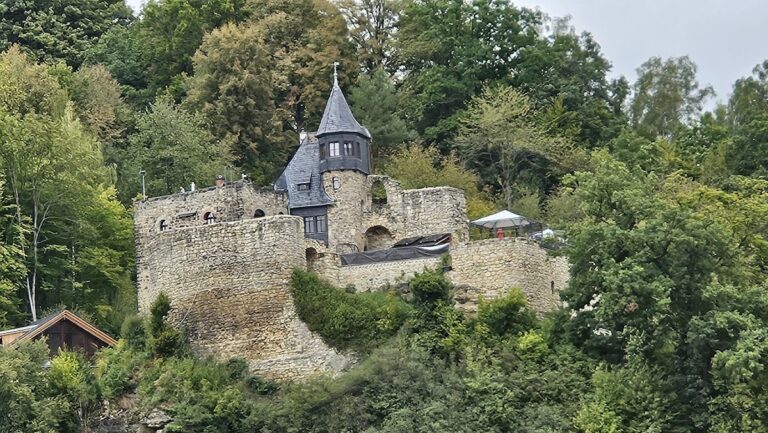
Burg Wehlen is a partially preserved medieval hilltop spur castle in Germany, situated in Stadt Wehlen in Saxony. Probably built in the early twelfth century, it first appears in records in 1269. Its position and successive ownership by noble families reflect the castle’s place within the political history of the region.
Medieval origins and noble ownership
In 1245, Heinrich the Erlauchte, the margrave of Meissen, received Burg Wehlen from Wenceslaus I, king of Bohemia from 1230 to 1253. The transfer formed part of the dowry of Wenceslaus’s daughter Agnes, whom Heinrich married as his second wife.
The castle was later granted as a fief to the Saxon noble family von Saalhausen and subsequently to the von Köckritz family. Nickel von Köckritz sold Burg Wehlen and its associated estates in 1484.
Transfer to the von Schönburg family
From 1523 to 1543, Burg Wehlen and its lordship belonged to the lords von Schönburg. They exchanged the property with Duke Moritz of Saxony for Penig, Altzschillen, and Zschillen Abbey, together with Hohnstein and Lohmen. Moritz was a sixteenth-century Saxon ruler whose territorial policies reshaped several local lordships.
Abandonment and gradual decay
The castle ceased to be inhabited in 1547 and then deteriorated. In 1550, Elector August of Saxony granted its remains as building material to the towns of Hohnstein and Neustadt. Major wall collapses in 1787 and 1788 resulted in the removal of all higher structural parts. From 1789, the castle plateau was leased as a garden for several decades.
Rediscovery and changing remembrance
The Mountain Association for Saxon Switzerland acquired the ruin from the Kingdom of Saxony in 1883 and developed it as a viewpoint. The association excavated and partly cleared the cellar vaults and added stairways on the southern and northern sides. In 1896, an obelisk commemorating the twenty-sixth anniversary of the Battle of Sedan was erected on the plateau. The battle had taken place in 1870 during the Franco-Prussian War.
Further excavation and clearance were carried out by the Wehlen Historical and Local Heritage Association until the outbreak of the Second World War. During the East German period, the southern wall, which had collapsed in 1960, was repaired in the following years. The viewpoint tower erected by the Mountain Association was dismantled despite opposition from local residents, and the excavated cellars were laboriously refilled. The Sedan memorial was demolished and placed in one of the filled cellars. Local residents had removed its medallion panels beforehand and hidden them in the fire station.
Recent conservation and reconstruction
Since 2017, a local interest group has maintained and partly restored the castle complex. Trees and uncontrolled vegetation were cleared from the plateau and walls, and the cellars were reopened. Guided tours began there in 2020. The remains of the Sedan memorial were found during the clearance work, and the monument was re-erected in 2021.
The original tower stump was rebuilt, and a modern viewpoint tower approximately 7 metres high was constructed on it from spring 2024. It opened ceremonially on 21 June 2025. Its design deliberately differs from the historic castle, while the wider project seeks to bring the castle silhouette closer to its historical appearance. Part of the construction was financed from assets secured from the SED, the Socialist Unity Party of Germany that ruled East Germany from 1949 to 1989.
Remains
Burg Wehlen occupies a spur on the right bank of the Elbe, about 145 metres above sea level and 25 metres above the river. The projecting landform lies between the Elbe and the Grundbach, which flows into the river at Wehlen. As a spur castle, the site used the surrounding slopes and terrain as part of its defensive setting. The former complex was approximately 85 metres long and 16 metres wide and included two outer baileys, enclosed areas outside the principal stronghold.
Castle walls and underground remains
Tower and cellar vaults
The surviving fabric includes exposed castle walls, the foundation walls of a tower, and a cellar owned by the city of Wehlen. Three cellar rooms with cross vaults and barrel vaults were cleared by the local mountain association at the end of the nineteenth century. After the tower remnant was demolished in the 1960s, its remains were placed in the cellars, which were later cleared again and reopened.
The northern round structure
A separate round structure on the northern side of the complex is probably a bastion, a projecting defensive platform. Known as the “Drum,” it remains in private ownership and was inhabited until the 1980s. Together with the foundation walls, plateau, exposed wall sections, and reopened cellar vaults, it forms part of the surviving physical layout of Burg Wehlen.
Memorial and reconstructed viewpoint
The re-erected Sedan memorial stands on the castle plateau. Its medallion panels survived because local residents removed and concealed them before the monument was demolished. The remaining parts were later recovered from a filled cellar. The rebuilt tower stump now supports the modern viewpoint tower, which rises approximately 7 metres and is visibly distinct from the historic castle. Most of the former buildings and higher structural elements no longer survive.