Hohnstein Castle: Medieval Lordship, Prison, and Youth Hostel in Germany


Site at a Glance
- Rating
- 4.4
- Popularity
- Medium
- Country
- Germany
- Primary era
- Early Modern
- External website
- Open
- Eras represented
- Medieval, Early Modern
- Civilizations
- Electorate of Saxony, Holy Roman Empire, Kingdom of Bohemia
- Site type
- Military
- Remains
- Castle
On this page12 sections
History
Hohnstein Castle is a medieval hill and rock castle in Hohnstein, Germany, established around 1200 during the eastward settlement of the region. It served as the administrative center of a manorial lordship, a landed estate whose lord exercised authority over dependent villages, in the Polenz watershed. Its creation belonged to a wider transformation of the cultural landscape, where forest-strip villages were founded between districts that had previously been settled by Slavic communities.
The Schönburg and Berka Lordships
The castle first appears in written evidence on 22 August 1317. On that date Friedrich, Hermann, and Viecko of Schönburg sealed a donation charter at Hohnstein. A second charter, dated 28 December 1319, identifies the castle and lordship as possessions of the Schönburg family. Hermann of Schönburg pledged his “house at Hohnstein” to Borso of Riesenburg in connection with unresolved debts and claims for compensation. The castellan Albert of Lutitz was instructed to surrender the castle if Hermann failed to meet his obligation.
Hohnstein, and probably the neighboring Schwarzberg lordship with its villages in the Sebnitz watershed, remained the outright property of the imperial Schönburg lords until August 1353. The Berka of Dubá then acquired the estate through exchanges and purchases. They held it as a fief from King Charles IV of Bohemia and thus became vassals of the Bohemian Crown. Hohnstein was not a border fortress, despite its elevated position.
In 1443, the Berka family lost the estate through a series of exchanges and purchases to Electoral Saxony under Frederick the Gentle. The Wettins, the dynasty that ruled Electoral Saxony and later the Kingdom of Saxony, used the castle as a base for hunting and salmon spearing. Hohnstein remained a Bohemian fief until 1806. The Schönburgs briefly re-established themselves in the Elbe Sandstone Mountains before transferring Hohnstein to Duke Maurice in an exchange in 1543.
Electoral Administration and Prison Use
In later centuries Hohnstein alternated among several official functions. It served as the seat of an electoral Amt, a territorial administrative office of the Elector of Saxony, as a court, and as a prison. Wooden buildings were gradually replaced with stone structures during the seventeenth and eighteenth centuries. The castle also withstood a Swedish siege in 1639.
The electoral administrative office was dissolved in 1861. The castle then became a men’s correctional institution and, from 1919, a juvenile prison. These uses continued the complex’s long association with administrative control and confinement while its buildings were adapted to changing state institutions.
Youth Hostel and Political Prison
In September 1924, the Saxon Parliament made Hohnstein Castle available to the German Youth Hostel Association, which organized hostels and youth travel in Germany. The castle opened as a youth castle and hostel in April 1926, with 1,000 sleeping places. At the time, it was Germany’s largest youth hostel. During 1926 and 1927, it received 2,357 holiday-camp guests, 1,258 course participants, 18,696 conference guests, and 2,357 participants in various celebrations.
The Hohnsteiner Kasper puppet theatre, named after the town and castle, gave its first performances at Hohnstein in 1928. This cultural use was followed by one of the darkest phases in the site’s history. In 1933 and 1934, the castle housed the Hohnstein concentration camp, where approximately 5,600 political prisoners were detained under “protective custody,” a Nazi term for imprisoning political opponents without ordinary judicial safeguards. From 1935, the complex again operated as a Reich Youth Hostel for the Hitler Youth.
During the Second World War, Hohnstein was converted into a prisoner-of-war camp. It first held 800 Polish officers in Oflag IV-A, using the German designation for an officers’ prisoner-of-war camp. French officers followed them. The site later operated as Stalag IV/4, a camp designation used for enlisted prisoners, holding Yugoslav and Soviet prisoners.
Postwar Institutions and Public Administration
After the war, the castle provided refuge for refugees and displaced persons. It became a youth hostel again in 1949 and, in 1951, was designated the largest youth hostel in the German Democratic Republic. It received the honorary name Ernst Thälmann. In 1953, a National Science Museum was established at the castle, covering geology, botany, zoology, and landscape ecology.
Until 1947, Hohnstein belonged to the Free State of Saxony. It then became public property administered by the Sebnitz district. In 1987, the Ministry for State Security planned an internment camp for up to 890 opponents of Socialist Unity Party rule, but the plan was not implemented. The Socialist Unity Party was the ruling communist party of the German Democratic Republic.
Ownership and Rehabilitation
After German reunification, ownership remained with the Sebnitz district and later passed through the districts of Saxon Switzerland and Saxon Switzerland-Eastern Ore Mountains. The castle was not classified as nationally significant for heritage administration, so it was not taken over by Saxony’s state palace administration.
In 1996, the Saxon Switzerland district leased Hohnstein to the Häuserwerk association of the German Friends of Nature. The association operated the museum founded in 1953 and a youth hostel with approximately 160 beds, while also renting rooms for celebrations and events. After the association became insolvent in 2007, necessary investment in the buildings could not be carried out. By 2017, some parts of the complex could operate only under restrictions or not at all. The town of Hohnstein assumed operation in January 2018.
A feasibility study completed in late 2018 recommended developing the castle as an accommodation facility while strengthening its identity as Hohnstein Castle and retaining public uses. In summer 2019, the town, the district, and the Free State of Saxony signed a declaration of intent for comprehensive renovation. Work on the castle garden began in August 2024 as the first phase of the planned rehabilitation.
Remains
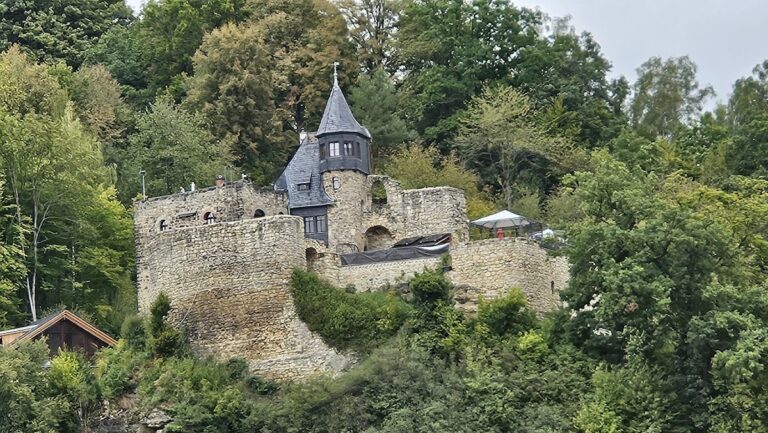
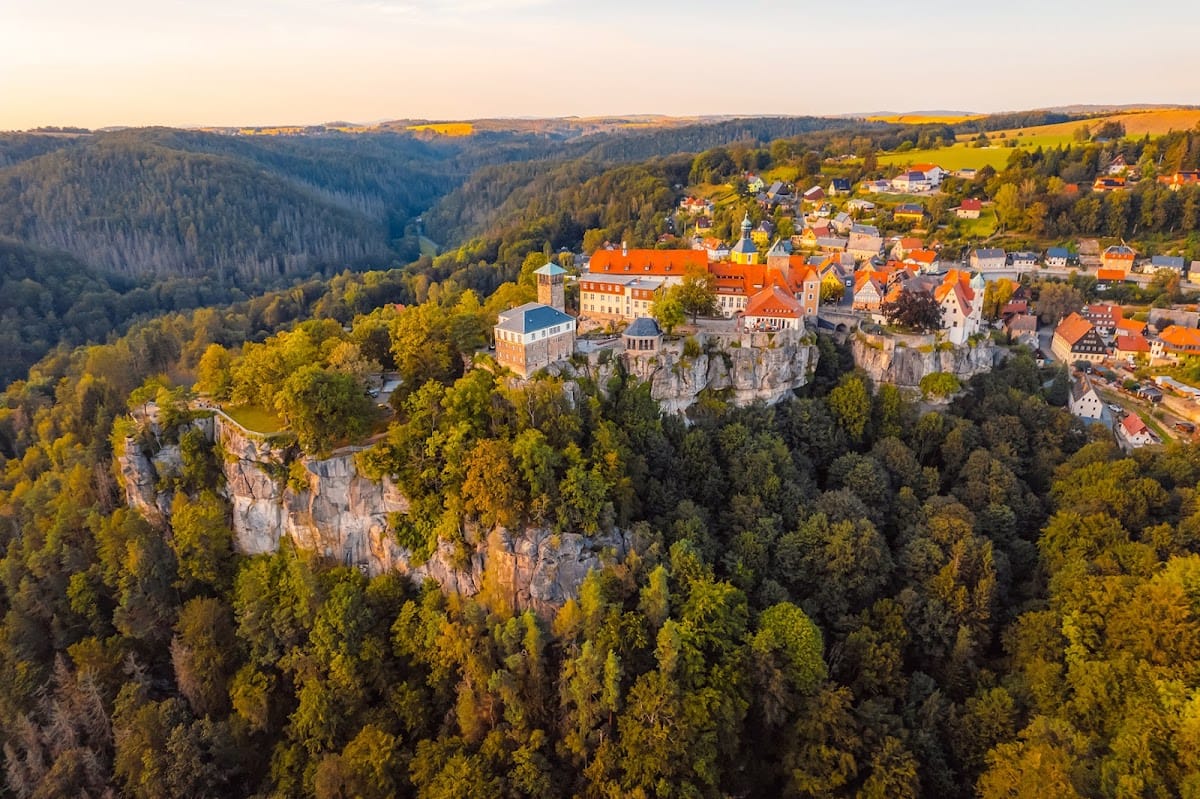
Hohnstein Castle occupies a hard sandstone slab approximately 140 metres above the Polenz Valley, at an elevation of about 285 metres above sea level. It combines a medieval castle with a Renaissance castle dating from 1550. The complex is reached from Hohnstein’s market square, and its position on the rock gives it a close physical relationship to the town. Of the formerly numerous castles east of the Elbe in Saxon Switzerland, Hohnstein is described as the only one to have survived.
Castle Complex and Stone Buildings
Medieval and Renaissance Castle
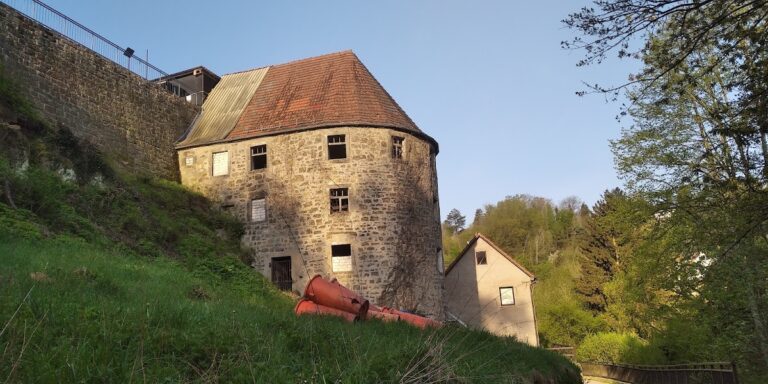
The surviving complex contains the medieval castle and a Renaissance castle built in 1550. The original timber-built elements were progressively replaced by stone structures during the seventeenth and eighteenth centuries. These later buildings form the principal surviving architectural fabric, while the earlier medieval and Renaissance phases remain part of the complex’s historical form.
Second Courtyard Passage
The passage leading to the second courtyard bears the coat of arms of the Berka of Dubá and Lípa. Its design shows crossed oak branches, linking a surviving architectural detail with the family that acquired Hohnstein in the fourteenth century and held it as a fief of the Bohemian Crown.
Rock and Garden Features
Bärengarten
The castle is associated with the Bärengarten, or bear garden, situated between the so-called Ritterfelsen, meaning “Knights’ Rock,” and the castle. This named rocky and garden area forms part of the physical setting of the castle complex.